Sign in

Libre University uses your GitHub account. Signing in is only needed to sit a final test, so the score is kept on your profile.

Classical Mechanics

Predict motion from forces: Newton's laws, energy and momentum, rotation, and the gravitation that holds a planet in its orbit.

Describing motion

Before anything can be said about why things move, there has to be a language precise enough to say how they move, and that language turns out to be one already built: a single function of time, differentiated twice and integrated back.

This course assumes the calculus in Calculus: derivatives, the chain rule, definite integrals, separation of variables in a simple first order equation, and Taylor expansion about a point. No vector calculus is needed anywhere, and vectors themselves are built from components in the next lesson.

Position, and the trouble with average speed

Fix an origin and a positive direction along a line. The position x(t) of a particle is its signed distance from that origin at time t, in metres, and everything in this lesson is a statement about that one function. Choosing the origin is free: physics never depends on where the zero sits, only on differences, which is why x appears in real equations almost exclusively as Δx=x2-x1.

The obvious summary of a motion is its average velocity, Δx/Δt. Usain Bolt covered 100 m in 9.58 s in Berlin in 2009, so his average velocity was 100/9.58=10.44 m s⁻¹. The published 10 metre splits for that run, which sum to exactly 9.58 s, are 1.89, 0.99, 0.90, 0.86, 0.83, 0.82, 0.81, 0.82, 0.83, 0.83. The first ten metres took 1.89 s, an average of only 5.29 m s⁻¹, and the stretch from 60 to 70 m took 0.81 s, an average of 12.35 m s⁻¹. The single number 10.44 describes no instant of the race. It is a fact about the two endpoints and nothing else.

Shortening the interval helps. The 10 m splits are better than the one number, 1 m splits would be better still, and the question that produces calculus is what happens as the interval shrinks towards nothing. On a graph of x against t, the average velocity over an interval is the slope of the chord joining its ends, and the chords approach the tangent.

Velocity as a derivative

Define the instantaneous velocity as the limit of the average:

v(t)=limΔt0x(t+Δt)-x(t)Δt=dxdt

Velocity is signed: v<0 means moving towards decreasing x. Speed is |v|, and losing the distinction is a reliable way to get a sign wrong later. A ball thrown upward has positive velocity going up, negative coming down, and a speed that is zero only at the single instant at the top.

The derivative is what makes a speedometer meaningful. There is no interval short enough to be "the instant", so the reading has to be defined as a limit rather than measured as a ratio, and the limit exists as long as the position function is smooth. It is worth noticing how much physics is packed into the assumption that it is smooth: a particle that jumped from one place to another would have no derivative at the jump, and Newtonian mechanics simply asserts that this does not happen.

Example. A trolley moves along a track with x(t)=12t-1.5t2, in metres, with t in seconds. Where is it at t=2 s, and how fast is it going?

Differentiate: v(t)=12-3t. At t=2, the position is x=24-6=18 m and the velocity is v=12-6=6 m s⁻¹. The trolley is still moving forward but has lost half the speed it started with, and v=0 at t=4 s, which is where it turns around.

Now you. A cart has x(t)=5+8t-0.4t3 metres. Find its position, velocity and acceleration at t=2 s.

Answer

v=8-1.2t2 and a=-2.4t. At t=2: x=5+16-3.2=17.8 m, v=8-4.8=3.2 m s⁻¹, and a=-4.8 m s⁻².

Acceleration, and why it is the physical one

Differentiate again and you have the acceleration:

a(t)=dvdt=d2xdt2

in metres per second per second, m s⁻². A car going at a steady 30 m s⁻¹ has zero acceleration; one speeding up from rest to 30 m s⁻¹ in 8 s has an average acceleration of 3.75 m s⁻². Acceleration is also signed, and its sign is not "speeding up" or "slowing down" on its own: a car reversing and speeding up has negative velocity and negative acceleration. The rule is that speed increases when v and a share a sign and decreases when they do not.

Nothing so far singles out acceleration as more important than the third derivative or the fourth. What singles it out is a physical fact that this lesson cannot yet prove: forces determine acceleration, and nothing else. That is why the chain stops at two derivatives and why the state of a particle is its position and velocity together. Give both now, plus the forces from now on, and the entire future follows. That claim is the content of the next few lessons.

Two derivatives is also exactly the number a person can feel. Sitting in a cruising aircraft at 250 m s⁻¹ feels like sitting in a chair, because velocity is not detectable from inside; the takeoff run is unmistakable, because acceleration is.

Running the calculus backwards

If acceleration is what physics hands you, the useful direction is the other one. Integrating once recovers velocity and integrating again recovers position:

v(t)=v0+0ta(t)dtx(t)=x0+0tv(t)dt

Each integration introduces one constant, fixed by an initial condition, and this is where v0 and x0 come from. Two integrations, two constants: the future needs the initial position and the initial velocity, and nothing more. A law of motion that gave the third derivative would need three, and a body's history would not be settled by where it is and how fast it is going, which is not the world we live in.

Geometrically, integration says that displacement is the area under the velocity graph, counting area below the axis as negative. A car that drives forward at 20 m s⁻¹ for 30 s and back at 20 m s⁻¹ for 30 s covers 1200 m of road with a displacement of zero, and the two areas cancel exactly. Distance travelled is |v|dt, which is a different integral, and confusing the two is the second most common error in kinematics after sign confusion.

The constant acceleration formulas, derived

The special case worth memorising is constant a, because it covers free fall near the ground, braking with a locked wheel, and any short interval over which the force barely changes. With a constant, the first integral is immediate:

v=v0+at

and integrating that gives

x=x0+v0t+12at2

These two are the whole set. Everything else is algebra: eliminating t between them gives v2=v02+2a(x-x0), and averaging the velocity gives x-x0=12(v0+v)t, which is valid only because a linear velocity has its mean at the midpoint of the interval. There are four formulas in most textbooks and two independent facts.

Free fall is the standard instance. Near the Earth's surface every body released from rest falls with the same downward acceleration g=9.81 m s⁻², independent of its mass, provided air resistance can be ignored. Drop a stone from rest and after 3.0 s it has fallen 12(9.81)(9)=44.1 m and is moving at 9.81×3=29.4 m s⁻¹. Galileo could not time a fall accurately with the clocks of 1600, so he diluted gravity by rolling balls down inclined planes and found the distance growing as the square of the time, which is the same claim in slow motion. The cleanest demonstration is David Scott's on Apollo 15 in 1971: a hammer and a falcon feather released together on the Moon, where there is no air, hit the surface together, in a fall from 1.6 m taking about 1.41 s at the lunar g of 1.62 m s⁻².

Example. A car brakes from 28 m s⁻¹, roughly 100 km/h, at a steady 7.5 m s⁻². How far does it travel before stopping, and how long does it take?

Take the initial direction as positive, so a=-7.5 m s⁻² and the final v is zero. From v2=v02+2aΔx with v=0, Δx=-v02/2a=784/15=52.3 m. From v=v0+at, t=28/7.5=3.73 s. Note that halving the speed quarters the distance, since Δx goes as v02: that quadratic is the whole argument for speed limits.

Now you. The same car brakes from 20 m s⁻¹ at 6.0 m s⁻². Find the stopping distance and the stopping time.

Answer

Δx=v02/(2|a|)=400/12=33.3 m, and t=20/6.0=3.3 s.

When time is not wanted

Often the question is about position and speed with no interest in when. The formula v2=v02+2aΔx answers it for constant a, but the trick behind it survives when a is not constant, and it is worth seeing once. Write acceleration using the chain rule with position as the intermediate variable:

a=dvdt=dvdxdxdt=vdvdx

so that adx=vdv. Integrating both sides between two positions gives

x0xadx=12v2-12v02

For constant a the left side is aΔx and the familiar formula drops out. For any a that is known as a function of position, the same integral still works, and time never appears. Multiply through by mass and this identity becomes the work energy theorem, which is where this course goes in a few lessons: the shortcut is not a trick at all but energy conservation in disguise.

Example. A ball is thrown straight up at 22 m s⁻¹. How high does it go, and when does it reach the top?

At the top v=0. Using v2=v02-2gh with v=0 gives h=v02/2g=484/19.62=24.7 m. The time is t=v0/g=22/9.81=2.24 s. The ball then falls back, reaching the thrower's hand at the same speed it left, which the symmetry of the equations guarantees and air resistance spoils by a few per cent.

Now you. A ball is thrown straight up at 16 m s⁻¹. Find its maximum height and the time to reach it.

Answer

h=162/(2×9.81)=13.0 m, and t=16/9.81=1.63 s.

What kinematics cannot do

Everything above is mathematics. Given a(t), the motion follows; given the motion, the acceleration follows. There is no physics in it, and the proof is that the equations are just as happy with a body whose acceleration is -9.81 m s⁻² as with one whose acceleration is +400 m s⁻² upward, or one that reverses every second for no reason.

That is the gap. Kinematics is a bookkeeping system with an empty input slot, and the whole of the next lesson but one is about what fills it. The answer, that acceleration is caused by forces and is proportional to their sum divided by the mass, is not derivable from any amount of graph reading. It had to be discovered, and it was discovered late, because the obvious guess, that force determines velocity rather than acceleration, is what everyday experience with friction actually suggests.

First, though, the description has to escape the straight line. Real motion happens in a plane or in space, and the next lesson shows that the escape costs almost nothing: a vector is a bundle of independent copies of what has just been built.
Motion in a plane

Real bodies do not move along a line, and the cost of escaping the line turns out to be almost nothing, because motion in a plane is two straight line problems that happen to share a clock.

The previous lesson built the whole of one dimensional kinematics out of one function x(t) and its two derivatives. Everything here is that machinery run twice, once per axis, so a reader arriving cold needs only that velocity is dx/dt, that acceleration is dv/dt, and that constant acceleration gives x=x0+v0t+12at2.

Two numbers instead of one

Fix an origin and two perpendicular axes. The position of a particle is now the pair (x,y), and it is convenient to write the pair as a single object, the position vector r=(x,y). A vector is a quantity with a magnitude and a direction, and in practice it is a list of components, one per axis. Its magnitude is |r|=x2+y2 by Pythagoras, and its direction can be reported as the angle θ=arctan(y/x) measured from the positive x axis, taking care with the quadrant, since arctan cannot tell (3,4) from (-3,-4).

Two vectors add by adding components: (ax,ay)+(bx,by)=(ax+bx,ay+by). Geometrically this is the tip to tail rule, and the two descriptions are the same statement. Multiplying by a number scales every component, so 2a points the same way and is twice as long, and -a points the opposite way. There is no operation that divides one vector by another, and looking for one is a sign that the wrong quantity is being sought.

The choice of axes is free, and choosing them well is most of the skill. Motion on a slope is usually easier with one axis along the slope; a projectile is easiest with one axis vertical. What must not change under that choice is any physical answer, and that invariance is worth testing on a problem occasionally, because it catches errors nothing else does.

Differentiating a vector

Velocity in a plane is defined exactly as on a line, as the limit of displacement over elapsed time:

v=drdt=(dxdt,dydt)

Because the axes are fixed, differentiating a vector means differentiating each component separately, and the same goes for acceleration, a=dv/dt. That single sentence is the whole content of two dimensional kinematics: the components do not talk to each other. Whatever is happening along x has no influence on what is happening along y, because the derivative of x never contains y.

Two consequences are worth stating separately because they are where intuition fails. First, velocity is a vector, so it can change without the speed changing, simply by turning. Second, acceleration need not point along the velocity: it is the rate of change of the velocity vector, not of its length. Split a into a part along v and a part perpendicular to it, and the parallel part changes speed while the perpendicular part changes direction only. A car that accelerates in a straight line uses only the first; a car cornering at constant speed uses only the second.

Speed is |v|=vx2+vy2, and it is worth noticing that this is not the derivative of |r|. A satellite in a perfectly circular orbit has a constant |r| and a speed of nearly eight kilometres per second.

Projectiles: the same lesson twice

Take a body moving near the ground with air resistance neglected. Every experiment since Galileo says the acceleration is g=9.81 m s⁻² straight down and nothing else, so in components ax=0 and ay=-g. The two axes are now separate one dimensional problems with a shared time:

x=x0+v0xty=y0+v0yt-12gt2

The horizontal motion has no acceleration and so is uniform. The vertical motion is free fall, identical to a dropped stone. This is the substance of Galileo's claim in the Two New Sciences of 1638, and the memorable form of it is that a bullet fired horizontally and a bullet dropped from the same height at the same instant hit the ground together, because their y equations are identical and their x equations are irrelevant to the landing.

For a launch from the ground at speed v0 and angle θ, the components are v0x=v0cosθ and v0y=v0sinθ. Setting y=0 gives the time of flight T=2v0sinθ/g, and multiplying by the horizontal speed gives the range

R=v02sin2θg

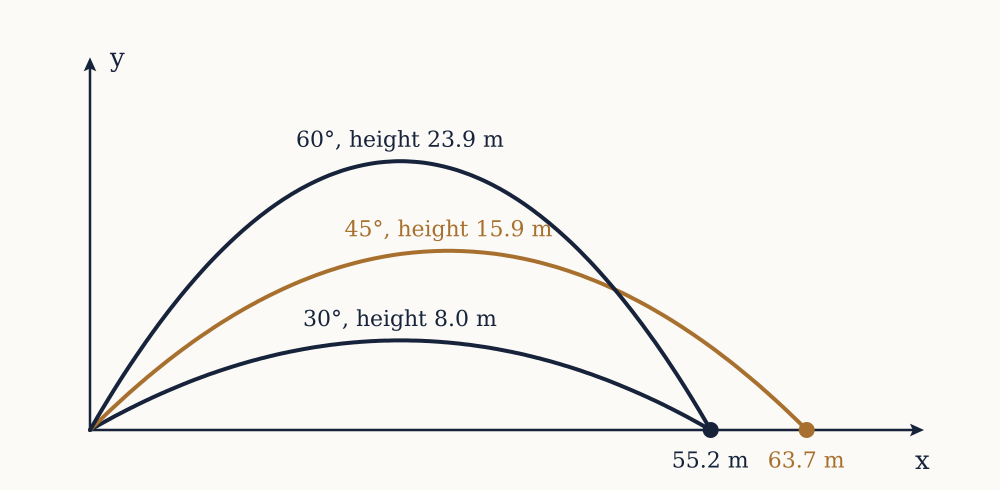
using 2sinθcosθ=sin2θ. Three things fall out at once. The range is maximised at θ=45, since that is where sin2θ=1. Angles either side of 45 that are equally far from it give the same range, so 30 and 60 land in the same place, one on a flat trajectory and one on a lofted one. And R goes as v02, so a ten per cent faster throw goes twenty one per cent further.

Example. A ball is launched from ground level at 25 m s⁻¹ at 40° above the horizontal. Find its time of flight, range and greatest height.

The components are v0x=25cos40=19.15 m s⁻¹ and v0y=25sin40=16.07 m s⁻¹. The vertical problem is a stone thrown up at 16.07 m s⁻¹, so it rises for 16.07/9.81=1.638 s and the flight lasts T=3.28 s. The range is 19.15×3.28=62.7 m, which the formula confirms: 625sin80/9.81=62.7 m. The greatest height is v0y2/2g=258.2/19.62=13.2 m.

Now you. A ball is launched from ground level at 18 m s⁻¹ at 30°. Find its time of flight, range and greatest height.

Answer

v0x=15.59 m s⁻¹ and v0y=9.00 m s⁻¹. Then T=2(9.00)/9.81=1.83 s, R=15.59×1.83=28.6 m, and H=81/19.62=4.13 m.

Where the parabola stops being true

Two assumptions are buried in that derivation, and both fail in ordinary cases.

The first is that the launch and landing heights are equal, which is what let y=0 close the problem. A shot putter releases the shot from about 2.1 m above the ground, and the extra fall changes the arithmetic. Launching at 14 m s⁻¹ and 40° from that height, the vertical equation 2.1+9.00t-4.905t2=0 gives t=2.044 s rather than the 1.834 s of a ground level launch, and the range becomes 10.72×2.044=21.9 m. More interestingly, the best angle is no longer 45°: scanning the angles for this speed and height puts the maximum at 42.3°, giving 21.98 m. Whenever a projectile lands below its launch point, the optimum tilts flatter, because time in the air is partly free.

The second assumption is the fatal one. Air resistance is not small for most things that fly. A baseball leaving the bat at 45 m s⁻¹ at 35° would, in a vacuum, travel 2025sin70/9.81=194 m. Real home runs of that launch condition go about 120 to 135 m, so the vacuum formula overestimates by roughly half. The trajectory is not a parabola either: it is steeper on the way down than on the way up, because the ball loses horizontal speed throughout the flight and never gets it back. Drag depends on speed, so the horizontal and vertical equations stop being independent, and the whole method of this section collapses. Solving that case needs the differential equation of a later lesson, and even then usually a computer.

The parabola is therefore a good model for a thrown stone, a poor one for a badminton shuttlecock, and a catastrophic one for artillery, which is why range tables were compiled by firing rather than by algebra.

Relative velocity

If a boat moves at vBW with respect to the water and the water moves at vWG with respect to the ground, the boat's velocity over the ground is the sum:

vBG=vBW+vWG

The subscripts chain, and reversing a pair negates it, vWB=-vBW. That is the entire theory of relative motion at everyday speeds, and it is exactly what fails at speeds near light, where velocities do not simply add. Nothing in this course goes near that regime.

Example. A river 80 m wide flows at 1.2 m s⁻¹. A boat that can do 2.5 m s⁻¹ through the water points straight across. How long does the crossing take, where does it land, and how fast is it moving over the ground?

Point the x axis across the river and y downstream. The boat's velocity through the water is (2.5,0) and the water's over the ground is (0,1.2), so over the ground the boat does (2.5,1.2). The crossing is governed by the x component alone: t=80/2.5=32 s, unaffected by the current, which is the same independence that governed the projectile. In that time it drifts 1.2×32=38.4 m downstream, and its ground speed is 2.52+1.22=2.77 m s⁻¹ at arctan(1.2/2.5)=25.6 from straight across.

Now you. The same boat on the same river wants to land directly opposite its start. At what angle upstream must it point, and how long does the crossing now take?

Answer

The downstream component must cancel, so 2.5sinα=1.2 and α=arcsin(0.48)=28.7 upstream. What is left across the river is 2.52-1.22=2.19 m s⁻¹, so the crossing takes 80/2.19=36.5 s, about four and a half seconds longer than the drifting crossing.

Going round in a circle

Now the case that breaks intuition. A particle moves round a circle of radius r at constant speed v. Its speed never changes, yet it is accelerating, and the size of that acceleration can be got without any calculus beyond similar triangles.

Over a short interval Δt the particle turns through an angle Δθ=vΔt/r, because it covers an arc of length vΔt. Its velocity vector has the same length before and after but has turned through that same angle Δθ, since velocity is always tangent to the circle. Draw the two velocity vectors from a common point: they form an isosceles triangle with two sides of length v and an apex angle Δθ, so the third side, which is |Δv|, is 2vsin(Δθ/2), and for small angles that is vΔθ. Therefore

|a|=|Δv|Δt=vΔθΔt=v2r

The direction takes one more step. As Δθ shrinks, Δv becomes perpendicular to v, and of the two perpendicular directions it points to the inside of the turn. So the acceleration has magnitude v2/r and points at the centre. It is called the centripetal acceleration, from centrum petere, to seek the centre. Since the time for one lap is T=2πr/v, the acceleration can also be written 4π2r/T2, which is the form to use when a period is known and a speed is not.

Nothing here says what causes the acceleration. Centripetal acceleration is not a force and not a cause; it is a description of what the velocity vector is doing. The next lessons ask what has to push.

Example. The Moon orbits the Earth at a mean radius of 3.844×10⁸ m with a period of 27.32 days. What is its centripetal acceleration?

The period is 27.32×86400=2.361×10⁶ s, so the orbital speed is v=2πr/T=1023 m s⁻¹. Then a=v2/r=10232/(3.844×108)=2.72×10-3 m s⁻². That is smaller than g at the Earth's surface by a factor of 3600, and the Moon's orbit is larger than the Earth's radius by a factor of 60.3, whose square is 3640. The agreement of those two numbers is the single most important coincidence in the history of physics, and a later lesson spends itself on what it means.

Now you. A centrifuge rotor spins at 12000 revolutions per minute. What is the centripetal acceleration at a radius of 0.10 m, and how many times g is it?

Answer

The angular rate is 12000×2π/60=1257 radians per second, and with v=ωr the acceleration is ω2r=12572×0.10=1.58×10⁵ m s⁻². Dividing by 9.81 gives about 16100 g, which is why a centrifuge tube must be rated for the speed it is spun at.

What has been gained, and what has not

Kinematics is now complete. Position, velocity and acceleration are defined in any number of dimensions, the constant acceleration case is solved, projectiles and circular motion are worked out, and relative motion is a sum. Given the acceleration of a body at every instant, its whole future can be written down.

That last sentence still contains the word "given". Nothing so far predicts an acceleration; every result above took one as input. The equations are equally content with a stone that falls at 9.81 m s⁻² and one that drifts sideways at 400 m s⁻² for no reason, and no amount of graph reading will separate them.

Filling that gap is the business of the next lesson, and it took the better part of two thousand years, because the natural guess is wrong. Everyday experience with sledges and carts suggests that force sets velocity, since a cart stops when you stop pushing. The right answer, that force sets acceleration and that the stopping is itself a force, requires believing in something nobody has ever seen: a body moving forever with nothing pushing it.

Newton's laws

Kinematics can describe any motion whatsoever and predict none of them, because the acceleration has to be supplied from outside, and the three laws published by Newton in 1687 are the supply.

This lesson assumes only that acceleration is the second derivative of position, which the first two lessons built. It is the least computational lesson in the course and the most important, because every calculation after it is an application of one equation stated here.

The wrong answer that lasted two thousand years

Aristotle's physics held that a body's natural state is rest, and that continued motion requires a continued cause. It is a reasonable summary of the evidence available to anyone pushing a cart on a road: stop pushing and the cart stops. It also has an obvious embarrassment, the thrown stone, which keeps moving after the hand has let go. The standard repair was that the air closes behind the stone and drives it forward, which is worse than the problem it solves.

The medieval alternative, developed by Jean Buridan in Paris around 1350, was impetus: the thrower imparts to the stone a quantity that keeps it going and gradually runs out. This is closer, and it survived because it makes roughly the right predictions for real projectiles in real air. What it gets wrong is the running out. Impetus is spent by the motion itself; momentum is not spent at all, and is only changed by something else pushing.

Galileo got the decisive result by a thought experiment about inclined planes. A ball rolling down one incline and up another rises to nearly the height it started from, whatever the second incline's slope; make the second incline gentler and the ball travels further to reach the same height; make it horizontal and there is no height to reach, so the ball should travel forever. He could not test this, because there is always friction, and the argument works by extrapolating friction away. That extrapolation is the birth of theoretical physics: the claim is not about any ball anyone has rolled, but about the limit that no experiment can reach.

The first law: inertial frames exist

Newton's first law, in the Principia of 1687, states that a body continues in its state of rest, or of uniform motion in a straight line, unless compelled to change that state by forces impressed upon it.

Read carelessly, this is a special case of the second law with F=0, and therefore redundant. Read properly it is a separate and stronger claim, because both laws are silently about some frame of reference, and the first law is what says a suitable frame exists.

Consider a ball resting on the floor of a train. If the train brakes, the ball rolls forward with no one touching it. In the frame of the train, a body with no force on it has accelerated, so the first law is false in that frame. The law is therefore not a universal truth about bodies; it is a test that selects frames. A frame in which an isolated body stays at uniform velocity is called an inertial frame, and the first law asserts that such frames exist. Once one is found, any frame moving at constant velocity with respect to it is another, since a constant added to a velocity vanishes on differentiation.

This matters because the second law is only true in an inertial frame. Everything else in this course is a calculation done in one, and the honest question is whether the ground under our feet qualifies. It does not exactly. The Earth spins, so a point on the equator is accelerating towards the axis at ω2R, with ω=2π/86164=7.292×10-5 radians per second and R=6.378×10⁶ m, giving 0.0339 m s⁻², about 0.35 per cent of g. The Earth also orbits the Sun, adding 5.9×10⁻³ m s⁻². Both are far too small to notice while dropping a stone, and far too large to ignore in a Foucault pendulum, in ballistics at long range, or in the circulation of the atmosphere.

The second law: force and mass, defined together

The second law is the working equation of the whole subject:

F=ma

the vector sum of all forces on a body equals its mass times its acceleration. Being a vector equation, it is really one equation per axis, Fx=max and Fy=may, which is what makes the component method of the previous lesson pay off. The unit of force follows: one newton is the force that gives one kilogram an acceleration of one metre per second squared, so 1 N = 1 kg m s⁻².

There is a circularity here that textbooks often slide past, and it is worth facing. What is a force? Something that causes acceleration. What is mass? The resistance to acceleration by a force. Each term is defined by the other, so as it stands the law says nothing falsifiable.

The way out is experimental, and it comes in two steps. First, mass can be compared without knowing anything about forces at all: let two bodies interact with each other alone, on an air track, and measure the two accelerations. Experiment says the ratio a1/a2 is always the same for the same pair of bodies, whatever the interaction is, whether they collide, or repel by magnets, or are joined by a spring. Define the mass ratio as the inverse of the acceleration ratio, m2/m1=a1/a2, pick one body as the standard, and every mass in the world follows by comparison. Since May 2019 the standard is not a metal cylinder in Sèvres but the fixed value of the Planck constant, 6.62607015×10⁻³⁴ J s, which fixes the kilogram through measurement rather than through an object that could be scratched.

Second, with masses known, the law becomes a real claim about forces: measure the acceleration a spring stretched by 2 cm gives to a known mass, and the law predicts what it gives to any other. That prediction can fail, and does not. The content of the second law is not the algebra but the discovery that the same number m works for every kind of force applied to a given body, and that the same force gives a given body the same acceleration regardless of what else is happening to it. Forces add as vectors: that is a physical finding, not a definition.

Example. A 3.0 kg block on a frictionless horizontal surface is pulled by a 12 N force along the positive x axis and simultaneously by a 9.0 N force at 60° to it. Find the acceleration.

Resolve into components. The 12 N force is (12,0). The 9.0 N force is (9cos60,9sin60)=(4.50,7.79) N. The sum is (16.50,7.79) N, whose magnitude is 16.502+7.792=18.25 N at arctan(7.79/16.50)=25.3 from the x axis. Dividing by the mass, a=18.25/3.0=6.08 m s⁻² in that same direction. The direction of the acceleration is the direction of the net force, always, and never the direction of the largest single force.

Now you. A 2.5 kg block is pulled by 15 N along x and 8.0 N along y, with no friction. Find the magnitude and direction of its acceleration.

Answer

The net force is (15,8) N, of magnitude 225+64=17.0 N at arctan(8/15)=28.1 from the x axis. The acceleration is 17.0/2.5=6.80 m s⁻² in that direction.

Mass, weight, and what a scale measures

Mass is a property of a body and is the same everywhere. Weight is the gravitational force on it, W=mg, and depends on where it is. A 70 kg astronaut weighs 687 N on Earth, 114 N on the Moon where g=1.62 m s⁻², and has a mass of 70 kg in both places. Confusing the two is harmless in ordinary speech and fatal in a calculation, because it is m and not W that appears on the right of the second law.

A bathroom scale does not measure either. It measures the normal contact force it exerts on your feet, and reports that force divided by 9.81 as though you were not accelerating. When you are, the reading is wrong in an informative way, and the whole of the sensation of a lift is contained in this.

Example. A 70 kg person stands on a scale in a lift accelerating upward at 2.0 m s⁻². What does the scale read, in newtons?

Two forces act on the person: gravity mg=687 N down, and the normal force N up. Take up as positive, so the second law gives N-mg=ma, and N=m(g+a)=70(9.81+2.0)=827 N. The scale reads 827 N, twenty per cent above the standing value, which is the pressed-into-the-floor feeling on starting to rise. If instead the cable snapped and the lift fell freely at a=-g, then N=0: the person floats, weightless, while the gravitational force on them has not changed at all. Weightlessness in orbit is exactly this, and not the absence of gravity.

Now you. The same person is in a lift accelerating downward at 1.5 m s⁻². What does the scale read?

Answer

N=m(g-a)=70(9.81-1.5)=582 N, about fifteen per cent light.

The third law and the pair it refers to

If body A exerts a force on body B, then B exerts on A a force equal in magnitude and opposite in direction, along the same line. The two forces are of the same kind, they act at the same instant, and, decisively, they act on different bodies.

That last clause is what makes the law useful and what makes it constantly misapplied. The stock objection is that a horse cannot pull a cart, since the cart pulls back equally hard and the two cancel. They do not cancel, because they never appear in the same equation: the horse's pull acts on the cart, and the cart's pull acts on the horse. Ask what accelerates the cart and the answer involves only forces on the cart. Ask what accelerates the horse and the answer involves the cart's backward pull and the ground's forward push on its hooves, which is a different pair.

The reliable test is to name both bodies for every force: not "the weight of the book" but "the Earth pulls the book down". Its partner is then automatic: the book pulls the Earth up with an equal force. The normal force of the table on the book is not that partner, despite being equal and opposite in the common case of a book at rest, and the giveaway is that it stops being equal the moment you press down on the book, while the true third law partner remains equal always.

The Earth really does accelerate upward towards a dropped stone. For a 1 kg stone the force on the Earth is 9.81 N, and dividing by 5.97×1024 kg gives 1.6×10⁻²⁴ m s⁻², which is why nobody notices.

Momentum, and the form Newton actually used

Newton did not write F=ma. He defined the quantity of motion as mass times velocity, what we call the momentum p=mv, and stated the second law as the claim that the change of motion is proportional to the impressed force:

F=dpdt

For constant mass this gives mdv/dt=ma and the two forms agree. When mass is not constant, as for a rocket burning fuel or a rope being lifted onto a table link by link, the momentum form is the one to reason with, though even then it must be applied to a fixed collection of matter rather than to a shrinking body, a subtlety a later lesson handles properly.

The momentum form also makes the third law say something startling. If A and B interact and nothing else acts, then dpA/dt=-dpB/dt, so the total momentum pA+pB has zero derivative and never changes. Conservation of momentum is not an extra law; it is the third law rewritten. Two lessons from now that observation carries the whole of collision theory.

Example. A rifle of mass 4.0 kg fires a 12 g bullet at 850 m s⁻¹. What is the recoil speed of the rifle, and what average force acts on the shoulder if the recoil is stopped in 0.15 s?

Total momentum starts at zero and the third law keeps it there, so mbvb=mrvr, giving vr=(0.012)(850)/4.0=2.55 m s⁻¹ backward. Stopping that in 0.15 s requires a force of Δp/Δt=(4.0)(2.55)/0.15=68 N, which is comfortable. The bullet leaves with the same 10.2 kg m s⁻¹ of momentum, but with vastly more energy, and the reason for that asymmetry is the subject of a later lesson.

Now you. A 60 kg skater standing at rest on frictionless ice throws a 3.0 kg ball forward at 8.0 m s⁻¹. How fast does the skater move backward?

Answer

Momentum starts at zero, so 60v=(3.0)(8.0)=24 kg m s⁻¹ and v=0.40 m s⁻¹ backward.

An equation with an empty right hand side

Write the second law out as what it is, a differential equation:

md2rdt2=F

Given the forces as functions of position, velocity and time, plus the initial position and velocity, the solution is unique and the entire future of the body follows. That is the claim of determinism that made mechanics the model for every science that came after, and it survived intact until quantum mechanics and, in a different way, until the discovery that some solutions depend so sensitively on the initial conditions that predicting them requires knowing the start to impossible precision.

None of that power is available yet, because the right hand side is empty. The laws say what force does, not what forces there are. Gravity near the ground, the push of a surface, the pull of a rope, the resistance of friction and the drag of air are separate empirical discoveries, each with its own formula and its own range of validity, and assembling that catalogue is the next lesson's work. It is also where the method that makes mechanics tractable appears: draw one body, name every force on it, and turn the picture into two equations.

Forces in action

Newton's second law is a machine with an empty input slot: it says what a net force does but never what forces are present, and filling that slot is a separate, empirical business.

The previous lesson established F=ma and that it holds one component at a time. This lesson names the forces that actually appear in mechanical problems, and sets out the procedure that turns a physical situation into algebra.

The free body method

Almost every mistake in elementary mechanics is a bookkeeping mistake, and the free body diagram exists to prevent it. The procedure has four steps and no shortcuts.

Choose one body and draw it alone, detached from everything it touches. Draw every force acting on it, each as an arrow from the body, and name the agent of each: the Earth pulls it down, the table pushes it up, the rope pulls it along the rope. If no agent can be named, the force is imaginary, and this test alone kills most of the spurious forces beginners draw, including the mysterious forward force on a coasting ball. Choose axes, preferring one along the acceleration if the direction is known. Then write Fx=max and Fy=may and solve.

Forces on other bodies never appear in this diagram. If two bodies are connected, draw two diagrams and let the connection appear once in each, with opposite signs, which is the third law doing its work.

Weight, normal contact and tension

Near the ground, gravity pulls every body straight down with a force mg, with g=9.81 m s⁻² in Britain and varying from about 9.78 at the equator to 9.83 at the poles. Nothing in this lesson depends on why: the inverse square law that explains it comes much later.

The normal force is the push a surface exerts perpendicular to itself. It is not mg except by accident, and treating it as though it were is the most common single error in the subject. A surface pushes exactly as hard as it must to stop the body sinking into it, and that requirement changes when the surface is tilted, when the body accelerates, or when something else presses on it. On a slope of angle θ with no other vertical force, resolving perpendicular to the surface gives N=mgcosθ; in a lift accelerating up at a it is m(g+a); and the moment a surface would have to pull rather than push, contact is lost and N=0, which is how a problem tells you a body has left the ground.

Tension is the pull transmitted along a rope or rod. An idealised string is massless and inextensible, and both idealisations do real work. Massless means the tension is the same at both ends, since a massless segment with unequal pulls would have infinite acceleration. Inextensible means the two bodies it connects have accelerations of equal magnitude, which is the extra equation that closes most connected body problems. A real rope has mass, so the tension in a hanging rope is larger at the top than the bottom, by exactly the weight of the rope below the point in question.

Friction, which is not a law

Slide one dry surface over another and it resists. The standard description, due to Amontons in 1699 and refined by Coulomb in 1785, is two rules.

While the surfaces are not sliding, static friction takes whatever value it must to prevent sliding, up to a limit:

fsμsN

Once sliding, kinetic friction acts backward along the motion with a roughly constant magnitude:

fk=μkN

The first is an inequality, not an equation, and writing fs=μsN for a body that is not on the verge of slipping is wrong in a way that produces plausible nonsense. A 10 kg crate that nobody is pushing has zero friction on it, not μsmg.

Both rules are fits to data, not laws, and their strangest feature is what is missing: the contact area. A brick slides no more easily on its side than on its end. The accepted explanation is that surfaces touch only at microscopic asperities whose true contact area is a tiny fraction of the apparent area and grows in proportion to the load, so the two effects cancel. That explanation also predicts where the rules fail, and they do fail: for very light loads, for very clean surfaces in vacuum, which can weld, and for polymers, where contact area does matter and f is not proportional to N. Rubber on dry road has μs near 1.0, steel on steel about 0.6, ice on ice about 0.1, and PTFE on PTFE about 0.04. Kinetic values run slightly below static ones, which is why a stuck drawer jerks free.

The braking distance of the previous lessons can now be predicted rather than assumed. With a locked wheel, the deceleration is μkg, so stopping from 28 m s⁻¹ on dry road with μk=0.80 needs v2/(2μkg)=784/15.70=49.9 m. On ice with μk=0.15 the same stop needs 266 m, more than five times as far, and no amount of care by the driver alters that number.

The inclined plane

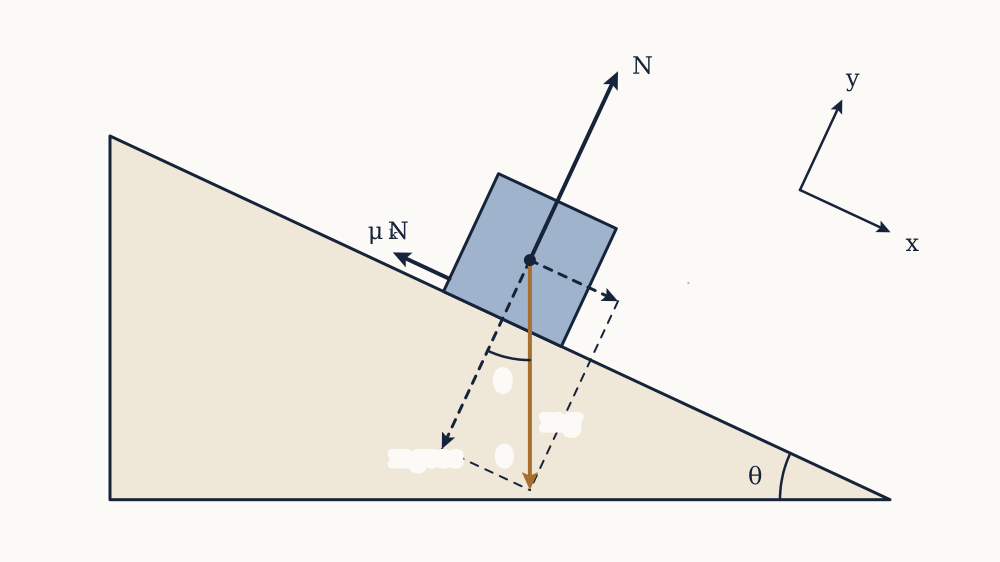
Put a block of mass m on a slope at angle θ and choose axes along and perpendicular to the surface, which is the choice that makes the acceleration lie on one axis. Gravity, of magnitude mg straight down, resolves into mgsinθ down the slope and mgcosθ into it. Perpendicular to the slope there is no acceleration, so N=mgcosθ. Along the slope, with friction opposing the sliding,

ma=mgsinθ-μkmgcosθ

and the mass cancels: a=g(sinθ-μkcosθ). Heavy and light blocks of the same material slide alike, which is the same insensitivity to mass that makes all bodies fall at g.

Setting a=0 at the point of slipping gives the angle of repose, tanθ=μs, and this is how coefficients are measured in the simplest laboratory: tilt the plane until the block moves and take the tangent. For μs=0.30 that angle is 16.7°, and for 0.60 it is 31.0°, which is roughly the steepest slope a pile of dry sand will hold.

Example. A block slides down a 25° slope with μk=0.30. What is its acceleration?

a=9.81(sin25-0.30cos25)=9.81(0.4226-0.2719)=9.81×0.1507=1.48 m s⁻². The friction has removed nearly two thirds of the driving component. Had μk been 0.47 the bracket would have vanished and the block would have slid at constant speed.

Now you. A block slides down a 35° slope with μk=0.25. What is its acceleration?

Answer

a=9.81(sin35-0.25cos35)=9.81(0.5736-0.2048)=3.62 m s⁻².

Connected bodies

When two bodies are joined, each gets its own free body diagram and its own equation, and the string supplies the link. The Atwood machine, two masses over a frictionless massless pulley, is the classic case, and George Atwood built it in 1784 precisely to slow gravity down to a speed his clocks could measure.

Take m2>m1, with m2 descending. For m1, taking up as positive, T-m1g=m1a. For m2, taking down as positive, m2g-T=m2a, using the same a because the string is inextensible. Add the two equations and T vanishes:

a=(m2-m1)gm1+m2T=2m1m2gm1+m2

Two checks say the algebra is right. With m1=m2 the acceleration is zero and T=mg, as it must be. With m1=0 the acceleration is g and the tension is zero, which is free fall. The device dilutes gravity by the ratio of the mass difference to the total, so nearly equal masses fall arbitrarily slowly while accelerating uniformly, and that is what made g measurable in 1784.

Example. An Atwood machine carries 3.0 kg and 5.0 kg. Find the acceleration and the tension.

a=(5.0-3.0)(9.81)/8.0=2.45 m s⁻², and T=2(3.0)(5.0)(9.81)/8.0=36.8 N. Notice that the tension lies between the two weights, 29.4 N and 49.1 N, as it must: the string pulls the light mass up faster than gravity alone and holds the heavy one back.

Now you. An Atwood machine carries 2.0 kg and 6.0 kg. Find the acceleration and the tension.

Answer

a=(6.0-2.0)(9.81)/8.0=4.91 m s⁻², and T=2(2.0)(6.0)(9.81)/8.0=29.4 N.

Drag, and the first real differential equation

Everything above has constant forces, so the second law never had to be integrated. Air resistance breaks that, because the force depends on the speed, which depends on the force.

At low speeds, for small slow objects in viscous flow, drag is proportional to speed, f=bv, which is Stokes' law. At everyday speeds for everyday objects the flow is turbulent and drag goes as the square of the speed:

f=12ρCdAv2

with ρ the air density, 1.2 kg m⁻³ at sea level, A the frontal area and Cd a dimensionless drag coefficient, about 1.0 for a person, 0.3 for a car, 0.47 for a sphere. The crossover between the two regimes is governed by the Reynolds number, which is not needed here beyond knowing that the linear law is for dust and mist and the quadratic one for cars, balls and people.

Take the linear case, since it can be solved in closed form. A body falling from rest obeys

mdvdt=mg-bv

Separate the variables and integrate:

0vdvg-(b/m)v=0tdt

which gives -(m/b)ln[1-(b/mg)v]=t, and rearranging,

v(t)=mgb(1-e-bt/m)

Two features matter. The speed approaches a terminal speed vt=mg/b but never reaches it, because the exponential never vanishes; at t=m/b the body has 63 per cent of it and at three times that, 95 per cent. And the terminal speed is where the drag exactly balances the weight, which can be read off the original equation by setting dv/dt=0 without solving anything. That shortcut works for any drag law, including the quadratic one that has no such tidy solution.

For quadratic drag the balance gives

vt=2mgρCdA

Example. A skydiver of mass 80 kg falls head down with a frontal area of 0.70 m² and Cd=1.0. What is the terminal speed?

vt=2(80)(9.81)/(1.2×1.0×0.70)=1569.6/0.84=1868.6=43.2 m s⁻¹, about 156 km/h. The dependence on the square root of everything is why the answer is so insensitive: doubling the mass raises the terminal speed by only 41 per cent.

Now you. The same skydiver spreads out, raising the area to 1.0 m² and Cd to 1.2. What is the new terminal speed?

Answer

vt=1569.6/(1.2×1.2×1.0)=1090=33.0 m s⁻¹, about 119 km/h. Spreading out costs a quarter of the speed, which is the entire technique of controlling a fall before the parachute opens.

The formula is honest about its own limits. It assumes constant air density, which is why Felix Baumgartner, jumping from 39 km in 2012 where the air is about one per cent as dense, passed 377 m s⁻¹ and went supersonic before the thickening air slowed him to an ordinary terminal speed lower down.

Where this method runs out

The free body method solves any problem in which the forces are known at every instant. That covers a great deal, but it has a structural weakness that the next lessons attack from two directions.

The first is that a body moving on a curved path has an acceleration that is not simply along one axis, and the natural question becomes what force is required to produce a given turn rather than what acceleration follows from a given force. Circular motion is where that inversion is worked out, and it is next.

The second weakness is deeper. Solving md2x/dt2=F requires knowing F as a function of time, and the interesting forces are known as functions of position instead: a spring depends on its extension, gravity on the separation. The whole apparatus of energy exists because there is a way to integrate over position rather than time, and it answers questions about speed and place without ever finding out when.

Circular dynamics

A body going round a circle at constant speed is accelerating towards the centre at v2/r, and since acceleration requires force, something real has to supply it, which turns a geometric fact into an engineering constraint.

Two results are carried in from earlier lessons: the centripetal acceleration of a body moving at speed v on a circle of radius r has magnitude v2/r and points at the centre, and the net force on a body of mass m equals m times its acceleration.

Inverting the question

Every problem so far has run forwards: given the forces, find the motion. Circular motion is naturally run backwards, because the path is usually known in advance. A car must follow the road, a satellite must stay in its orbit, a conker on a string must go round in a circle because the string is that long. The path fixes the acceleration, and the second law then says what the forces must add up to:

Ftowards centre=mv2r

That is the entire content of this lesson. The equation is not a new law and mv2/r is not a new force: it is the right hand side of F=ma with the known acceleration substituted in. The skill is entirely in the free body diagram, and the discipline is to write only forces with named agents on the left and put mv2/r on the right, never both on the same side.

The pattern is worth noticing before the examples. The required force grows with the square of the speed and falls with the radius, so the dangerous combination is fast and tight. Real forces have limits, and where the demand exceeds the supply, the body does not go round. It leaves.

The flat curve, and the limit of friction

A car of mass m takes a level bend of radius r at speed v. Draw its free body diagram: weight mg down, normal force N up, and friction from the road, horizontally. Nothing else touches it.

Vertically there is no acceleration, so N=mg. Horizontally the only force available is friction, and it must supply the whole centripetal requirement: f=mv2/r. Notice that this is static friction, not kinetic, because a rolling tyre is not sliding across the road: the contact patch is momentarily at rest. Static friction is capped at μsN=μsmg, so

mv2rμsmgvmax=μsgr

The mass cancels, so a loaded lorry and an empty one have the same cornering limit, at least until tyre behaviour stops being ideal. Above vmax the friction available is less than the friction required, and the car travels on a path of larger radius than the bend, which is to say it runs wide off the outside of the corner. It is not "thrown outward": nothing pushes it out, and what actually happens is that the inward force ran out and the car went comparatively straight.

Example. A bend of radius 60 m has μs=0.80 in the dry. What is the fastest speed a car can take it?

vmax=0.80×9.81×60=470.9=21.7 m s⁻¹, which is 78 km/h. The square root is unforgiving in both directions: halving the grip costs only 29 per cent of the speed, but a corner posted for 78 km/h taken at 95 km/h needs a coefficient of 1.2, which no ordinary tyre and road can deliver.

Now you. The same road is wet, with μs=0.35, on a bend of radius 120 m. What is the fastest safe speed?

Answer

vmax=0.35×9.81×120=412.0=20.3 m s⁻¹, about 73 km/h. Doubling the radius did not recover what halving the grip took away.

Banking, which removes the need for friction

Tilt the road inward by an angle θ and the normal force, which is perpendicular to the surface, acquires a horizontal component pointing at the centre of the bend. That component can do the whole job.

Assume no friction at all, which is the design case. The forces are N perpendicular to the road and mg down. Resolve into horizontal and vertical, not along the slope, because the acceleration is horizontal. Vertically there is no acceleration, so Ncosθ=mg. Horizontally, Nsinθ=mv2/r. Divide the second by the first and N and m both disappear:

tanθ=v2rg

A banked curve has exactly one design speed, at which no friction is needed. Below it the car tends to slide down the bank and friction must hold it up; above it friction must hold it in. Real roads are banked for a chosen speed and rely on friction for the spread of speeds around it.

The numbers are checkable. Daytona's turns, banked at 31° with a radius of about 300 m, have a design speed of 300×9.81×tan31=1768=42.1 m s⁻¹, or 151 km/h, and cars lap far faster than that, which is why they need enormous downforce and enormous tyres: everything above the design speed is paid for by friction. An ordinary motorway curve of radius 200 m intended for 30 m s⁻¹ would need tanθ=900/(200×9.81)=0.459, an angle of 24.6°, which is far steeper than any road is built, and so real motorway curves are much larger in radius instead.

The conical pendulum

Hang a mass on a string of length L and swing it so that it travels in a horizontal circle with the string making a constant angle θ to the vertical. The string sweeps out a cone, and the analysis is the banked curve with tension in place of the normal force.

The radius of the circle is r=Lsinθ. Vertically, Tcosθ=mg; horizontally, Tsinθ=mv2/r. Dividing gives tanθ=v2/(rg) again, and substituting r=Lsinθ and v=2πr/τ for a period τ gives the tidy result

τ=2πLcosθg

The tension is T=mg/cosθ, which exceeds the weight always and diverges as θ approaches 90°: a string can never be pulled horizontal by a mass on its end, however fast it is swung, because a horizontal string has no vertical component to hold the weight up.

That period formula is also the first appearance of a result the course returns to. As θ becomes small, cosθ1 and τ2πL/g, which is the period of an ordinary pendulum swinging back and forth. The two motions are the same motion seen from different sides, and the connection is made properly in the lesson on oscillations.

Example. A 0.25 kg bob on a 1.2 m string swings in a horizontal circle at 30° to the vertical. Find the radius, the speed, the period and the tension.

The radius is 1.2sin30=0.600 m. From tanθ=v2/(rg), v=9.81×0.600×tan30=3.399=1.84 m s⁻¹. The period is 2π1.2cos30/9.81=2π0.1059=2.05 s, which the check τ=2πr/v=3.770/1.843 confirms. The tension is mg/cos30=(0.25)(9.81)/0.866=2.83 N, some 15 per cent more than the bob's weight of 2.45 N.

Now you. A bob on a 0.80 m string swings in a horizontal circle at 40° to the vertical. Find the radius, the speed and the period.

Answer

r=0.80sin40=0.514 m, v=9.81×0.514×tan40=2.06 m s⁻¹, and τ=2π0.80cos40/9.81=1.57 s.

The vertical loop

Now let the circle be vertical, so gravity is sometimes towards the centre and sometimes away from it. The speed is no longer constant, but at any instant the components of force towards the centre must still sum to mv2/r.

At the top of the loop, both the weight and the track's push point downward, which is to say towards the centre:

N+mg=mv2r

so N=mv2/r-mg. As the speed falls, N falls, and it reaches zero when v2=gr. Below that speed the equation demands a negative N, meaning the track would have to pull the car inward, which a track that only pushes cannot do. So the minimum speed at the top of a loop is

vtop=gr

and it is independent of mass. For a loop of radius 8.0 m that is 9.81×8.0=8.86 m s⁻¹. At the bottom of the same loop, energy conservation, which the next lesson derives properly, gives vbot2=vtop2+4gr=5gr, so vbot=19.8 m s⁻¹, and there the normal force is N=mv2/r+mg=6mg: the rider is pressed into the seat at six times their weight. That is why real roller coaster loops are not circles but clothoids, tightening as they rise, so that the radius is small where the speed is low and large where the speed is high, and the load on the rider stays near 4g throughout instead of spiking at the bottom.

The same equation describes a bucket of water swung in a vertical circle. The water stays in because at the top the bucket's base is pushing it downward, adding to gravity to supply mv2/r. For an arm and bucket of radius 1.0 m, the minimum speed is 9.81=3.13 m s⁻¹, a period of 2.0 s. Slower than that and the water leaves the bucket in a parabola, exactly as the lesson on projectiles said it would.

Example. A stone of mass 0.40 kg is whirled on a string in a vertical circle of radius 0.90 m. What is the minimum speed at the top, and what is the tension at the top if it moves at 5.0 m s⁻¹ there?

The minimum is 9.81×0.90=2.97 m s⁻¹. At 5.0 m s⁻¹, the required centripetal force is mv2/r=(0.40)(25)/0.90=11.1 N, of which gravity supplies mg=3.92 N, so the string supplies T=11.1-3.92=7.19 N.

Now you. The same stone is at the bottom of the circle moving at 6.0 m s⁻¹. What is the tension there?

Answer

At the bottom the centre is upward, so the tension acts towards it and gravity away from it: T-mg=mv2/r. That gives T=(0.40)(36)/0.90+3.92=16.0+3.92=19.9 N, nearly three times the tension at the top.

Centrifugal force, and what it really is

A passenger in a cornering car feels thrown against the door, and calls the sensation centrifugal force. In the road's frame there is no such force. What acts on the passenger is the door pushing them inward, supplying their share of mv2/r; without the door they would carry on in a straight line, which relative to the turning car means moving outward. The feeling is the door, and the outward tendency is the absence of a force rather than the presence of one.

That said, the term is not simply an error. In a frame that is itself rotating, the first law fails, and the failure can be repaired by inventing forces. Add an outward mω2r on every body, plus a velocity dependent Coriolis term, and the second law works again inside the rotating frame. These are fictitious or inertial forces: they have no agent, no third law partner, and they vanish on returning to an inertial frame. They are also indispensable in practice, because meteorology, oceanography and long range gunnery are all done in the Earth's rotating frame and would be unmanageable otherwise.

The Earth supplies a measurable instance. The centrifugal effect of its spin at the equator is ω2R=0.0339 m s⁻², so a body there weighs about 0.35 per cent less than the same body at the pole, part of the reason g measures 9.78 m s⁻² at the equator and 9.83 at the poles, the rest coming from the equatorial bulge that the same spin produced.

When the speed is not constant

Uniform circular motion is the special case where only the direction changes. In general a body on a curved path has both: an acceleration v2/r towards the centre, changing direction, and an acceleration dv/dt along the path, changing speed. The two are perpendicular, so the total has magnitude (v2/r)2+(dv/dt)2, and a car accelerating out of a corner is using both at once. Since the tyre's total grip is limited by μsg however it is spent, spending some on speeding up leaves less for turning, which is the entire content of the friction circle that racing drivers work with.

Every problem in this lesson has been solved by knowing the force at each instant of time. That has been the method since the second law appeared, and it is about to become inadequate. Ask how fast a roller coaster is going at the top of a loop given its speed at the bottom, and the time it took is neither known nor wanted. Answering it requires integrating force over distance instead of over time, which produces a quantity that is conserved, and that is the next lesson.

Work and kinetic energy

Solving the second law requires knowing the force at every instant of time, and most interesting forces are known instead as functions of position, which is the gap this lesson closes.

What is carried in is F=ma and the identity from the first lesson that a=vdv/dx. Nothing else is assumed; energy is built here from scratch.

Integrating over distance

The first lesson noticed a trick and promised to come back to it. Write acceleration using the chain rule with position as the intermediate variable, a=dv/dt=(dv/dx)(dx/dt)=vdv/dx, so that adx=vdv. Multiply the second law by dx and integrate from one position to another:

x1x2Fdx=v1v2mvdv=12mv22-12mv12

Time has vanished. What is left on the left is a new quantity, the integral of force over distance, called the work. What is left on the right is another new quantity, 12mv2, evaluated at the two ends, called the kinetic energy. The equation says that the work done equals the change in kinetic energy, and it is not an extra physical law: it is the second law integrated once, so anything it predicts could in principle be got the long way round.

The reason to bother is that the long way round is often impossible. Ask how fast a roller coaster reaches the bottom of a drop and the answer follows in one line; ask for the same thing by integrating the second law and you need the shape of the track, the time of every instant, and a numerical solver.

Work, and what the angle does

For a constant force F moving its point of application through a displacement s, the work is the product of the displacement with the component of the force along it:

W=Fscosφ

where φ is the angle between the force and the displacement. This combination is common enough to have a name, the scalar product of the two vectors, written Fs, and in components it is Fxsx+Fysy. It turns two vectors into a single number, and that number has no direction: work is a scalar, and a body has no notion of which way its kinetic energy points. The unit is the joule, one newton metre, and 1 J = 1 kg m² s⁻².

The cosine carries three cases worth separating. When the force has a component along the motion, φ<90 and the work is positive: energy goes in. When it opposes the motion, as friction always does, the work is negative: energy comes out. And when the force is perpendicular to the motion, the work is exactly zero.

That last case is not a curiosity, it is most of mechanics. The normal force on a block sliding along a floor does no work, because the floor pushes up while the block moves sideways. The tension in a string does no work on a conical pendulum bob. The gravitational force on a satellite in a circular orbit does no work, which is why its speed is constant. Static friction on the driving wheel of a car does no work either, since the contact patch is instantaneously at rest, and the energy that accelerates the car comes from the fuel rather than from the road.

Example. A 20 kg crate is dragged 12 m along a floor by a rope pulling at 50 N, 30° above the horizontal, against μk=0.15. Find the work done by each force and the final speed, starting from rest.

The rope does W=(50)(12)cos30=519.6 J. The normal force must be found before friction can be: vertically, N+50sin30=mg, so N=196.2-25.0=171.2 N, less than the weight because the rope lifts as well as pulls. Friction is then 0.15×171.2=25.68 N opposing the motion, doing -25.68×12=-308.2 J. Gravity and the normal force do no work, being perpendicular to the displacement. The net work is 519.6-308.2=211.5 J, so 12(20)v2=211.5 and v=4.60 m s⁻¹.

Now you. The same crate is dragged 6.0 m by an 80 N rope at 25° above the horizontal, with the same μk=0.15. How much work does the rope do, and what is the work done against friction?

Answer

The rope does (80)(6.0)cos25=435 J. The normal force is 196.2-80sin25=196.2-33.8=162.4 N, so friction is 24.4 N and does -146 J.

The work energy theorem

Collecting the result and stating it as a theorem: for any body, the total work done by all forces acting on it equals the change in its kinetic energy.

Wnet=ΔK=12mv22-12mv12

Kinetic energy is never negative and does not depend on the direction of travel, which is both the strength and the weakness of the method. It is a strength because a curved, complicated path can be handled without tracking the direction at every point. It is a weakness because one scalar equation cannot determine a two dimensional velocity: the theorem gives the speed at the bottom of a slide and says nothing about which way the rider is facing.

The dependence on v2 is where the practical bite is. A 1500 kg car at 28 m s⁻¹ carries 12(1500)(784)=588 kJ. Stopping it in 50 m requires the brakes to do -588 kJ of work, an average force of 11.8 kN, which is exactly what a coefficient of friction of 0.80 supplies, since 0.80×1500×9.81=11.8 kN. Double the speed and the energy quadruples, so the same brakes need four times the distance. Every argument about speed limits and stopping distances is this quadratic, and it is worth noting that the energy has to go somewhere: 588 kJ deposited into brake discs is enough to raise 2 kg of steel by roughly 600 K, which is why brakes fade on long descents.

Variable forces, and the spring

The theorem was derived as an integral, so a force that varies with position costs nothing extra. The standard case is a spring. Robert Hooke published the relation in 1678 as the anagram ceiiinosssttuv, unscrambled as ut tensio sic vis, as the extension so the force:

F=-kx

with x the displacement from the natural length and k the stiffness in newtons per metre. The minus sign says the force opposes the displacement, which is what makes a spring restore rather than run away. To stretch a spring you must pull with +kx, so the work you do is

W=0xkxdx=12kx2

That is the area of a triangle under the straight line F=kx, which is a useful check: for a linear force law the work is the average force times the distance, and the average of a force rising from 0 to kx is 12kx.

Hooke's law is a first order approximation and fails for large extensions, where a real spring stiffens and then yields permanently. The reason it works at all for small ones is the same reason it will reappear in the lesson on oscillations: any smooth restoring force looks linear close enough to equilibrium.

Example. A spring of stiffness 800 N m⁻¹ is compressed 0.15 m and released against a 0.50 kg block on a frictionless surface. How fast does the block leave the spring?

The spring does 12kx2=12(800)(0.0225)=9.0 J of work on the block as it returns to its natural length. All of it becomes kinetic energy, so 12(0.50)v2=9.0 and v=36=6.0 m s⁻¹.

Now you. A spring of stiffness 250 N m⁻¹ is stretched 0.20 m. How much work was done stretching it, and what speed would that give a 0.40 kg block?

Answer

W=12(250)(0.04)=5.0 J. Then 12(0.40)v2=5.0 gives v2=25 and v=5.0 m s⁻¹.

Power

Work says how much energy moved; power says how fast. It is the rate of doing work,

P=dWdt=Fv

measured in watts, one joule per second. The second form follows because dW=Fds and ds/dt=v, and it is usually the more useful one, since it needs no integration.

James Watt, needing to sell engines to people who owned horses, defined the horsepower in the 1780s by measuring how much a mill horse could lift, and set it at 550 foot-pounds per second, which is 746 W. The figure is generous: a horse sustains rather less, and a fit human cyclist sustains about 200 to 300 W for an hour, with sprint peaks above 1000 W.

The Fv form explains the shape of a car's performance. A 100 kW engine at 30 m s⁻¹ can deliver at most 100000/30=3.3 kN of force, and at 60 m s⁻¹ only 1.7 kN, which is why acceleration falls away at speed even with the throttle wide open. Top speed arrives when all the power is being spent against drag: with CdA=0.66 m² and air at 1.2 kg m⁻³, the drag at 30 m s⁻¹ is 12(1.2)(0.66)(900)=356 N, costing 10.7 kW. Since drag force goes as v2, drag power goes as v3, and doubling the top speed of a car requires eight times the power.

Example. A cyclist and machine of total mass 85 kg climb a 6 per cent gradient at a steady 5.0 m s⁻¹. What power is needed against gravity alone?

A 6 per cent gradient rises 6 m in 100 m along the road, so sinθ=0.0599 once the angle is worked out from tanθ=0.06. At steady speed the rider's force along the road matches the gravitational component mgsinθ=(85)(9.81)(0.0599)=49.9 N, and the power is 49.9×5.0=250 W. That is a hard but sustainable effort for a trained rider, and it explains why hills are where cycling races are decided: on the flat the same 250 W buys a much higher speed, because it is fighting drag rather than gravity.

Now you. A lift of total mass 1200 kg rises at a constant 2.0 m s⁻¹. What power must the motor supply, ignoring any counterweight and friction?

Answer

At constant speed the cable tension equals the weight, 1200×9.81=11772 N, so P=Fv=11772×2.0=23.5 kW. A real lift uses a counterweight of roughly the car plus half the load, which cuts this by most of its value.

What the theorem cannot do

The work energy theorem holds for every force, including friction, and that generality hides a distinction which the next lesson makes central.

Slide a block round a closed loop on a rough table and return it to its start. Gravity did no net work, since the height did not change. The normal force did none, being perpendicular throughout. Friction, though, did negative work on every centimetre of the journey, because it always opposes the motion, and over the whole loop it took out an amount proportional to the path length. Take a longer route and it takes out more.

So some forces have the property that the work they do between two points is the same for every route, and others do not. That distinction is not a technicality: it is the difference between a force for which a potential energy can be defined and one for which it cannot, and therefore between energy that can be recovered and energy that is gone. Where the energy goes when friction takes it is a question that mechanics cannot answer at all and thermodynamics was invented to answer.

The next lesson develops the recoverable case and gets a conserved total energy out of it, which turns out to be the single most useful equation in the subject.

Potential energy and conservation

Friction takes more energy out of a body the longer the route it travels, while gravity takes the same amount whatever route is taken between two heights, and that difference is what makes energy conservation possible.

Carried in from the previous lesson: work is the integral of force over distance, the net work on a body equals its change in kinetic energy 12mv2, and stretching a spring by x takes 12kx2 of work.

The test that divides forces in two

Take a body from point A to point B by two different routes and compute the work done by one particular force on each route. For some forces the two answers agree, always, for every pair of routes. Such a force is called conservative, and an equivalent statement is that the work it does round any closed loop is zero.

Gravity near the ground passes the test immediately. The force is mg downward, so the work it does is -mg times the height gained, whatever the horizontal wandering, because horizontal displacement is perpendicular to the force and contributes nothing. Walk to the top of a hill by the steep path or the long zigzag and gravity has taken the same mgh from you. An ideal spring passes too, since its work depends only on the extensions at the two ends.

Friction fails, and fails structurally rather than by accident. Kinetic friction always opposes the motion, so its work is negative on every segment of every path and can never cancel on the way back. Round a closed loop it gives -μkNL where L is the total path length, which is not zero and grows without limit as the path is made longer. Air resistance fails for the same reason.

The distinction is the whole lesson. For a conservative force, the work done between two points is a property of the two points, so it can be tabulated in advance as a function of position and looked up rather than integrated. For a non-conservative force it cannot, because there is no such function to tabulate.

Potential energy

For a conservative force, define the potential energy U so that the work the force does going from 1 to 2 equals the drop in U:

W12=U1-U2=-ΔU

Equivalently, U(x)=-Fdx, and differentiating back,

F=-dUdx

Force is minus the slope of the potential energy curve. That single relation replaces a great deal of reasoning about directions: a body is pushed towards lower potential energy, downhill on the graph, and the steeper the graph the harder the push.

Two instances cover almost everything in this course. Near the ground, F=-mg taking up as positive, so U=mgy, with the zero of height chosen wherever it is convenient. For a spring, F=-kx gives U=12kx2, measured from the natural length.

The arbitrary constant is not a defect. Only differences in U appear in any physical result, so choosing the floor, the table top or sea level as the zero changes every value of U and no answer. It is also worth being careful about where the energy lives. Potential energy is not stored in the body; it belongs to the configuration of the interacting system, the book and the Earth together. Saying that a raised book has potential energy is shorthand, and the shorthand becomes misleading in the lesson on gravitation, where the two bodies are of comparable importance.

Conservation of mechanical energy

Now put the two halves together. The work energy theorem says Wnet=ΔK. If every force doing work is conservative, then Wnet=-ΔU, so ΔK+ΔU=0, which means the sum

E=K+U=12mv2+U(x)

does not change as the body moves. This is conservation of mechanical energy, and it is a consequence of the second law rather than an addition to it.

Its practical value is that it relates speed to position directly, skipping the trajectory. A ball dropped 40 m arrives at 2gh=2(9.81)(40)=28.0 m s⁻¹, and so does a ball that slid down a frictionless curved chute of the same height, or one that swung down on a string, because the equation contains only the height. That indifference to the path is what makes it powerful, and it is the same indifference that makes it silent about direction and about time.

Example. A roller coaster car starts from rest at the top of a 40 m drop and runs on a frictionless track into a vertical loop of radius 12 m. How fast is it at the bottom, how fast at the top of the loop, and does it make it round?

Take the bottom of the track as the zero of height. From the start to the bottom, mgh=12mv2 gives v=28.0 m s⁻¹, independent of mass, which is why coasters do not need to be weighed. At the top of the loop the car is 2×12=24 m up, so 12mv2=mg(40-24) and v=2(9.81)(16)=17.7 m s⁻¹. The previous lesson's condition for staying on the track is vgr=9.81×12=10.85 m s⁻¹, so 17.7 is comfortable. Note that the two lessons were needed together: energy gave the speed, and circular dynamics said what speed was enough.

Now you. The same car starts from rest at the top of a 25 m drop, on a frictionless track. What is its speed at the bottom, and could it get round a loop of radius 12 m?

Answer

At the bottom, v=2(9.81)(25)=22.1 m s⁻¹. At the top of the loop, 24 m up, only 1 m of drop is left, giving v=2(9.81)(1)=4.4 m s⁻¹, well below the 10.85 m s⁻¹ needed. The car would leave the track before reaching the top.

Energy diagrams

Draw U(x) against x and add a horizontal line at the total energy E. Since K=E-U and kinetic energy cannot be negative, the body is confined to the regions where the curve lies below the line, and the points where the curve meets the line are turning points, where the speed is zero and the motion reverses.

The picture answers questions that would otherwise take a calculation. A dip in U with the line cutting both sides gives motion trapped between two turning points, which is bound: a pendulum, a mass on a spring, a planet in orbit. Raise the line above the lip on one side and the body escapes that way, which is how escape velocity is defined in a later lesson. Where the curve is flat, dU/dx=0 and the force is zero, which is equilibrium: stable at a minimum, since a displacement produces a force back towards it, and unstable at a maximum, since a displacement produces a force away. A ball in a valley and a ball balanced on a hilltop both have zero force on them, and the second derivative is what tells them apart.

That last observation is the seed of a later lesson. Near a minimum, every smooth potential looks like a parabola, and a parabolic potential is exactly a spring, so every stable system oscillates the same way when disturbed gently. Reading it off the graph costs nothing; deriving it takes a Taylor expansion, which is done when the oscillation lesson arrives.

Example. A pendulum of length 2.0 m is released from rest at 40° to the vertical. How fast is the bob moving at the lowest point?

The tension does no work, being perpendicular to the motion throughout, so mechanical energy is conserved with gravity alone. The bob rises above its lowest point by h=L(1-cosθ)=2.0(1-cos40)=2.0(1-0.766)=0.468 m. Then v=2gh=2(9.81)(0.468)=3.03 m s⁻¹. Nothing about the swing's shape or duration entered.

Now you. A pendulum of length 1.5 m is released from rest at 60° to the vertical. Find the speed at the lowest point.

Answer

h=1.5(1-cos60)=1.5×0.5=0.750 m, so v=2(9.81)(0.750)=3.84 m s⁻¹.

When friction is there anyway

Real problems have friction, and the method survives with one extra term. Split the forces into conservative and the rest, and the work energy theorem becomes

ΔK+ΔU=Wother

where Wother is the work done by every non-conservative force, negative for friction and drag, positive for a motor or a person pushing. Mechanical energy is not conserved; it changes by exactly the work of the other forces, and no book-keeping is lost.

Example. A 2.0 kg block slides 5.0 m down a 30° incline with μk=0.25, starting from rest. How fast is it going at the bottom?

The height dropped is 5.0sin30=2.50 m, so gravity releases mgh=(2.0)(9.81)(2.50)=49.05 J. The normal force is mgcos30=16.99 N, so friction is 4.248 N and removes 4.248×5.0=21.24 J over the slide. What is left is 49.05-21.24=27.81 J of kinetic energy, giving v=2(27.81)/2.0=5.27 m s⁻¹, against the 7.0 m s⁻¹ a frictionless slide would have given.

Now you. A 3.0 kg block slides 4.0 m down a 25° incline with μk=0.35, from rest. Find its speed at the bottom.

Answer

The drop is 4.0sin25=1.690 m, releasing mgh=49.75 J. Friction is 0.35(3.0)(9.81)cos25=9.335 N, removing 37.34 J. The remaining kinetic energy is 12.41 J, so v=2(12.41)/3.0=2.88 m s⁻¹.

Where the missing energy goes

The 21.24 J that friction removed did not cease to exist. It went into heating the block and the incline, and mechanics has nothing to say about that, because a temperature is not a mechanical variable and the sliding surfaces are not a point particle.

This is the honest boundary of the subject. Mechanical energy is conserved only when the non-conservative forces do no work; total energy is conserved always, but proving that requires counting the energy stored in the disordered motion of enormous numbers of molecules, which is where thermodynamics begins. The joule is the same unit in both subjects, and the reason the two fields use it is Joule's discovery, in the 1840s, that a fixed amount of mechanical work always produces a fixed amount of heating: 4.18 kJ per kilogram of water per kelvin, measured by letting falling weights turn a paddle in an insulated tank.

There is also an asymmetry worth stating plainly. The kinetic energy of an ordered stream of molecules can be turned entirely into disordered motion, as friction does effortlessly; the reverse conversion is limited by a law that mechanics does not contain. Classical mechanics is time reversible, and a film of a block sliding to a halt run backwards shows a block spontaneously cooling and accelerating, which no one has ever seen. The equations of this course permit it.

What one scalar equation cannot do

Energy conservation gives a single equation relating speed and position, and one equation cannot determine a velocity in two dimensions. That is a real limitation, and the case where it bites is the collision.

Two pucks meet on ice and separate. Energy conservation, if it held, would give one relation between the two outgoing speeds, leaving the directions undetermined. Worse, it usually does not hold: a collision that dents, deforms or sticks converts mechanical energy into heat and sound, and there is no way to know in advance how much.

What survives is a different quantity, and it survives precisely because the third law makes the internal forces cancel in pairs. It is a vector, so it carries direction, and it is conserved in every collision whether energy is or not. That quantity is momentum, and it is next.

Momentum and collisions

Energy conservation is one scalar equation and a collision has more unknowns than that, which is why the subject needs a conserved quantity that carries direction.

Two results are carried in. Newton's second law in its original form says F=dp/dt with p=mv, and the third law says that when two bodies interact the forces on them are equal and opposite at every instant.

Impulse: integrating over time

The previous two lessons integrated the second law over distance. Integrating it over time instead gives something simpler and just as useful. From F=dp/dt,

J=t1t2Fdt=p2-p1=Δp

The integral is the impulse, measured in newton seconds, which are the same as kg m s⁻¹. The statement is that the impulse delivered equals the change in momentum, exactly, whatever shape the force has in between.

That last clause is the point. A collision involves a force that rises from nothing to an enormous peak and falls back within milliseconds, and nobody knows its detailed shape. The impulse does not need it: only the area under the curve matters, and the area is fixed by the momentum change, which is measurable at leisure before and after. Where a shape is wanted, the useful summary is the average force, F=Δp/Δt.

The engineering consequence is that a required momentum change can be bought either with a large force over a short time or a small force over a long one, and safety design is entirely the second option. A 70 kg driver at 15 m s⁻¹ has 1050 kg m s⁻¹ of momentum to lose. Stopped by a rigid steering column in 0.10 s, the average force is 10.5 kN, roughly fifteen times body weight and enough to break a sternum. Stopped by an airbag and a crumple zone in 0.50 s, it is 2.1 kN. Nothing about the momentum changed; the collision was merely made longer.

Example. A 0.145 kg baseball arrives at 40 m s⁻¹ and leaves at 50 m s⁻¹ in the opposite direction. What impulse did the bat deliver, and what average force acted if the contact lasted 0.70 ms?

Take the outgoing direction as positive, so the incoming momentum is -(0.145)(40)=-5.80 kg m s⁻¹ and the outgoing is +(0.145)(50)=+7.25. The impulse is the difference, +13.05 N s, and the sign convention has done real work: the speeds add rather than subtract because the direction reversed. The average force is 13.05/0.00070=18.6 kN, about two and a half tonnes weight, applied for less than a thousandth of a second.

Now you. A 0.058 kg tennis ball arrives at 30 m s⁻¹ and is returned at 45 m s⁻¹ the other way, with 5.0 ms of contact. Find the impulse and the average force.

Answer

J=0.058(45+30)=4.35 N s, and F=4.35/0.0050=870 N.

Conservation, and why it is the third law in disguise

Take two bodies that interact only with each other. By the third law, F12=-F21 at every instant, so

dp1dt+dp2dt=F21+F12=0

and the total momentum p1+p2 has zero derivative. The total momentum of a system is constant whenever the net external force on it is zero. Internal forces, however violent, cancel in pairs and cannot shift the total.

Three features make this more useful than energy conservation in a collision. It is a vector statement, so it is really one conservation law per axis, and each can be applied separately. It holds regardless of what the internal forces are, so nothing need be known about how the bodies deform. And it holds even when mechanical energy does not, because the third law says nothing about energy.

Two qualifications keep it honest. External forces do have to be absent, or at least negligible: gravity acts throughout a collision, but over a millisecond it changes the momentum by an amount too small to matter against the collision forces, which is why momentum is treated as conserved during an impact and not afterwards. And momentum is conserved along an axis only if the external force along that axis vanishes: two cars colliding on a road conserve horizontal momentum while the ground supplies whatever vertical impulse it likes.

Collisions, and the two extreme kinds

A collision is any brief interaction in which the internal forces are much larger than the external ones. Momentum is conserved in all of them; kinetic energy is not.

A perfectly inelastic collision is one in which the bodies move off together, and it is the case that loses the most energy consistent with conserving momentum. With m1 at u1 striking a stationary m2:

v=m1u1m1+m2

Example. A 1200 kg car at 20 m s⁻¹ runs into a stationary 900 kg car and the two lock together. Find the common speed and the fraction of kinetic energy lost.

v=(1200)(20)/2100=11.43 m s⁻¹. The kinetic energy before is 12(1200)(400)=240 kJ and after is 12(2100)(11.432)=137 kJ, so 103 kJ, or 42.9 per cent, has gone into crushing metal, heat and noise. That lost energy is not a defect of the calculation: it is the design intent, since a car that bounced off elastically would deliver a far larger impulse to its occupants.

Now you. A 0.40 kg lump of putty at 6.0 m s⁻¹ hits a stationary 1.6 kg block and sticks. Find the common speed and the energy lost.

Answer

v=(0.40)(6.0)/2.0=1.20 m s⁻¹. Before, K=12(0.40)(36)=7.20 J; after, K=12(2.0)(1.44)=1.44 J. The loss is 5.76 J, which is 80 per cent.

An elastic collision is one in which kinetic energy is also conserved. No macroscopic collision is exactly elastic, but hard steel balls, billiard balls and gas molecules come close, and collisions between subatomic particles can be exactly so.

Solving the elastic collision

Take m1 moving at u1 into m2 at rest, in one dimension. Two conservation laws give two equations:

m1u1=m1v1+m2v212m1u12=12m1v12+12m2v22

Solving these directly involves a quadratic and a wrong root. The elegant route is to rearrange each as a difference: m1(u1-v1)=m2v2 from the first, and m1(u12-v12)=m2v22 from the second. Dividing the second by the first and using the difference of two squares gives u1+v1=v2, which rearranges to

u1-u2=v2-v1

once a general u2 is carried through. In an elastic collision the relative speed of separation equals the relative speed of approach. That is one linear equation replacing the quadratic, and with the momentum equation it solves in two lines:

v1=m1-m2m1+m2u1v2=2m1m1+m2u1

The limits are worth reading off. Equal masses give v1=0 and v2=u1: the incoming body stops dead and the target leaves with the whole velocity, which is the shot every snooker player learns first. A light body hitting a much heavier one gives v1-u1 and v20: it bounces back at nearly its original speed, which is why a ball rebounds from a wall. A heavy body hitting a light one gives v1u1 and v22u1: the projectile is barely slowed and the target leaves at twice the incoming speed, which is how a golf club moving at 50 m s⁻¹ sends a ball off at nearly 70.

That middle case is also why nuclear reactors are moderated with light nuclei. A neutron loses the largest fraction of its energy to a target of its own mass, which is hydrogen, so water and graphite slow neutrons in a few dozen collisions while lead would take thousands.

Example. A 0.50 kg ball moving at 4.0 m s⁻¹ collides elastically with a stationary 0.30 kg ball. Find both final velocities and check the energy.

v1=(0.50-0.30)/(0.80)×4.0=1.00 m s⁻¹ and v2=2(0.50)/(0.80)×4.0=5.00 m s⁻¹, both forward. Momentum: before 2.00, after (0.50)(1.00)+(0.30)(5.00)=2.00 kg m s⁻¹. Energy: before 12(0.50)(16)=4.00 J, after 0.25+3.75=4.00 J. And the separation speed, 5.00-1.00=4.00 m s⁻¹, equals the approach speed, as it must.

Now you. A 2.0 kg body at 3.0 m s⁻¹ collides elastically with a stationary 6.0 kg body. Find both final velocities.

Answer

v1=(2.0-6.0)/8.0×3.0=-1.50 m s⁻¹, so the light body rebounds, and v2=2(2.0)/8.0×3.0=+1.50 m s⁻¹. Momentum checks: -3.0+9.0=6.0 kg m s⁻¹, as before. Energy checks: 2.25+6.75=9.00 J.

Two dimensions, and the missing equation

In a plane, momentum conservation supplies two equations, one per axis, and the unknowns are two outgoing speeds and two outgoing directions: four unknowns, two equations. Even adding energy conservation for an elastic collision leaves one short. The missing information is physical, not mathematical: it is the impact parameter, how squarely the bodies hit, and no conservation law can supply it. In practice one outgoing direction is measured and the rest follows.

One result does survive without that measurement. For an elastic collision between equal masses with one initially at rest, the two bodies always separate at 90° to each other. The proof is short: momentum gives u=v1+v2, and squaring gives u2=v12+v22+2v1v2, while energy for equal masses gives u2=v12+v22. So v1v2=0, which for two non-zero velocities means perpendicular. Snooker players rely on it constantly, and it visibly fails when the balls have spin or the collision is not quite elastic.

The ballistic pendulum

The instrument that made this lesson practical was Benjamin Robins' ballistic pendulum of 1742, the first device that could measure the speed of a musket ball. A bullet is fired into a heavy block hanging on a cord; the block swings up by a measured height; the bullet's speed is inferred.

The critical point, and the reason the device is a teaching classic, is that the problem has two stages governed by different laws, and using the wrong one in either stage gives an answer wrong by a factor of hundreds.

Stage one is the embedding, which takes about a millisecond. It is perfectly inelastic, so momentum is conserved and kinetic energy is emphatically not: mu=(m+M)v.

Stage two is the swing, which takes about a second. Now the only forces doing work are gravity and the cord tension, both conservative or workless, so mechanical energy is conserved: 12(m+M)v2=(m+M)gh, giving v=2gh.

Combining, u=m+Mm2gh.

Example. A 10 g bullet is fired into a 2.00 kg block and the block rises 0.202 m. What was the bullet's speed, and what fraction of the kinetic energy survived the impact?

From the swing, v=2(9.81)(0.202)=1.99 m s⁻¹. From the embedding, u=(2.010/0.010)(1.99)=400 m s⁻¹, a plausible musket velocity. The energy before is 12(0.010)(4002)=800 J and after is 12(2.010)(1.992)=3.98 J, so 99.5 per cent was lost in the first millisecond. Anyone who had used energy conservation across the impact would have obtained a bullet speed of about 28 m s⁻¹, low by a factor of fourteen.

Now you. An 8.0 g bullet is fired into a 1.50 kg block, which rises 0.176 m. What was the bullet's speed?

Answer

v=2(9.81)(0.176)=1.86 m s⁻¹, and u=(1.508/0.008)(1.86)=350 m s⁻¹.

What is still assumed

Every body in this lesson has been treated as a point. A car has been a point, a block has been a point, and the collision has been an event with no spatial extent. That was never justified, and it is plainly false: real bodies spin, deform, and have their mass spread over metres.

The justification exists and is worth having, because it is what licenses eight lessons of point particles retroactively. For any system of particles, however complicated, there is one special point that moves exactly as a single particle would under the external forces alone. Finding it, proving that claim and then using it on a body that throws its own mass away is the next lesson.

Centre of mass and rockets

Every calculation so far has treated cars, blocks and planets as points, which is obviously false, and this lesson supplies the theorem that makes it legitimate anyway.

Carried in: the second law in the form F=dp/dt, the third law, and the fact that the total momentum of a system is unchanged by internal forces.

A system of particles

Take N particles with masses mi at positions ri, total mass M=mi. Define the centre of mass as the mass weighted average position:

R=1Mimiri

In components, X=mixi/M and likewise for Y. Nothing physical has been claimed yet; this is a definition, and its justification is what follows from it.

Differentiate twice with respect to time. Since the masses are constant,

MR=imiriMR˙=imivi=PMR¨=imiai=iFi

The last sum is over every force on every particle, and it splits into internal forces, which particles exert on each other, and external ones. By the third law the internal forces occur in equal and opposite pairs, so they cancel exactly, leaving

Fext=MAcm

This is the result the course has been assuming since its third lesson. The centre of mass of any system moves exactly as a single particle of the total mass would, driven by the external forces alone. The system may be a spinning wrench, an exploding shell, a crowd of people or a galaxy; the internal complexity is irrelevant to that one point.

It also says P=MVcm, so the momentum of a whole system is the total mass times the velocity of its centre of mass, which is why momentum conservation is the statement that the centre of mass keeps moving uniformly when no external force acts.

Finding it

For a few discrete masses the definition is arithmetic. For a continuous body the sum becomes an integral,

X=1Mxdm

and the work is in expressing dm in terms of dx. For a uniform rod of length L and mass M, dm=(M/L)dx and the integral gives X=L/2, as symmetry already said. For a rod whose density grows linearly along its length, dm=cxdx, and

X=0Lcxxdx0Lcxdx=L3/3L2/2=2L3

Symmetry is the shortcut worth taking whenever it is available: the centre of mass of a uniform body lies on every plane of symmetry it has, which locates it instantly for a sphere, a cube or a cylinder. It need not lie inside the body at all. The centre of mass of a ring is at its centre, where there is no material, and the centre of mass of a high jumper arched over the bar in a Fosbury flop passes underneath the bar while every part of the jumper passes over it, which is the entire reason the technique won the 1968 Olympics.

Example. Three particles lie in a plane: 2.0 kg at the origin, 3.0 kg at (4.0, 0) and 5.0 kg at (6.0, 3.0), in metres. Where is the centre of mass?

The total mass is 10.0 kg. Then X=[2(0)+3(4)+5(6)]/10=42/10=4.20 m and Y=[2(0)+3(0)+5(3)]/10=15/10=1.50 m. The centre of mass is at (4.20, 1.50) m, which is not at any particle and is pulled towards the 5.0 kg mass, as a weighted average should be.

Now you. Three particles: 1.0 kg at the origin, 2.0 kg at (3.0, 4.0) and 4.0 kg at (5.0, 0), in metres. Find the centre of mass.

Answer

M=7.0 kg, X=[0+6+20]/7=3.71 m and Y=[0+8+0]/7=1.14 m.

What the theorem buys

Three familiar facts become one line each.

A hammer thrown spinning across a room follows a complicated path in every part except one: its centre of mass traces a clean parabola, because gravity is the only external force. Photographs of this are the standard demonstration, and they show a point moving smoothly through a body that is tumbling wildly around it.

A shell fired on a parabola and exploding in flight has fragments flying in all directions, but the explosion is internal, so the centre of mass of the fragments carries on along the original parabola until the first piece lands.

And the Earth does not orbit the Sun. Both orbit their common centre of mass, and the same is true of the Earth and the Moon: with mM/(mE+mM)=7.342×1022/6.045×1024 and a separation of 3.844×10⁸ m, the barycentre is 4.67×10⁶ m from the Earth's centre, which is 1700 km beneath the surface. The Earth wobbles about that point once a month, and the same wobble applied to stars is one of the ways planets around other stars are detected.

Example. A shell is fired from level ground at 80 m s⁻¹ at 50° and explodes into two equal fragments at the top of its flight. One fragment drops vertically from rest and lands directly below the burst. Where does the other land?

The undisturbed range would be R=v02sin2θ/g=6400sin100/9.81=642.5 m, and the burst is at the halfway point horizontally, 321.2 m from the launch. The explosion is internal, so the centre of mass continues on the original parabola and reaches 642.5 m at the moment the pieces land, both of which land together since they fall from the same height. With equal masses, the centre of mass is midway between them, so (321.2+x)/2=642.5, giving x=963.7 m.

Now you. The same experiment with a shell fired at 60 m s⁻¹ at 45°. Where does the second fragment land?

Answer

R=3600sin90/9.81=367.0 m, the burst is above 183.5 m, and (183.5+x)/2=367.0 gives x=550.5 m.

The zero momentum frame

Since P=MVcm, a frame moving with the centre of mass is one in which the total momentum is exactly zero. It is an inertial frame whenever no external force acts, so all the mechanics of this course works in it, and it makes the energetics of a collision transparent.

Split the kinetic energy of a system into two parts: the energy of the whole moving together, 12MVcm2, and the energy of the internal motion relative to the centre of mass. Momentum conservation fixes Vcm once and for all, so the first part is untouchable, and a collision can only spend the second. That is the reason a perfectly inelastic collision is the maximum loss case: in the zero momentum frame both bodies end at rest, and every joule that could be lost has been.

The car collision of the previous lesson makes the point numerically. A 1200 kg car at 20 m s⁻¹ striking a stationary 900 kg car gives Vcm=11.43 m s⁻¹, so the untouchable energy is 12(2100)(11.432)=137 kJ of the original 240 kJ. The internal energy, and therefore the absolute maximum that could go into crushing metal, is 240-137=103 kJ, which is precisely the loss that was calculated there. The shortcut is 12μvrel2 with the reduced mass μ=m1m2/(m1+m2)=514 kg, giving 12(514)(400)=103 kJ directly.

Systems that shed mass

Now the case the second law handles badly. A rocket accelerates by throwing mass backwards, so its mass falls as it goes, and writing F=ma with a changing m is a well known route to a wrong answer. The fix is to apply momentum conservation to a fixed collection of matter: the rocket plus the fuel it is about to eject, considered together over a short interval.

At time t the rocket has mass m and velocity v, so the momentum of the whole is mv. In the interval dt it ejects a mass |dm| backwards at a speed vex relative to itself, and the rocket's mass becomes m+dm, with dm negative. Afterwards the momentum is (m+dm)(v+dv) for the rocket plus (-dm)(v-vex) for the exhaust. Setting the two totals equal in the absence of external forces and cancelling mv:

mdv+vdm+dmdv=-dmv+dmvex+vdm

Discarding the second order term dmdv and simplifying leaves

mdv=-vexdm

which separates at once:

v0vdv=-vexm0mdmmΔv=vexlnm0m

This is the rocket equation, derived by Konstantin Tsiolkovsky in 1897 and, unknown to him, by William Moore in 1813. Its form is the whole difficulty of spaceflight. The velocity gained depends on the logarithm of the mass ratio, so every extra increment of speed costs exponentially more propellant, and the exhaust speed multiplies everything.

Real rockets, and why they are built in stages

The quantity engineers quote is the specific impulse Isp=vex/g0, in seconds. The Saturn V's first stage F-1 engines burned kerosene and oxygen at Isp=263 s at sea level, an exhaust speed of 2579 m s⁻¹; its hydrogen burning second stage reached Isp=421 s in vacuum, or 4129 m s⁻¹, which is why hydrogen was worth the trouble of keeping it at 20 K.

Example. A rocket with an exhaust speed of 3000 m s⁻¹ burns until its mass has fallen to one fifth of its starting value. What speed does it gain in free space?

Δv=3000ln5=3000×1.609=4828 m s⁻¹. Notice how little the fifth of the mass that remains has bought: reaching low Earth orbit needs about 9400 m s⁻¹ once gravity and drag losses are included, and with the same engine that would require a mass ratio of e9400/3000=23.0, meaning the empty vehicle, engines, tanks and payload together would have to be 4.4 per cent of the launch mass. No material is good enough, which is why rockets are staged: the tanks that have been emptied are thrown away so that they need not be accelerated further.

Now you. A stage with an exhaust speed of 2500 m s⁻¹ has a mass ratio of 8. What is its ideal velocity change?

Answer

Δv=2500ln8=2500×2.079=5199 m s⁻¹.

The derivation assumed no external forces, which is why the result is called the ideal velocity change. A launch from the ground also fights gravity throughout the burn, losing roughly g times the burn duration, and fights atmospheric drag for the first minute. Those two together account for the gap between the 7800 m s⁻¹ needed for orbital speed and the 9400 m s⁻¹ actually budgeted.

Everything that is left

The centre of mass theorem is a licence and a limitation in the same sentence. It says that one point of any body moves in a way that eight lessons of this course can already predict. It says nothing whatever about the motion of the body around that point.

That is not a small omission. A wrench thrown across a room tumbles; a wheel rolls; a diver somersaults; a planet spins. In each case the centre of mass does something simple and the interesting behaviour is elsewhere. Worse, the missing motion has its own conserved quantity, which is how a skater speeds up by pulling their arms in without anything pushing them.

Describing that motion needs new variables, because position and velocity do not capture an orientation, and it needs a new measure of inertia, because a body's resistance to being spun depends on where its mass sits and not merely how much of it there is. That is the next lesson.

Rotation

The centre of mass of any body moves like a single particle, which leaves entirely undescribed the tumbling, spinning and rolling that goes on around it.

This lesson needs the kinematics of the first two lessons, the kinetic energy 12mv2, and the result that the centre of mass of a system is its mass weighted average position. It builds the rotational half of mechanics from those.

Angular variables

A rigid body turning about a fixed axis has one degree of freedom: the angle θ through which it has turned. Every particle in it sweeps the same angle in the same time, which is what "rigid" means, so one variable describes the whole object however complicated its shape.

Measure θ in radians, defined as arc length divided by radius, θ=s/r. The definition is what makes the whole formalism tidy, because it makes the arc length s=rθ with no conversion factor, and a full turn is 2π radians. Degrees would insert π/180 into every equation in this lesson.

Differentiate as before. The angular velocity is ω=dθ/dt in radians per second, and the angular acceleration is α=dω/dt in radians per second squared. Every statement of the first lesson carries over by replacing each symbol with its angular counterpart, so for constant α,

ω=ω0+αtθ=θ0+ω0t+12αt2ω2=ω02+2αΔθ

These are not new physics and need no separate derivation: they are the same integrations performed on different letters.

The link back to linear quantities is through the radius. A particle at distance r from the axis moves at speed v=ωr along its circle, has a tangential acceleration at=αr that changes that speed, and a radial acceleration ar=v2/r=ω2r that keeps it on the circle. The two accelerations are perpendicular, and both are present whenever a spinning body is speeding up. Note that ω is a property of the whole body while v is not: the rim of a wheel moves faster than a point near the hub, which is why the outer edge of a grinding wheel does the cutting.

Example. A wheel starts from rest and is given a constant angular acceleration of 2.5 rad s⁻² for 8.0 s. Find the final angular velocity, the angle turned and the number of revolutions. If the wheel has a radius of 0.40 m, how fast is a point on its rim moving at the end?

ω=2.5×8.0=20 rad s⁻¹. The angle is 12(2.5)(64)=80 radians, which is 80/2π=12.7 revolutions. The rim speed is v=ωr=20×0.40=8.0 m s⁻¹, and the rim's radial acceleration at that moment is ω2r=400×0.40=160 m s⁻², sixteen times g.

Now you. A centrifuge rotor reaches 1200 revolutions per minute from rest in 5.0 s at constant angular acceleration. Find the final angular velocity, the angular acceleration and the number of revolutions made.

Answer

ω=1200×2π/60=125.7 rad s⁻¹, so α=125.7/5.0=25.1 rad s⁻². The angle is 12(25.1)(25)=314 radians, which is exactly 50 revolutions.

Rotational kinetic energy, and where the moment of inertia comes from

A spinning body has kinetic energy even though its centre of mass is at rest, and adding it up is what produces the central quantity of this lesson.

Divide the body into particles of mass mi at distance ri from the axis. Each moves at vi=ωri, so the total kinetic energy is

K=i12mivi2=i12miω2ri2=12(imiri2)ω2

The angular velocity came outside the sum because it is the same for every particle. What is left inside is a property of the body and the chosen axis alone:

I=imiri2K=12Iω2

I is the moment of inertia, in kg m². Compare 12mv2 and the analogy is exact: I plays the part of mass in rotational motion, and it is the resistance a body offers to being spun up.

The crucial difference from mass is the r2. Moment of inertia depends on how the mass is distributed, not merely on how much there is, and mass far from the axis counts enormously more. Two wheels of the same mass, one a solid disc and one a hoop with all its mass at the rim, differ by a factor of two in I. It also means a body has no single moment of inertia: the axis must be named, and the same rod has three different values about three natural axes.

Computing it

For a continuous body the sum becomes I=r2dm, and the skill is expressing dm and choosing the element so that every part of it is at the same r.

Take a uniform rod of mass M and length L about a perpendicular axis through its centre. A slice of length dx at distance x has dm=(M/L)dx, and every point of it is at distance |x| from the axis. So

I=-L/2L/2x2MLdx=ML[x33]-L/2L/2=ML23L38=ML212

For a hoop of radius R every particle is at r=R, so I=MR2 with no integration at all. For a solid disc about its axis, take a ring of radius r and thickness dr, whose mass is dm=(M/πR2)(2πrdr), and

I=0Rr22MrR2dr=2MR2R44=12MR2

The results worth remembering are the hoop at MR2, the disc or cylinder at 12MR2, the solid sphere at 25MR2, the thin spherical shell at 23MR2, and the rod at 112ML2 about its centre. Each is MR2 multiplied by a pure number below one, and that number measures how far out the mass sits. The Earth's is 0.3307, lower than the 0.4 of a uniform sphere, and that single number is one of the main pieces of evidence that the Earth has a dense iron core.

The parallel axis theorem

Moment of inertia is defined about an axis, and it is usually easiest to compute about one through the centre of mass. The parallel axis theorem gets every other parallel axis for free.

Put the centre of mass at the origin and consider an axis through it, and a second axis parallel to it at distance d. For a particle at (xi,yi), its distance from the second axis, taken as displaced along x, satisfies r2=(xi-d)2+yi2=ri2-2dxi+d2. Sum with the masses:

I=miri2-2dmixi+d2mi

The middle sum is MXcm, which is zero because the origin was put at the centre of mass. So

I=Icm+Md2

Two things follow immediately. The moment of inertia is smallest about an axis through the centre of mass, so a body is always easiest to spin about its own centre. And the correction is the whole mass treated as a point at distance d, which is the centre of mass theorem showing up again. Applying it to a rod about its end, I=112ML2+M(L/2)2=13ML2, four times the central value, which is why a bat is harder to swing from the handle than from the middle.

Example. A flywheel is a uniform steel disc of mass 200 kg and radius 0.50 m, spinning at 3000 revolutions per minute. What is its moment of inertia and its stored kinetic energy?

I=12(200)(0.25)=25.0 kg m². The angular velocity is 3000×2π/60=314.2 rad s⁻¹, so K=12(25.0)(314.22)=1.23×10⁶ J. That is 1.23 MJ, more than twice the 588 kJ of kinetic energy in a 1500 kg car at 28 m s⁻¹, stored in a wheel that would fit in a wheelbarrow. The energy goes as ω2, which is why flywheel storage is a matter of spinning fast rather than building heavy, and why the failure mode of a burst flywheel is taken so seriously.

Now you. A solid sphere of mass 5.0 kg and radius 0.20 m rolls with its centre moving at 3.0 m s⁻¹. What is its moment of inertia about its centre, and its rotational kinetic energy?

Answer

I=25(5.0)(0.04)=0.080 kg m². Rolling without slipping gives ω=v/R=3.0/0.20=15 rad s⁻¹, so Krot=12(0.080)(225)=9.0 J, against a translational 12(5.0)(9.0)=22.5 J.

Rolling, which is both motions at once

A wheel rolling along the ground without slipping is turning about its axle and travelling along the road simultaneously, and the condition that links the two is that the contact point does not slide. In one full turn the wheel advances one circumference, so vcm=ωR, and differentiating, acm=αR.

The kinetic energy is then the sum of the two parts, and the theorem behind that split is worth stating: the kinetic energy of any body equals the kinetic energy of its total mass moving with the centre of mass, plus the kinetic energy of the motion about the centre of mass.

K=12Mvcm2+12Icmω2

For rolling, substitute ω=v/R and write Icm=kMR2, where k is the pure number tabulated above. Then K=12Mv2(1+k), and the fraction of the energy that is rotational is k/(1+k): a third for a solid disc, two sevenths for a solid sphere, a half for a hoop.

Now roll several bodies down the same slope from the same height. Energy conservation gives Mgh=12Mv2(1+k), so

v=2gh1+k

and the mass and radius both cancel. The winner is the body with the smallest k, which is the one with its mass closest to the axis, and the result is independent of size: a marble beats a bowling ball only if the bowling ball is hollow. From a height of 2.0 m, a solid sphere arrives at 5.29 m s⁻¹, a solid disc at 5.11, a hoop at 4.43, and a frictionless sliding block, which stores nothing rotationally, at 6.26.

Example. A solid cylinder rolls from rest down a 25° incline without slipping. What is the acceleration of its centre?

With k=12, energy gives v2=2gh/1.5 and, since h=xsinθ along the slope, v2=(4/3)gxsinθ. Comparing with v2=2ax gives a=23gsinθ=23(9.81)(0.4226)=2.76 m s⁻², against the 4.15 m s⁻² of a block sliding on a frictionless slope. A third of the available energy is being diverted into spin.

Now you. A solid sphere rolls from rest down the same 25° incline. What is the acceleration of its centre?

Answer

With k=25, the same argument gives a=gsinθ/(1+k)=9.81×0.4226/1.4=2.96 m s⁻², slightly more than the cylinder, which is why the sphere wins the race.

What has been left out

Every result here has come from energy or from kinematics, and none of it says what makes ω change. The rolling problems were solved by conservation, which works but conceals the mechanism: something must be exerting a twisting influence on the sphere, and it is the friction at the contact point, which does no work yet is indispensable, since a sphere on a frictionless slope would slide down without turning at all.

There is also an unpaid debt. Rotation was set up about a fixed axis, and the analogy with linear motion was drawn by substituting symbols rather than by deriving anything. Establishing that α is caused by a quantity built from force and geometry, and that this quantity has its own conservation law, is the next lesson. That conservation law is what lets a skater double their spin rate by pulling their arms in, and, applied to a planet, it turns out to be a law Kepler had written down seventy years before Newton.

Torque and angular momentum

A body's angular velocity changes only when something twists it, and building the quantity that does the twisting completes the rotational half of mechanics.

What is carried in: the moment of inertia I=miri2 and the rotational kinetic energy 12Iω2 from the previous lesson, together with F=dp/dt and the third law.

Torque

Push on a door at the handle and it swings; push with the same force near the hinge and almost nothing happens; push straight at the hinge and nothing happens at all. What matters is not the force but the combination of the force, the distance from the axis and the direction of the push. That combination is the torque:

τ=rFsinφ=Fr=Fd

where φ is the angle between the position vector from the axis and the force. The three forms are the same number read three ways: the distance times the perpendicular component of the force, or the force times the perpendicular distance from the axis to the line of the force, which is called the moment arm. Torque is measured in newton metres. Deliberately not in joules, though the units are identical, because torque is not energy.

A sign convention is needed, and the usual one takes anticlockwise as positive. In three dimensions torque is a vector, τ=r×F, pointing along the axis by the right hand rule, but for the fixed axis problems in this course a sign is enough.

Example. A spanner 0.30 m long is pulled with 150 N. What torque does it apply to the bolt when the force is perpendicular to the spanner, and when it is at 60° to it?

Perpendicular: τ=(0.30)(150)=45 N m. At 60°: τ=(0.30)(150)sin60=39.0 N m, thirteen per cent less for the same effort. This is why a torque wrench must be pulled square, and why a longer spanner is worth more than a stronger arm: doubling r doubles the torque exactly.

Now you. A force of 80 N is applied at 40° to a lever arm 0.45 m long. What is the torque, and what perpendicular force at the same point would match it?

Answer

τ=(0.45)(80)sin40=23.1 N m. A perpendicular force would need to be 23.1/0.45=51.4 N, which is 80sin40, as it must be.

The rotational second law

Now derive rather than assert. Take one particle of mass mi at distance ri from the axis, in a rigid body. Only the tangential component of the force on it changes its speed, and Newton's second law along the tangent gives Fi,t=miai,t=miriα, using at=αr and the fact that α is common to the whole rigid body. Multiply both sides by ri:

τi=Fi,tri=miri2α

Sum over every particle. The internal torques cancel in pairs, because internal forces are equal, opposite and act along the line joining the particles, so they have the same moment arm and opposite signs. What survives is

τext=Iα

the rotational counterpart of F=ma, with torque in place of force and moment of inertia in place of mass. Everything about it must be taken about the same axis: a torque is meaningless until the axis is named.

Example. A 2.0 kg mass hangs from a light cord wound round a uniform pulley of mass 1.0 kg and radius 0.10 m, which turns freely on its axle. Find the acceleration of the mass and the tension in the cord.

Two free bodies, two equations. For the hanging mass, taking down as positive, mg-T=ma. For the pulley, the only torque is the cord's, TR=Iα, with I=12MR2 and α=a/R since the cord does not slip. The second becomes TR=12MR2(a/R), so T=12Ma. Substituting,

a=mgm+M/2=(2.0)(9.81)2.0+0.5=7.85 m s-2

and T=12(1.0)(7.85)=3.92 N. The pulley's mass matters: a massless pulley would have given a=g and T=0. Notice that the radius cancelled entirely, so a heavy pulley of any size behaves the same, and that what enters is M/2, the pulley's mass discounted by its shape factor.

Now you. A 3.0 kg mass hangs from a cord round a uniform pulley of mass 2.0 kg. Find the acceleration and the tension.

Answer

a=(3.0)(9.81)/(3.0+1.0)=7.36 m s⁻², and T=12(2.0)(7.36)=7.36 N.

Angular momentum

Define, for a rigid body turning about a fixed axis,

L=Iω

in kg m² s⁻¹, and for a single particle, more generally, L=mvrsinφ, the momentum times its moment arm about the chosen point. Then differentiating L=Iω for a rigid body of fixed shape gives dL/dt=Iα, and the rotational second law becomes

τext=dLdt

which is the exact counterpart of F=dp/dt and is the more general statement, because it survives when I itself changes.

The immediate corollary is the one that matters. If no external torque acts about an axis, the angular momentum about that axis is constant. For a body that can change shape, I1ω1=I2ω2, so pulling mass inward, which cuts I, must raise ω in the same proportion.

This is a genuinely independent conservation law, not a consequence of momentum conservation. A system can have zero momentum and enormous angular momentum: two equal masses whirling about their common centre in opposite directions have P=0 and L0.

Example. A skater spinning at 2.0 rad s⁻¹ with arms outstretched has a moment of inertia of 3.5 kg m². Pulling their arms in reduces it to 1.2 kg m². What is the new spin rate, and what happened to the kinetic energy?

The ice exerts no vertical torque worth mentioning, so L is conserved: ω2=(3.5/1.2)(2.0)=5.83 rad s⁻¹, nearly three times faster. The kinetic energy was 12(3.5)(4.0)=7.00 J and is now 12(1.2)(34.0)=20.4 J. Energy is not conserved and has risen by 13.4 J.

That is not a paradox and it is the interesting part of the example. The skater did that work. Their arms were moving in circles and needed a centripetal force to hold them there; pulling them inward means exerting that inward force through a real inward displacement, which is positive work. The general result is that K=L2/2I at fixed L, so shrinking I raises K, and the energy comes from whoever does the shrinking. Letting the arms back out returns it.

Now you. A turntable of moment of inertia 0.80 kg m² spins freely at 4.0 rad s⁻¹. A 0.50 kg lump of putty is dropped onto it at 0.40 m from the axis and sticks. What is the new angular velocity?

Answer

The putty adds mr2=(0.50)(0.16)=0.080 kg m², so I2=0.880 kg m². Conservation of angular momentum gives ω2=(0.80)(4.0)/0.880=3.64 rad s⁻¹. Energy fell from 6.40 J to 5.82 J, the difference going into the impact, exactly as in a perfectly inelastic linear collision.

Where the law shows itself

Angular momentum conservation is not confined to skaters. A diver leaves the board with a fixed L, tucks to cut I by a factor of three or four, completes the somersaults quickly, then opens out to slow the rotation for a clean entry, and no torque is available in mid air to help.

A collapsing star is the extreme case. A star of radius 7×10⁸ m turning once in 25 days that collapses to a neutron star 10 km across cuts its radius by 70000, so I falls by the square of that, 4.9×10⁹, and ω rises by the same factor. The 25 day period becomes about 4.4×10⁻⁴ s. That estimate is crude, because a real collapse sheds mass and the core is not uniform, but it explains at a stroke why pulsars spin hundreds of times a second, which is otherwise an absurd rate for an object heavier than the Sun.

The same law explains why a helicopter needs a tail rotor. Spinning the main rotor one way requires the engine to exert a torque on it, and the third law returns an equal torque to the fuselage, which would otherwise spin the other way. The tail rotor supplies an external torque to cancel it.

Central forces, and Kepler's second law

Now the result that reaches furthest. A central force is one directed always along the line joining a body to a fixed point: the tension in a string held at the centre, the electrostatic attraction of a nucleus, and, though it has not been introduced yet, gravity.

The torque of a central force about that centre is exactly zero, because τ=rFsinφ and φ is zero or 180° by definition. So the angular momentum of a body moving under any central force whatever is conserved. Three consequences follow at once, with no knowledge of the force law needed.

The motion is confined to a plane, since L is a fixed vector and the position and velocity must stay perpendicular to it. The body speeds up as it approaches the centre and slows as it recedes, since mvr is fixed. And the rate at which the line from the centre to the body sweeps out area is constant: in a short time dt the body sweeps a thin triangle of area dA=12r(vsinφdt), so

dAdt=rvsinφ2=L2m

which is constant. That statement, that a planet sweeps out equal areas in equal times, is Kepler's second law, published in 1609 from Tycho Brahe's observations of Mars. It is derived here without ever saying that gravity is an inverse square force, or indeed anything about gravity at all: the law holds for any central force, and what it really reports is that the Sun's pull on a planet points at the Sun.

The Earth's orbit shows the effect in numbers. At perihelion in early January the Earth is 1.471×10¹¹ m from the Sun and moving at 30290 m s⁻¹; at aphelion in early July it is 1.521×10¹¹ m away and moving at 29294 m s⁻¹. The products vr agree to four figures, as conservation of angular momentum demands, and the three per cent speed difference is why the northern winter half of the year is about seven days shorter than the summer half.

Gyroscopes, and an honest limit

Everything above treats angular momentum as a signed number about one fixed axis. In three dimensions it is a vector, and the interesting behaviour is that a torque changes the direction of L rather than its size.

A spinning top leaning over does not fall. Gravity supplies a horizontal torque about the pivot, perpendicular to the top's angular momentum, so dL/dt is perpendicular to L and the vector turns without changing length. The top precesses, sweeping a cone at a rate Ω=τ/L, which is slower the faster it spins.

The honest limit is that this course does not develop the vector treatment properly. In three dimensions the relation between L and ω is not a simple multiplication by a number: a body has three different moments of inertia about three principal axes, and L and ω are generally not parallel. That is why a badly balanced wheel shakes its bearings, and why a book spun about its intermediate axis tumbles chaotically while the same book spun about either of the other two is stable. Those results need machinery beyond this course, and asserting the simple formula outside its range is where most confusion about gyroscopes comes from.

The equation nobody can solve

One thing rotation has quietly failed to deliver is a solved problem of the kind the earlier lessons produced. Applying τ=Iα to a pendulum, a rod swinging on a pivot, gives

Iθ¨=-mgdsinθ

and that equation has no solution in elementary functions. The sinθ makes it nonlinear, and nonlinear differential equations are, with rare exceptions, unsolvable in closed form.

The escape is the most productive approximation in physics. For small angles sinθθ, the equation becomes linear, and its solution is a sine wave. The same escape works for a mass on a spring, a molecule vibrating, an atom in a crystal and a circuit oscillating, because every potential energy curve looks like a parabola near its minimum. Making that argument properly, solving the resulting equation, and finding out exactly how wrong the approximation is, is the next lesson.

Small oscillations

The equation of a swinging pendulum contains a sine of the angle and cannot be solved in elementary functions, which is a problem the whole of physics solves the same way.

This lesson needs the potential energy of the earlier lessons, the fact that force is minus the slope of that potential, the rotational law τ=Iα, and, from calculus, the Taylor expansion of a function about a point.

Why every stable equilibrium is a spring

Take any body moving in one dimension under a conservative force with potential energy U(x), and suppose it has a stable equilibrium at x0, meaning a minimum of U. Expand about that point:

U(x)=U(x0)+U(x0)(x-x0)+12U′′(x0)(x-x0)2+

The first term is a constant and can be dropped, since only differences in U matter. The second vanishes, because U(x0)=0 is what equilibrium means. So the leading behaviour near any equilibrium is the quadratic term, and the force is

F=-dUdx=-U′′(x0)(x-x0)

which is Hooke's law with k=U′′(x0). The conclusion is general and worth stating in full: any system displaced slightly from a stable equilibrium experiences a restoring force proportional to the displacement, whatever the underlying physics. The stiffness is the curvature of the potential at the minimum, and it is positive precisely when the equilibrium is stable, which is the analytic version of the picture of a ball in a valley.

This is why the same equation describes a mass on a spring, a pendulum, a floating hydrometer bobbing in water, a molecule vibrating, an atom in a crystal lattice, and an electrical circuit. None of them is a spring. All of them are near a minimum.

Solving the equation

With x measured from equilibrium, the second law gives

md2xdt2=-kxd2xdt2=-ω2x,ω=km

The equation asks for a function whose second derivative is itself, negated and scaled, and sine and cosine are the only elementary candidates. The general solution, with the two constants that any second order equation requires, is

x(t)=Acos(ωt+φ)

with A the amplitude and φ the phase, both fixed by the initial position and velocity. This is simple harmonic motion. Differentiating gives v=-Aωsin(ωt+φ) and a=-Aω2cos(ωt+φ), so the maximum speed is Aω and the maximum acceleration is Aω2.

The period is T=2π/ω=2πm/k, and the single most important feature is what is missing from it. The period does not depend on the amplitude. A spring pulled twice as far takes exactly as long to return, because the extra distance is exactly compensated by the extra force. Systems with this property are called isochronous, and it is the reason oscillators can keep time at all: a clock whose escapement delivers a slightly variable push would otherwise run at a variable rate.

Energy in the motion sloshes between the two forms. With x=Acosωt, the potential energy is 12kA2cos2ωt and the kinetic energy is 12mA2ω2sin2ωt=12kA2sin2ωt, and since the squares of sine and cosine sum to one, the total is 12kA2, constant, as conservation requires. Each form averages half the total over a cycle.

Example. A 0.50 kg mass on a spring of stiffness 200 N m⁻¹ is pulled 8.0 cm from equilibrium and released. Find the angular frequency, period, frequency, maximum speed, maximum acceleration and total energy.

ω=200/0.50=20.0 rad s⁻¹, so T=2π/20=0.314 s and f=1/T=3.18 Hz. With A=0.080 m, the maximum speed is Aω=1.60 m s⁻¹ at the equilibrium point, and the maximum acceleration is Aω2=32.0 m s⁻² at the extremes, over three times g. The total energy is 12kA2=12(200)(0.0064)=0.640 J, which also equals 12mvmax2=12(0.50)(2.56), as it must.

Now you. A 2.0 kg mass on a spring of stiffness 50 N m⁻¹ oscillates with an amplitude of 12 cm. Find the period and the maximum speed.

Answer

ω=50/2.0=5.0 rad s⁻¹, so T=2π/5.0=1.26 s. The maximum speed is Aω=0.12×5.0=0.60 m s⁻¹.

The simple pendulum

A bob of mass m on a light string of length L, displaced by an angle θ, has a restoring torque about the pivot of -mgLsinθ and a moment of inertia mL2, so τ=Iα gives

mL2d2θdt2=-mgLsinθd2θdt2=-gLsinθ

The mass has already cancelled, which is why pendulum timekeeping does not depend on the bob. The remaining obstacle is the sine, and the previous section says what to do about it: for small θ in radians, sinθθ, and

d2θdt2=-gLθT=2πLg

The period depends only on the length and on g, and not on the amplitude or the mass. A pendulum 1.000 m long has a period of 2π1/9.81=2.006 s. A pendulum that beats seconds, taking one second per swing and so two seconds per full period, needs L=g/π2=0.994 m, which is why longcase clocks are the height they are.

Turned around, the formula measures g: time a hundred swings, divide, and solve for g=4π2L/T2. This was the standard method of gravimetry from Huygens, who built the first pendulum clock in 1656 and worked out the theory in 1673, until well into the twentieth century, and it is how the variation of g with latitude was first mapped.

Example. How long is a pendulum with a period of 1.50 s, and what would its period be on the Moon, where g=1.62 m s⁻²?

Rearranging, L=gT2/4π2=(9.81)(2.25)/39.48=0.559 m. On the Moon the same pendulum has T=2π0.559/1.62=3.69 s, longer by the square root of the ratio of the two values of g, which is 9.81/1.62=2.46.

Now you. Find the period of a 2.50 m pendulum on Earth, and the length needed for a period of 1.00 s.

Answer

T=2π2.50/9.81=3.17 s. For T=1.00 s, L=(9.81)(1.00)/39.48=0.248 m.

The physical pendulum

A real pendulum is not a point on a string. Any rigid body pivoted about a point other than its centre of mass swings, and the same derivation applies with the body's own moment of inertia. If d is the distance from the pivot to the centre of mass and I is the moment of inertia about the pivot,

Id2θdt2=-mgdsinθT=2πImgd

for small angles. Comparing with the simple pendulum identifies the equivalent length Leq=I/md: the length of a simple pendulum that would keep the same time.

Example. A uniform rod of length 1.00 m swings about a pivot at one end. What is its period, and what simple pendulum matches it?

About the end, I=13mL2, and the centre of mass is at d=L/2. So Leq=(13mL2)/(mL/2)=23L=0.667 m, and T=2π0.667/9.81=1.64 s. A rod swings noticeably faster than a bob on a string of the same length, which would take 2.01 s, because much of the rod's mass is close to the pivot where it has little effect on the restoring torque but still less on the inertia.

Now you. A uniform rod of length 1.50 m swings about one end. Find its period.

Answer

Leq=23(1.50)=1.00 m, so T=2π1.00/9.81=2.01 s.

Exactly how wrong the approximation is

The small angle step is where a physicist ought to be nervous, and it is easy to quantify, because the exact pendulum equation can be solved in terms of elliptic integrals. The exact period is the small angle answer multiplied by a factor that depends only on the amplitude θ0:

T=T0(1+14sin2θ02+964sin4θ02+)

Evaluating it settles the question. At an amplitude of 5° the exact period is 0.048 per cent longer than T0; at 10°, 0.19 per cent; at 20°, 0.77 per cent; at 30°, 1.74 per cent; at 90°, 18.0 per cent. The approximation is not merely good at small angles, it is good in a very specific and useful sense: the error grows as the square of the amplitude, so halving the swing quarters the error.

For a clock that matters a great deal. A pendulum swinging at 10° rather than infinitesimally runs slow by 0.19 per cent, which is about 165 seconds a day, and a clock that loses nearly three minutes daily is useless. Clockmakers solved it by keeping the amplitude both small, a degree or two, and constant, which is what a good escapement is for: it is not primarily a device for supplying energy but a device for supplying the same energy every swing.

The isochronism of a pendulum is therefore approximate, and Huygens knew it. His answer in 1659 was to make the bob swing on a cycloidal path rather than a circular one, using shaped cheeks at the suspension, which is exactly isochronous at every amplitude. In practice the friction the cheeks introduced cost more than the error they removed, and clockmakers went back to small circular arcs.

Damping and resonance

Real oscillators stop. Add a resistive force proportional to velocity and the equation becomes mx¨+bx˙+kx=0, whose solution for light damping is an oscillation whose amplitude decays exponentially, Ae-bt/2m, at a frequency slightly below the undamped one. Heavier damping kills the oscillation entirely: at critical damping the system returns to equilibrium in the shortest time without overshooting, which is what a car's shock absorbers and a door closer are tuned for.

Drive a lightly damped oscillator at a frequency near its own and the amplitude grows large, which is resonance, and the sharpness of the peak is set by how little damping there is. This is what makes a wine glass sing and a radio tune to one station.

Two famous examples deserve care, because the popular version of each is wrong. The Tacoma Narrows bridge, which destroyed itself in November 1940, is usually offered as resonance with vortex shedding, and it was not: the collapse was aeroelastic flutter, a self-excited oscillation in which the deck's own twisting motion extracted energy from a steady wind, with no external periodic driving at all. The London Millennium Bridge, closed two days after opening in June 2000, is closer to the textbook case but has its own twist: a small lateral sway made pedestrians adjust their gait in step with it, and the synchronised walking fed the sway, which is a feedback loop rather than a fixed external drive. It was fixed by hanging dampers under the deck, viscous ones to bleed energy out of the lateral sway and tuned masses to broaden the peak, which is the engineering answer to every resonance problem: if the driving cannot be removed, remove the sharpness of the peak.

What is still assumed

Every force in this course so far has been a contact force or the constant mg near the ground, and mg has been taken on trust for twelve lessons. Nothing has said why it is 9.81 m s⁻², why it is the same for all bodies, or what happens far from the Earth where it is not constant at all.

That question is the last and largest part of the subject. The answer is a force that acts across empty space, falls off as the square of the distance, and is the same law for an apple, the Moon and a comet. Establishing it, and then finding what such a force does to a body over long times, is where the remaining lessons go, and the oscillation machinery just built has one more use there: a satellite in a circular orbit, seen edge on, oscillates exactly as a pendulum does.

Gravitation

Every force in this course so far has been a push or a pull between things in contact, and the one exception, the weight mg that has appeared since the first lesson, has been used without explanation.

What this lesson needs: circular motion, with a centripetal acceleration of v2/r or equivalently 4π2r/T2; the second law; and the definition of potential energy as minus the integral of a force over distance.

Three laws that were only data

By 1619 Johannes Kepler had extracted three regularities from Tycho Brahe's naked eye observations, the most accurate ever made before telescopes, accurate to about two arcminutes. Each planet moves on an ellipse with the Sun at one focus. The line from the Sun to a planet sweeps equal areas in equal times. And the square of a planet's period is proportional to the cube of the semi-major axis of its orbit, T2a3.

These were descriptions, not explanations. Kepler had no mechanism, and his own proposal, that the Sun sweeps the planets round with a rotating influence, is closer to Aristotle than to Newton. The second law has already been derived in this course, in the lesson on angular momentum, and its derivation used only that the force points at the Sun. The third law is the one that fixes how strong the force is.

Take a circular orbit, which is the special case of an ellipse with a=r. The centripetal acceleration is 4π2r/T2, so the force on a planet of mass m is F=4π2mr/T2. If Kepler's third law holds, T2=Cr3 for some constant C the same for every planet, and substituting,

F=4π2mrCr3=4π2mC1r2

The force must fall off as the inverse square of the distance. This is not a guess and not a fit: given the third law and the second law, no other exponent is possible. The modern data make the third law's constancy plain. Computing T2/a3 in SI units gives 2.975×10⁻¹⁹ for Mercury, 2.975×10⁻¹⁹ for the Earth, 2.970×10⁻¹⁹ for Jupiter and 2.978×10⁻¹⁹ for Neptune, across a range of orbital radii of nearly eighty to one.

The Moon test

The inverse square law describes the planets. Newton's claim, and the reason the word universal appears in the title of the law, is that the same force holds an apple to the ground. That is a leap, and it can be checked in one calculation, which Newton first did around 1666 and, dissatisfied with the value of the Earth's radius available to him, redid two decades later.

If the same force acts, and it falls off as the inverse square, then the acceleration of the Moon towards the Earth should be smaller than the acceleration of an apple by the square of the ratio of their distances from the Earth's centre.

The Moon's orbital radius is 3.844×10⁸ m and its period is 27.32 days, or 2.361×10⁶ s. Its centripetal acceleration is

a=4π2rT2=4π2(3.844×10⁸)(2.361×10⁶)2=2.723×10⁻³ m s-2

Compare that with g=9.81 m s⁻² at the Earth's surface: the ratio is 3602. Now the geometric ratio. The Moon is at 60.34 Earth radii, and 60.342=3640. The two numbers agree to within one per cent, and the residual is mostly because the Moon and Earth both orbit their common centre of mass rather than the Earth being fixed.

That agreement is the moment celestial and terrestrial physics became one subject. The same law, with the same exponent and the same constant, governs a falling apple and an orbiting Moon, and there is no separate physics of the heavens.

The universal law

Newton's law of universal gravitation, published in the Principia in 1687, states that every pair of point masses attracts along the line joining them with a force

F=Gm1m2r2

The mass of both bodies appears, by the third law: the force on each is the same, so it cannot depend on one mass alone. And the mass that appears here is the same m that measures inertia in F=ma, which is not obvious at all. It is why all bodies fall at the same rate, since mg=GMm/r2 cancels the mass, and it is an experimental fact tested to about one part in 1015 by the MICROSCOPE satellite in 2022. Einstein took it as the starting point for general relativity rather than as a coincidence.

The constant G is 6.674×10⁻¹¹ N m² kg⁻², and it is the most poorly known of the fundamental constants, uncertain in the fifth digit, because gravity is so weak that the experiment is almost impossible to isolate. Two 1000 kg spheres one metre apart attract with 6.7×10⁻⁵ N, which is the weight of a grain of sand.

Example. Mars has a mass of 6.417×10²³ kg and a radius of 3.390×10⁶ m. What is the surface gravity, and what would a 70 kg astronaut weigh there?

g=GM/R2=(6.674×10-11)(6.417×1023)/(3.390×106)2=3.73 m s⁻². The astronaut's weight is 70×3.73=261 N, against 687 N on Earth, and their mass is 70 kg in both places.

Now you. The Moon has a mass of 7.342×10²² kg and a radius of 1.737×10⁶ m. What is its surface gravity?

Answer

g=(6.674×10⁻¹¹)(7.342×10²²)/(1.737×106)2=1.62 m s⁻², which is the value used in the earlier lessons.

The shell theorem

There is a gap in everything above. The law is stated for point masses, and the Earth is not a point: it is a ball 12742 km across, and a person standing on it is 6371 km from the middle and a few metres from some of it. Why should the distance in the formula be measured to the centre?

Newton proved that it should, and the proof delayed the Principia by years. The shell theorem has two parts. A uniform spherical shell attracts an external body exactly as though all its mass were concentrated at its centre. And a uniform spherical shell exerts no net force at all on a body anywhere inside it.

The first part licenses everything: a sphere is a nest of shells, so any spherically symmetric body, however its density varies with depth, pulls external bodies as a point mass at its centre. That is why g=GM/R2 works at the surface of a planet, and it is a special property of the inverse square law rather than a general geometric fact.

The second part is more surprising and can be seen without calculus. Stand off centre inside a hollow shell and look in opposite directions. The patch of shell on the near side is close, so its pull is strong, but it is small; the patch on the far side is distant and weak, but proportionally larger. The area of each patch grows as the square of its distance, exactly cancelling the inverse square weakening, so the two pulls are equal and opposite. This holds for every pair of opposite directions, so the total is zero everywhere inside.

Putting the two together gives the field inside a uniform planet. At depth, only the mass within the current radius counts, and that mass is M(r/R)3, so

g(r)=GM(r/R)3r2=GMrR3

Gravity falls linearly to zero at the centre, rather than diverging. The real Earth is not uniform, so its interior field actually rises slightly with depth before falling, peaking near the core mantle boundary, which is itself evidence about the density profile.

Weighing the Earth

The law contains G and M only as a product. Timing the Moon gives GME to great precision and neither one separately, which means that before G was measured nobody knew the mass of the Earth at all.

Henry Cavendish separated them in 1798, using a torsion balance built by John Michell, who died before he could use it. Two small lead balls sit at the ends of a light rod hung from a thin wire; two large lead balls are brought close, and the tiny gravitational attraction twists the wire. The wire's stiffness is calibrated by timing the rod's torsional oscillations, which is the small oscillations machinery of the previous lesson doing real work, and the deflection then gives the force.

Cavendish framed the result as the mean density of the Earth, 5.48 times that of water, against the modern 5.514. That number was the point: it is twice the density of surface rock, which is how it was first known that the interior must be metallic. From it, M=ρV=5.97×1024 kg, and G follows from g=GM/R2. The apparatus was so sensitive that Cavendish operated it from another room through a telescope, to keep his own body heat from stirring the air, and his value stood essentially unimproved for a century.

Example. Given g=9.81 m s⁻² at the surface, RE=6.371×10⁶ m and G=6.674×10⁻¹¹, find the mass of the Earth and its mean density.

From g=GM/R2, M=gR2/G=(9.81)(6.371×106)2/(6.674×10-11)=5.97×1024 kg. The volume is 43πR3=1.083×10²¹ m³, so the mean density is 5.51×10³ kg m⁻³, or 5.51 times water.

Now you. The International Space Station orbits at an altitude of 408 km. What is g there, and what fraction of its surface value is that?

Answer

The orbital radius is 6.371×10⁶+4.08×105=6.779×10⁶ m, so g=GM/r2=(6.674×10-11)(5.972×1024)/(6.779×106)2=8.67 m s⁻², which is 88 per cent of the surface value. Astronauts on the station are not weightless because gravity is absent; they are weightless because they are in free fall.

Potential energy, and escape

Gravity is a central force and passes the path independence test, so it has a potential energy. Integrating the force from a reference point to a distance r,

U(r)=-rGMmr2dr=-GMmr

taking the zero at infinite separation, which is the only choice that makes the constant natural. The negative sign says that work must be done to separate two bodies, and it means bound systems have negative total energy, a fact the next lesson builds an entire classification on.

Near the surface this must reduce to mgh, and it does. Raising a body from R to R+h changes U by GMm(1/R-1/(R+h))=GMmh/(R(R+h)), and for hR that is GMmh/R2=mgh. The familiar formula is the first term of an expansion, valid while the height is small compared with the radius of the planet.

Escape velocity follows in one line. A body just escapes if its total energy is zero, since then it arrives at infinity with nothing left:

12mv2-GMmR=0vesc=2GMR

The mass of the escaping body cancels, so a pebble and a spacecraft need the same speed. For the Earth it is 11.2 km s⁻¹, for the Moon 2.38 km s⁻¹, and for the surface of the Sun 618 km s⁻¹. It is worth being clear about what the number means: it is the speed needed for an unpowered projectile launched from the surface. A rocket under continuous thrust can leave at any speed it likes, and pays for the privilege in propellant.

Escape velocity also explains atmospheres. A gas molecule at temperature T has a typical speed of a few hundred metres per second, well below 11.2 km s⁻¹, but the distribution has a tail, and over billions of years the tail leaks away. Light molecules move faster at a given temperature, which is why the Earth has kept its nitrogen and oxygen but lost nearly all its hydrogen and helium, and why the Moon, with an escape velocity a fifth of the Earth's, has no atmosphere at all.

Example. Jupiter has a mass of 1.898×1027 kg and an equatorial radius of 6.991×10⁷ m. What is its escape velocity, and what does that imply about its composition?

vesc=2(6.674×10⁻¹¹)(1.898×1027)/(6.991×107)=6.02×104 m s⁻¹, or 60.2 km s⁻¹, which is 5.4 times the Earth's. Nothing escapes from Jupiter, and it has therefore kept the hydrogen and helium it formed from, in roughly the proportions the Sun has. The rocky planets, which could not hold those gases, are what is left over.

Now you. Ceres, the largest asteroid, has a mass of 9.38×10²⁰ kg and a radius of 4.696×10⁵ m. What is its escape velocity?

Answer

vesc=2(6.674×10⁻¹¹)(9.38×10²⁰)/(4.696×105)=516 m s⁻¹, slower than a rifle bullet. A visiting spacecraft can leave under gentle thrust, and no atmosphere of any kind could survive there.

What the law has not yet been asked

At this point gravity is fully specified: a central, inverse square, always attractive force between every pair of masses, with a known constant and a potential energy. Everything that has been done with it, though, has assumed a circular orbit or a straight fall.

The general question is what such a force does to a body given any starting position and velocity. It is a genuine differential equation, and it has a complete solution: the possible paths are exactly the conic sections, circle, ellipse, parabola and hyperbola, with the sign of the total energy deciding which. All three of Kepler's laws come out, along with the radius at which a satellite hovers over one spot on the Earth and the cost of a trip to Mars.

The same solution is where the subject finds its edge. Mercury's orbit precesses by 43 arcseconds per century more than Newtonian gravity can account for, and that small discrepancy, measured carefully in the 1850s, was the first hard evidence that this law is an approximation to something else.

Orbits

An inverse square attraction has now been established, and the last question the subject can ask is what such a force does to a body given any starting position and any starting velocity.

Everything needed is in place: the gravitational force GMm/r2 and its potential energy -GMm/r, the conservation of energy and of angular momentum, and the centripetal condition v2/r for circular motion.

The circular orbit

Start with the easiest case, where the force is exactly what a circle needs. A satellite of mass m at radius r from the centre of a body of mass M requires a centripetal force mv2/r, and gravity supplies GMm/r2. Setting them equal, the satellite mass cancels and

v=GMr

The higher the orbit the slower it goes, which is the first thing about orbits that contradicts intuition. Squaring the period relation T=2πr/v gives

T2=4π2GMr3

which is Kepler's third law with its constant now identified. The constant depends only on the mass of the central body, which makes it a scale: measure the period and radius of any satellite of anything, and its primary's mass falls out. That is how the mass of the Sun, of Jupiter and of the black hole at the centre of the galaxy are all known.

Example. The International Space Station orbits at an altitude of 408 km. Find its speed and period, taking GME=3.986×10¹⁴ m³ s⁻².

The orbital radius is 6.371×10⁶+4.08×105=6.779×10⁶ m. Then v=3.986×10¹⁴/6.779×106=7668 m s⁻¹, and T=2πr/v=5555 s, which is 92.6 minutes. The measured period is about 92.7 minutes, and the small discrepancy is the atmosphere the station is still skimming, which is why it needs reboosting several times a year.

Now you. At what radius does a satellite orbit the Earth once every sidereal day, 86164 s, and what is that altitude and speed?

Answer

From T2=4π2r3/GM, r=(GMT2/4π2)1/3=4.216×107 m. Subtracting the Earth's radius gives an altitude of 35792 km, and the speed is GM/r=3075 m s⁻¹. A satellite there keeps pace with the ground beneath it, which is the geostationary orbit every television broadcast satellite occupies, and it is why satellite dishes never move.

Energy decides everything

The interesting classification comes from energy. A body at radius r moving at speed v has

E=12mv2-GMmr

and since gravity is conservative, E is fixed for the whole motion. The potential term is negative and tends to zero as r grows, so the sign of E says whether the body can ever get away.

If E<0 the body is bound: there is a maximum radius, where the kinetic term would have to go negative, and it cannot pass it. The orbit is an ellipse, or a circle in the special case. If E=0 the body just barely escapes, arriving at infinity with no speed left, on a parabola: this is the escape velocity condition of the previous lesson. If E>0 the body escapes with speed to spare, on a hyperbola, which is the path of an interstellar object such as 1I/ʻOumuamua, seen passing through in 2017 and never returning.

For a circular orbit the numbers are tidy. Substituting v2=GM/r gives K=GMm/2r and U=-GMm/r, so

E=-GMm2r=-K=12U

The total energy is exactly minus the kinetic energy. This has a consequence that catches everyone out: a satellite that is slowed by atmospheric drag loses energy, so E becomes more negative, r falls, and the new orbit is faster. Drag speeds satellites up. The energy lost to drag comes out of the potential term, which drops by twice as much as the kinetic term gains.

For an elliptical orbit the same expression holds with the semi-major axis a in place of r:

E=-GMm2a

which says that the energy of an orbit depends on its size alone, and not at all on how elongated it is. A nearly circular orbit and a long thin cigar with the same semi-major axis cost exactly the same to reach.

Kepler's first law

The general solution of the inverse square problem is that the path is a conic section with the centre of force at one focus. The proof requires either a clever substitution, writing the orbit equation in terms of u=1/r against angle, or a vector argument using a conserved quantity called the Laplace-Runge-Lenz vector. Both are beyond what this course has built, and it is more honest to say so than to wave at them.

What can be said without the proof is why the result is remarkable. Almost no force law gives closed orbits at all. A body under a general central force traces a path that fails to close on itself, so the orbit slowly rotates and eventually fills an annulus. Bertrand's theorem, proved in 1873, says there are exactly two force laws for which every bound orbit closes: the inverse square, and the linear spring force -kr. Nothing else. That the gravitational law is one of the two is the reason the planets trace stable, repeating ellipses instead of drifting rosettes, and it is why any small departure from the inverse square shows up immediately as a slow rotation of the orbit.

The ellipse is described by its semi-major axis a, which sets the size and the energy, and its eccentricity e between 0 and 1, which sets the shape. The nearest and furthest points are rmin=a(1-e) and rmax=a(1+e). The Earth's orbit has e=0.0167, which is so nearly circular that a drawing of it to scale looks like a circle; the difference between perihelion and aphelion is 3.3 per cent of the distance and the seasons owe nothing to it.

The vis viva equation

Combining the energy expression with E=-GMm/2a gives one formula that covers every orbit:

v2=GM(2r-1a)

This is the vis viva equation, from Leibniz's old name for kinetic energy, living force. It gives the speed at any point of any orbit knowing only the current radius and the size of the orbit. The circular case has r=a and returns v2=GM/r; the escape case has a and returns v2=2GM/r.

Example. A satellite is in an elliptical orbit with perigee 300 km and apogee 3000 km above the Earth's surface. Find its speed at each end and its period.

The radii are rp=6.671×10⁶ m and ra=9.371×10⁶ m, so a=(rp+ra)/2=8.021×106 m. At perigee, v2=GM(2/rp-1/a), giving vp=8355 m s⁻¹; at apogee, va=5948 m s⁻¹. The check is angular momentum: vprp=5.573×10¹⁰ and vara=5.573×10¹⁰, equal as Kepler's second law demands. The period is 2πa3/GM=7150 s, or 119 minutes.

Now you. A satellite in a circular orbit of radius 8.021×10⁶ m has what speed, and how does it compare with the two speeds above?

Answer

v=3.986×10¹⁴/8.021×106=7050 m s⁻¹. It lies between the elliptical orbit's perigee and apogee speeds, and the two orbits have the same period and the same total energy, since they share a semi-major axis.

Getting from one orbit to another

The cheapest transfer between two circular orbits, worked out by Walter Hohmann in 1925, is an ellipse touching both: fire once to raise the apoapsis to the target orbit, coast half an orbit, then fire again to circularise.

Take Earth to Mars, with orbital radii 1.496×10¹¹ m and 2.279×10¹¹ m about the Sun, for which GMS=1.327×10²⁰ m³ s⁻². The transfer ellipse has a=(r1+r2)/2=1.888×1011 m. The Earth moves at GMS/r1=29788 m s⁻¹, while the transfer orbit needs GMS(2/r1-1/a)=32732 m s⁻¹ at its perihelion, so the first burn is 2944 m s⁻¹. At the far end the ship arrives at GMS(2/r2-1/a)=21486 m s⁻¹ while Mars is moving at 24135 m s⁻¹, so the second burn is 2648 m s⁻¹, and the total is 5592 m s⁻¹ on top of whatever it took to leave the Earth.

The trip takes half the period of the transfer ellipse, πa3/GMS=2.236×107 s, which is 259 days. Mars must be where the ship will arrive rather than where it is at launch, which is what confines launches to a window every 26 months.

Example. What velocity change is needed to go from a 408 km circular orbit to escape from the Earth entirely?

The circular speed there is 7668 m s⁻¹, and escape requires 2 times that, since E=0 demands v2=2GM/r. So vesc=10846 m s⁻¹ and the burn is 10846-7668=3178 m s⁻¹. Reaching low orbit from the ground costs about 9400 m s⁻¹, so the first stage of any journey uses three quarters of the velocity budget to get out of the atmosphere and up to orbital speed, and leaving the Earth from there is comparatively cheap.

Now you. What velocity change would take a satellite from a circular orbit of radius 8.021×10⁶ m to escape?

Answer

The circular speed is 7050 m s⁻¹ and escape needs 2×7050=9971 m s⁻¹, so the burn is 2921 m s⁻¹.

Where Newton fails

Newtonian gravitation is the most successful theory in the history of science, and the way it failed is as instructive as the way it worked.

Its greatest triumph came from a discrepancy. Uranus, found in 1781, refused to follow its predicted path. Urbain Le Verrier and John Couch Adams independently assumed an unseen planet was pulling it and computed where that planet must be, and in September 1846 Johann Galle found Neptune within a degree of Le Verrier's position. A theory that predicts an entire planet from an error in a table has earned considerable trust.

Le Verrier then applied the same method to Mercury, whose perihelion advances. Of the observed 5600 arcseconds per century, about 5025 is the precession of the Earth's own equinoxes, a bookkeeping effect of the coordinate system, and about 532 is the pull of the other planets, chiefly Venus and Jupiter. That leaves 43 arcseconds per century unaccounted for: an angle of about one three-hundredth of a degree per century, and far larger than the observational error. Le Verrier proposed a planet inside Mercury's orbit, named it Vulcan, and it was never found.

The resolution came in November 1915, when Einstein computed the perihelion advance from general relativity and obtained 43 arcseconds per century with no adjustable parameters. Gravity is not a force but the curvature of spacetime, and the inverse square law is the weak field approximation to it. Newton's law is wrong in exactly the way a good approximation is wrong: it fails where the field is strong or the speeds are high, which is why Mercury, the innermost and fastest planet, shows it first.

The correction is not confined to astronomy. GPS satellites at a radius of 2.66×10⁷ m carry clocks that run fast by 45 microseconds a day from the weaker gravity and slow by 7 from their speed, a net 38 microseconds. Left uncorrected, that would put positions out by about 10 km after one day, so every receiver in every phone depends on a correction this course cannot derive.

What has been built

Fourteen lessons started from a function of time and its two derivatives, which contained no physics at all. Newton's laws supplied the missing input, forces were named one at a time, and integrating the second law over distance and over time produced two conserved quantities that solve problems the direct method cannot touch. Extending to many particles justified the point mass, rotation gave the motion about that point its own variables and its own conservation law, and every stable system turned out to oscillate. Finally one force law, inferred from Kepler and confirmed against the Moon, was solved completely.

That is enough to predict the motion of anything from a thrown stone to a spacecraft, which was the purpose. It is worth being exact about the boundaries. The scheme fails at speeds near light, where velocities stop adding; at atomic scales, where the trajectory itself stops being a meaningful notion; and in strong gravitational fields, where 43 arcseconds a century become the whole story. Inside those boundaries it is not merely a useful approximation but the working physics of every bridge, engine, satellite and machine ever built.

Classical Mechanics, from libre.university