Temperature feels like the most obvious quantity in physics and is one of the hardest to define honestly, because the thing everyone starts from, the feeling of hot and cold, turns out not to measure anything.
Hot and cold are sensations
The previous lesson described a system by its state variables: pressure, volume, composition, each with an operational definition anyone can carry out with a ruler or a balance. Temperature is different. The usual first definition, that a hot thing is one that feels hot, collapses under a demonstration that takes two minutes and a kitchen.
Fill three bowls: one at about °C, one of iced water near °C, one tepid at °C. Put your left hand in the hot bowl and your right in the cold one, wait half a minute, then plunge both into the tepid bowl. The same water, at one temperature, feels cold to the left hand and hot to the right. John Locke described the experiment in , and it is decisive: two answers about a single body means the hands are not measuring a property of that body alone.
What the skin responds to is the rate at which heat crosses it, which depends on the size and direction of the temperature difference and on how fast the material conducts. This is why, at °C, a steel bench feels colder than a wooden one that has sat beside it all night: steel draws heat from a finger perhaps four hundred times faster, so the nerve endings cool faster and report "colder", while a thermometer laid on each reads the same. Sensation gives an ordering that is subjective and confounded with conductivity. If temperature is to be a state variable, it has to be built from something more robust: a single experimental fact about how systems left in contact behave.
Thermal equilibrium and the walls that allow it
Take two systems, each separately in equilibrium, and put them in contact through a rigid wall that lets nothing pass but allows their states to influence each other. In general something happens: the pressure of a sealed gas on one side drifts, the resistance of a wire on the other drifts, and after a while the drifting stops and nothing further changes, however long you wait. The two systems are then in thermal equilibrium.
A wall that permits this interaction is diathermal: a thin sheet of copper is close to ideal. A wall that prevents it, so each system keeps its state indefinitely, is adiabatic: a good vacuum flask approximates one. No real wall is perfectly adiabatic, since a flask eventually lets its contents reach room temperature, so it is a limit approached rather than reached, and every argument built on it inherits that caveat.
Thermal equilibrium is defined by an observation, that changes cease, and needs no prior notion of temperature or of heat. It is a relation between two systems, written , and so far nothing more. Two of its properties are trivial: any system is in equilibrium with itself, and if then , so the relation is reflexive and symmetric by construction. The third is neither trivial nor guaranteed by logic: whether it is transitive is a question about the physical world, to be settled by experiment.
The Zeroth Law
Experiment settles it. If is in thermal equilibrium with , and is separately in thermal equilibrium with the same , then bringing and into diathermal contact produces no change at all. This is the Zeroth Law of Thermodynamics, a statement of transitivity.
A relation that is reflexive, symmetric and transitive is an equivalence relation, and an equivalence relation partitions the set it acts on into disjoint classes. Every system falls into exactly one class, whose members are in thermal equilibrium with each other and with nothing outside it. Attach a label to each class, any label, and the rule follows: two systems are in thermal equilibrium if and only if they carry the same label. That label is what a temperature is. The numbers, the degrees, the scale, all of it is bookkeeping laid on top of a class label.
This is what licenses a thermometer to exist. A thermometer is the system above, small enough to disturb what it touches very little and carrying an easily read property that shifts when its class does. Without transitivity it would be useless: that a mercury column matched a bath yesterday and a furnace today would say nothing about the bath and the furnace. The Zeroth Law is the permission to compare two bodies without ever putting them in contact.
Example. A mercury thermometer left in bath settles and reads °C. Moved to bath , it settles at the same °C. The baths are then connected through a thin copper sheet. What happens, and which principle guarantees it?
Nothing drifts. Each bath was in thermal equilibrium with the same system , the thermometer, so by the Zeroth Law the two baths are in thermal equilibrium with each other: they carry the same class label, and diathermal contact between members of one class produces no change. Without transitivity the two matching readings would license no prediction at all.
Now you. A platinum wire is lowered into bath and its resistance settles at Ω. In bath it settles at Ω again. The baths are brought into diathermal contact. What happens, and why?
Answer
Nothing changes. The wire is the shared system : both baths are in thermal equilibrium with it, so by the Zeroth Law they are in thermal equilibrium with each other, and contact between systems in the same equivalence class leaves every state variable where it was.
The name is an accident of history. The first, second and third laws were formulated and numbered through the nineteenth century and into the early twentieth, by which time it was noticed that all three quietly assumed a prior principle nobody had stated. Ralph Fowler named it in the s, and since the numbering was settled, the law that logically precedes the rest got the only number left.
Empirical scales disagree with each other
The Zeroth Law says a temperature exists. It says nothing about how to number the classes, and the obvious method is less innocent than it looks. Pick a property varying monotonically with hotness, mercury in a capillary, say; mark the column at the ice and steam points at one standard atmosphere; call those and ; divide the space between into a hundred equal parts. Anders Celsius did something of this kind in .
The choice buried in that recipe is the word "equal". Nothing in nature says the temperature interval between two marks is proportional to the length of glass tube between them. Declaring it so defines a scale rather than discovering one, in terms of the expansion of one particular liquid. The consequence appears with the second thermometer. An alcohol thermometer, a platinum resistance wire and a mercury thermometer all read and at the fixed points, because they are forced to. Put all three in the same bath in between and they disagree: mercury and platinum by a few tenths of a degree mid-range, and alcohol, whose expansion is markedly more curved, further still. Each is reproducible; they simply order the classes with different numbers.
So an empirical temperature is a property of the instrument, not of the system measured. To say a bath is at °C is incomplete unless you say by which thermometer, which is intolerable for a quantity meant to appear in the laws of physics. One scale has to be selected as the real one, on grounds that mention no particular substance.
The gas thermometer and the disappearance of the substance
Gases offer the first way out. Take a fixed quantity of gas in a rigid bulb, connect it to a manometer, and use its pressure as the thermometric property, holding the volume constant with a mercury reservoir. This is a constant-volume gas thermometer: slow, bulky, awkward, and possessed of one virtue nothing else has.
Fill it with nitrogen, calibrate at the ice and steam points, and measure a bath. Refill with oxygen or hydrogen or helium, recalibrate, and measure the same bath: the readings differ, though by much less than mercury and alcohol did. Now repeat with less gas in the bulb, so the ice point pressure is halved, and halved again. The disagreements shrink each time, roughly in proportion to the gas left, and extrapolating to vanishing pressure they disappear altogether. What makes gases differ is the interaction between their molecules, and interactions become negligible as the molecules are moved apart. The scale defined by that limit belongs to no substance in particular, which is exactly what an empirical scale could not manage.
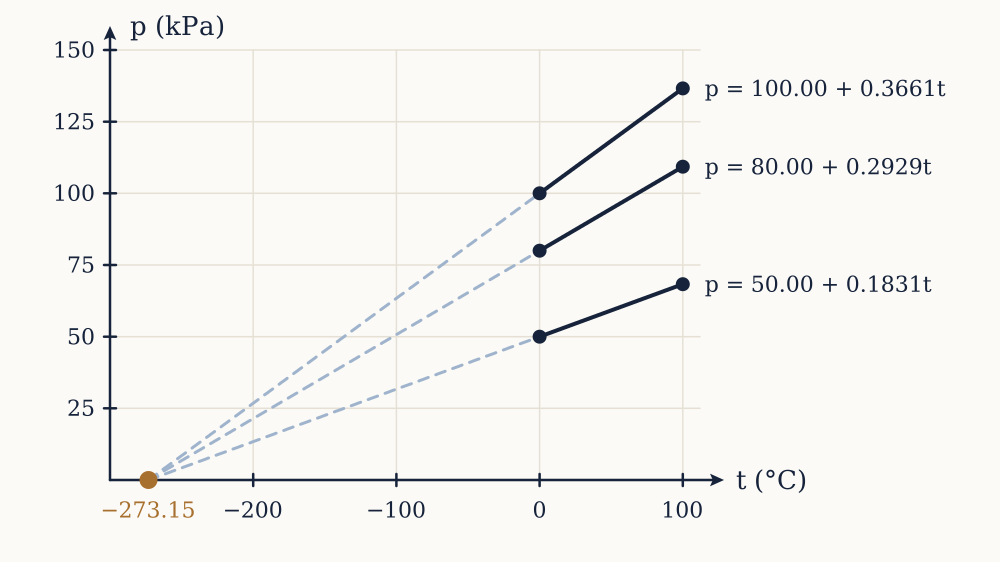
The same limit does something else besides. Plot the pressure of a dilute gas at constant volume against Celsius temperature and the points lie on a straight line. Extend it backwards and it crosses zero pressure at a definite temperature, the same for every gas. That intercept is not a temperature anything has been cooled to; it is where a strictly linear law would run out of pressure.
Working out where the line crosses zero
Guillaume Amontons noticed the effect around ; the modern number follows from one measured ratio. For a dilute gas at constant volume, the steam point pressure divided by the ice point pressure is
Suppose the bulb is charged so that kPa exactly. The steam point pressure is then kPa. Two points fix the line, so the slope in pressure per Celsius degree is
The line through those points is , with in kilopascals and in degrees Celsius. Set and solve for :
The division gives , which rounds to . The assumed kPa never mattered, since only the ratio enters: . Doubling the charge of gas doubles both pressures and leaves the intercept where it was, which is the sign that it belongs to the scale rather than to the apparatus.
Example. A constant-volume gas thermometer is charged so that it reads kPa at the ice point and kPa at the steam point. Where does its straight line cross zero pressure?
The slope is kPa per °C, so the line is . Setting gives °C, the same intercept the kPa charge gave, as it must be.
Now you. The bulb is partly evacuated so that kPa, and the steam point then reads kPa. Find the slope of the line and the temperature at which it crosses zero pressure.
Answer
Slope kPa per °C, so °C. Halving the charge halves both pressures and the slope together, and the intercept stays put.
Shift the origin to that intercept and every dilute gas obeys with , which defines the ideal gas temperature, measured in kelvins. Be blunt about what has not been shown: the linear law is exact only in the extrapolated limit, and a real gas liquefies long before its pressure reaches zero. Helium, the last to give up, condenses at K under one atmosphere. The straight line is honest arithmetic about a limit, not a description of any gas near the intercept.
The thermodynamic scale and the 2019 redefinition
The Second Law later supplies a scale defined by the efficiency of a reversible engine, with no working substance in the definition at all. That is the thermodynamic or Kelvin scale, proposed by William Thomson, Lord Kelvin, in . Its merit is that it can be derived rather than stipulated; its inconvenience is that nobody can build a reversible engine. It is a theorem that the ideal gas and thermodynamic scales coincide wherever both are defined, so the gas thermometer is the practical realisation of a scale defined by engines.
Fixing the size of the kelvin then takes one number chosen by convention. From to that number was the triple point of water, exactly K, which with absolute zero sets the whole scale. The triple point was chosen over the ice point because it is fixed by the substance itself, independent of pressure and of dissolved air, reproducible in a sealed cell to a few tenths of a millikelvin.
The trouble is that this ties the unit to a substance again, and to its isotopic composition, since ocean water and Antarctic ice have measurably different triple points. It also degrades away from the fixed point: realising K by ratio to K carries far more uncertainty than the point itself. Since May the kelvin has instead been defined by fixing the Boltzmann constant at exactly J/K, so the unit is defined through an energy, , and any experiment relating energy to temperature can realise it directly. The cost is a swap of which quantity carries the uncertainty: the triple point of water is now a measured quantity, K with a standard uncertainty of about K. Nothing measurable changed on the day, because was chosen so that the new kelvin matched the old to within the best measurements then available.
Example. What is the thermal energy for a laboratory at °C?
Convert to kelvin first: K. Then J. The conversion is not optional: using directly would be wrong by a factor of twelve, since is defined on the absolute scale.
Now you. A furnace runs at °C. What is there, in joules?
Answer
K, so J.
Thermometers people actually use
None of this is done with a gas bulb in practice. The International Temperature Scale of , ITS-, approximates thermodynamic temperature with instruments that are quick to use. It assigns values to fixed points, each a phase transition of a pure substance: the triple point of hydrogen at K, of neon at K, of water at K, the freezing point of zinc at K, of silver at K. Between them it prescribes the instrument and the interpolating equation.
From about K to the freezing point of silver, that instrument is the standard platinum resistance thermometer. Pure platinum is used because its resistance varies smoothly and reproducibly and can be annealed to a state that does not drift; a good one resolves a millikelvin. Its limits are practical: it is fragile, slow because the sensor has real mass, and above about K platinum contaminates and its calibration wanders, so ITS- hands that range to radiation thermometry using Planck.s law. Below K, rhodium-iron and germanium resistance thermometers take over.
For everyday work the thermocouple is more common. Join two dissimilar metals and a voltage of tens of microvolts per kelvin appears across the junction, the Seebeck effect. A type K couple, chromel against alumel, gives about µV/K from around K to K; type S, platinum against a platinum-rhodium alloy, reaches K. They are cheap, rugged and fast, but an order of magnitude less accurate, typically a degree or two, and they measure a difference, so they need a known reference junction. Every one of these instruments is calibrated against the fixed points, which is how a number read off a hand-held probe inherits its meaning from an equivalence relation.
Temperature is now a state variable on a scale independent of the thermometer. What it does not explain is what the thermometer was watching: something crossed the diathermal wall while the readings drifted, and stopped when they stopped. Naming that quantity, distinguishing it from work, and finding what is conserved when both act on a system is the business of the next lesson.