Thermodynamics is unusual among physical theories in that almost all of its difficulty is in the bookkeeping: deciding what you are talking about, what counts as a property of it, and when a number written down about it means anything at all.
The subject grew out of a practical question: steam engines worked, and nobody could say what limited them. Sadi Carnot's Reflections on the Motive Power of Fire of 1824 attacked that, and the theory that came out of it governs chemical reactions, refrigerators, stars and the direction of time. It only works if the words are used precisely, so this lesson is about the words, and none will be restated later.
System, surroundings and boundary
A system is whatever region of matter or space you have decided to analyse. The surroundings are everything else, and the boundary is the surface separating them. The boundary is a choice, not an object: it can follow a fixed lump of matter or sit still while matter flows through it, and it can be real (a cylinder wall) or imaginary (a surface across a turbine inlet). Choosing it well is most of the skill in a problem, because every term you write is a flow across that surface or a change inside it.
Systems are classified by what the boundary lets through. A closed system exchanges energy but no matter, so its mass is fixed: a sealed can of soup heating in a pan, where heat crosses the tin and nothing else does. An open system, or control volume, exchanges both: a kettle with the lid off, losing steam from the top while the element pushes energy in at the bottom, its mass visibly falling. An isolated system exchanges neither, which a vacuum flask approximates over an afternoon, its silvered double wall cutting conduction, convection and radiation until the coffee cools by a degree an hour rather than in minutes.
Isolation is always an approximation, and the honest statement is about a timescale: the flask leaks, just slowly compared with the hour you care about. What the subject does not tolerate is silence about which system you meant, since half the wrong answers in it come from quietly changing the system halfway through a calculation.
Example. A pressure cooker is heating on a stove with its valve rattling and releasing steam. Taking the contents as the system, is it open, closed or isolated?
Open. Energy crosses the boundary as heat from the stove, and matter crosses it too: every rattle of the valve lets steam out, so the mass inside is falling. Before the valve first lifts, the same cooker is a closed system, which is a reminder that the classification belongs to the boundary's behaviour during the interval you are analysing, not to the pot.
Now you. A sealed can of fizzy drink chills in a refrigerator overnight. Taking the drink and its headspace gas as the system, is it open, closed or isolated?
Answer
Closed. Energy leaves through the aluminium as heat, so it is not isolated, but the can is sealed and no matter crosses the boundary: the mass is fixed. Gas moving between the drink and the headspace stays inside the system, so it does not change the classification.
Properties, extensive and intensive
A property is any characteristic to which a value can be assigned when the system is settled: pressure, volume, temperature, mass, energy. An extensive property scales with the amount of stuff, so cutting the system in half halves volume, mass and energy. An intensive property does not: pressure, temperature and density are unchanged, because each half already had them. The test is exactly that, an imaginary partition and a look at which numbers survive.
The ratio of two extensive properties is therefore always intensive: if both halve when the system halves, their quotient is untouched. This is why specific properties, meaning per unit mass, are the working currency of the subject. Specific volume is intensive, and so is its reciprocal, density . Working in them lets you solve a problem once for a kilogram and apply it to any quantity, which is why property tables are printed per kilogram.
For air as an ideal gas, with J kg⁻¹ K⁻¹. At kPa and degrees Celsius, which is K,
giving kg m⁻³, the familiar density of air. The same holds for a gram of air in a syringe and for the tonne of it in a room, which is the point of dividing by mass.
Example. Air in a compressed-air line sits at kPa absolute and K. What are its specific volume and density?
From , m³ kg⁻¹, and kg m⁻³. Doubling the pressure from atmospheric has roughly doubled the density, moderated a little by the higher temperature.
Now you. Air outside an aircraft cruises past at kPa absolute and K. What are its specific volume and density?
Answer
m³ kg⁻¹, so kg m⁻³.
State, and the state postulate
The state of a system is the complete set of values of its properties at a moment. Two systems in the same state are thermodynamically interchangeable, whatever their histories. That would be useless if you had to measure every property, and the state postulate says you do not: for a simple compressible system the state is fixed by two independent intensive properties. Both qualifiers carry weight. Simple compressible means the only work mode available is compression or expansion, so surface tension, magnetisation, polarisation and elastic stress are absent or negligible. Each extra work mode adds one more property you must specify: a stretched rubber sheet needs its area, a magnetic salt needs the field. The count is one per independent way of doing work, plus one.
Independent is the trickier word. Two properties are independent when one can be varied while the other is held fixed. Pressure and temperature are independent for steam at degrees Celsius and bar. They are emphatically not independent for boiling water at degrees Celsius, because at that temperature the pressure of a liquid and its vapour in contact is pinned at kPa. Quoting both tells you nothing about how much of the sample is liquid and how much steam, so the pair fails to fix the state. That is no edge case: it is the region every power station and refrigerator operates in, and a later lesson introduces a new property, quality, to repair it.
So the states of a simple compressible substance form a two-dimensional surface, and any two independent coordinates can draw it. Every diagram in this course is a projection of that surface.
Equilibrium, and why the theory needs it
Every property named so far assumes a single value exists to be named. Ask for the pressure of a gas just struck by a shock wave and there is no answer: it is bar at one end and bar at the other. A bar with a blowtorch on one end has no temperature, only a temperature field. Equilibrium is the condition in which a system has no unbalanced driving force inside it, so that a single value of each intensive property describes the whole of it.
It comes in kinds, and full equilibrium means all at once. Mechanical equilibrium means no pressure imbalance, so nothing is accelerating or moving a boundary. Thermal equilibrium means no temperature difference, so no heat flows internally. Chemical equilibrium means the composition has stopped changing, with no reaction or diffusion running, and phase equilibrium is the case where the amounts of liquid and vapour have stopped shifting. A system can sit in one and not the others: a warm cup of water is in mechanical equilibrium while its temperature gradients are still relaxing.
Here is the awkwardness at the centre of the subject. Classical thermodynamics defines its properties only for equilibrium states, and every process worth studying is a departure from equilibrium. A gas expands because its pressure exceeds the load on the piston; heat flows because a temperature difference exists. Remove the imbalance and nothing happens. So the theory describes exactly the situations in which nothing is happening, and is asked about the ones in which something is.
The escape is care about what is claimed. Where a process starts and ends in equilibrium, quantities depending only on the endpoints can be computed exactly however violent the middle was: the energy change of an exploding gas is well defined even though its pressure during the explosion is not. For quantities that do depend on the middle, an idealisation is needed.
Quasi-static and reversible processes
A process is any change of state, and the states it passes through are its path. A quasi-static process is carried out so slowly that the system is never measurably far from equilibrium: at every instant it has one pressure and one temperature, so the path is a continuous line on the state surface and can be drawn. The image is compressing a gas by laying grains of sand on the piston one at a time. Slam the piston down instead and the gas near the face is compressed before the far end knows anything has happened, so no single state exists during the transit and there is no line to draw.
Reversible is stronger: a reversible process can be run backwards so that system and surroundings both return exactly to their original states, leaving no trace anywhere. Quasi-static is necessary but not sufficient, because dissipation can still occur. Slide the piston slowly against friction and every state is well defined, yet the frictional heat cannot be gathered up and turned back into the work that made it. Reversibility requires a process that is quasi-static and free of friction, unrestrained expansion, mixing, and heat flow across any finite temperature difference.
No real process meets that standard. Heat flow needs a temperature difference to drive it, so a reversible heat transfer takes infinite time; friction is never zero; every real expansion is somewhat unrestrained. Reversibility is unattainable in the strict sense in which a frictionless plane is unattainable.
It is nevertheless the most valuable idea in the subject, for a reason that becomes a theorem later in the course: reversible processes bound the real ones. The reversible route between two states delivers the most work a real route could deliver and demands the least it could require, so it sets a target no engineering can beat. A steam plant achieving thermal efficiency means little in isolation; measured against the reversible limit for its temperatures it becomes a judgement.
State functions and path functions
Here is the idea that structures everything after it: some quantities depend only on the state a system is in, and some depend on how it got there.
Pressure, volume, temperature, internal energy and entropy are state functions, also called point functions. Their change over a process is the end value minus the start value, , and nothing about the route survives, so around any complete cycle the change of a state function is exactly zero. Work and heat are path functions. They are not properties at all: a system does not contain work or heat. They are modes of energy transfer that exist only during a process, and their size depends on the route. This is why the increments are written and rather than and : the differential is inexact, and there is no function to differentiate.
The pressure-volume plane makes it visible. For a quasi-static expansion the work done by the system is , so the total is , the area under the path. Two paths from the same state to the same state enclose an area between them, and that area is exactly the difference in the work.
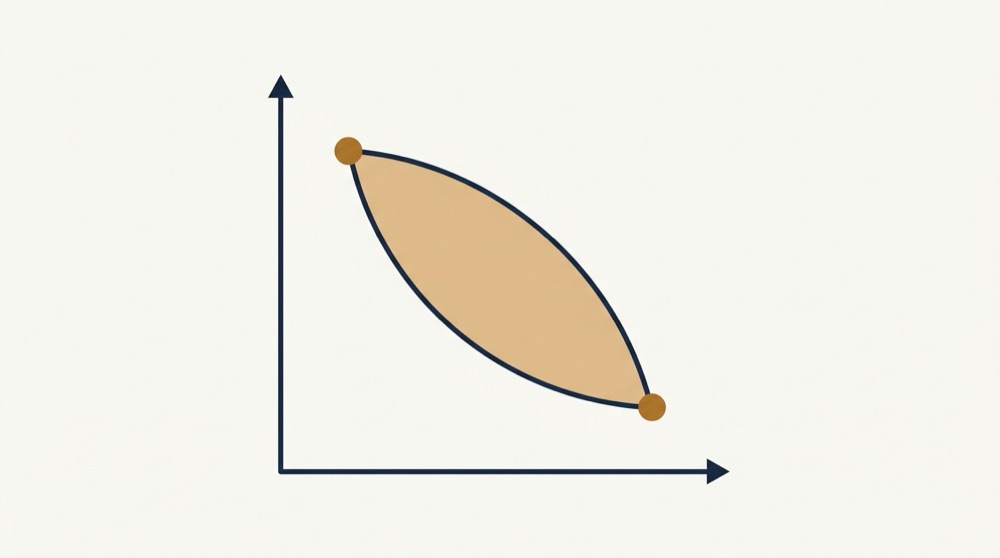
Put numbers on it. Take state at kPa, m³ and state at kPa, m³. Path A expands at constant kPa to m³, then drops the pressure at fixed volume, which does no work since : its work is J. Path B drops the pressure first, then expands at constant kPa, giving J. Same start, same end, kJ against kJ. The difference is the rectangle the paths enclose, J, as it must be. Meanwhile is m³ on both routes, because volume is a state function and does not care.
The whole of engine design lives in that gap. A cycle returns to its starting state, so every state function returns to its original value and the net work is the area enclosed by the loop on the - diagram. An engine is a device for going out along a high-pressure path and back along a low-pressure one.
Getting the numbers right
Most errors in thermodynamics are unit errors rather than conceptual ones. The SI base quantities in play are the kilogram, metre, second and kelvin. Force is derived: one newton accelerates one kilogram at one metre per second squared. One pascal is one newton per square metre, which is very small, so kPa, bar ( Pa) and MPa are the practical units. Energy is the joule, one newton metre.
The mass and force distinction is the classic trap. A kilogram is an amount of matter; its weight is a force, , and depends on where it is. A kg person weighs N on Earth and N on the Moon while remaining kg. Bathroom scales report mass by silently assuming Earth's gravity, and the pound-mass and pound-force of imperial practice differ by the factor , the confusion that destroyed the Mars Climate Orbiter in 1999.
The second trap is the pressure datum. Most gauges measure the difference from local atmospheric pressure, so they read gauge pressure: , and a tyre at bar gauge holds bar absolute. Every equation of state in this course, included, needs absolute pressure. A vacuum gauge reads the other way, .
A worked case ties it together. A vertical cylinder is closed by a freely sliding piston of mass kg and face area m², roughly mm across, with atmospheric pressure kPa above it. The piston is not accelerating, so mechanical equilibrium fixes the gas pressure: the upward force from the gas balances the piston's weight plus the atmosphere pushing down. The weight is N, and spread over m² that is Pa, or kPa. So the absolute pressure is kPa, and a gauge on the cylinder would read kPa. It does not depend on how much gas is under the piston or how hot it is: heat the gas and it expands at constant pressure, because the piston's weight and the atmosphere are unchanged. Constant-pressure processes in this course almost always arise this way.
Example. A heavier arrangement uses a piston of mass kg on a face area of m², with the same kPa atmosphere above. What absolute pressure does the trapped gas hold, and what does a gauge on the cylinder read?
The weight is N, and spread over m² that is Pa, or kPa. The absolute pressure is kPa, and the gauge reads the difference from atmospheric, kPa.
Now you. A piston of mass kg slides freely in a cylinder of face area m², atmosphere at kPa above it. Find the absolute pressure of the gas and the gauge reading.
Answer
Weight N, over m² gives Pa, or kPa. Absolute pressure kPa, gauge reading kPa.
Two independent intensive properties now fix that gas completely, and one of them, temperature, has been used throughout this lesson as though everybody knows what it means. Making it a measurable property rather than a sensation is the business of the next lesson.