A capacitor alone charges instantly, in principle, because nothing limits the rush of charge. Put a resistor in the path and the picture changes entirely, because the resistor caps the current, so the charge can only trickle on and the capacitor's voltage climbs gradually. This pairing, a resistor and a capacitor in series, is the RC circuit, and it is the simplest circuit that does something over time. Understanding its one curve and its one number explains timers, the smoothing of power supplies, and the filters that separate fast signals from slow ones.
The charging curve
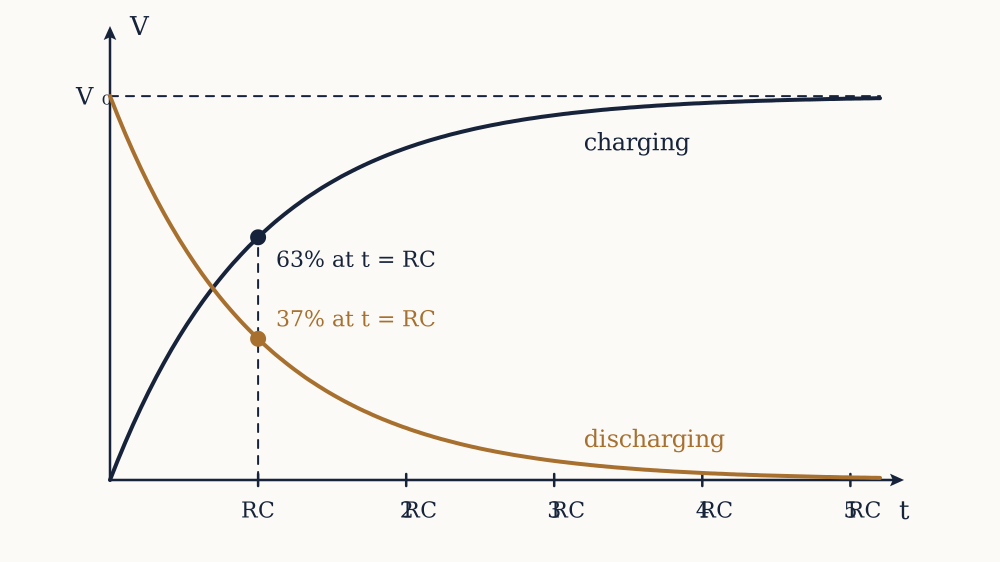
Connect a resistor and capacitor in series to a voltage , starting with the capacitor empty. At the first instant the capacitor is at zero volts, so the full source voltage is across the resistor, and by Ohm's law the current is at its largest, . Charge pours onto the capacitor and its voltage rises, which leaves less voltage across the resistor, so the current falls, so the charging slows. The capacitor fills quickly at first and ever more slowly as it approaches the source voltage, never quite reaching it in the mathematics though it gets there for any practical purpose. The voltage across the capacitor follows
an exponential approach to . The discharging case, where a charged capacitor is allowed to empty through a resistor, is the mirror image, an exponential fall:
starting at the full voltage and decaying toward zero, fast at first and slowing as it goes. Both curves are governed by the same combination in the exponent, , and that combination is the whole story of the circuit's speed.
The time constant
The product is called the time constant, written , and it has units of seconds, which is worth checking because it is not obvious: an ohm times a farad works out to a second. It is the natural clock of the circuit. After one time constant the charging capacitor has reached of the source voltage, about 63 per cent, and the discharging one has fallen to , about 37 per cent. After about five time constants the process is over to better than one per cent, which is the rule of thumb for how long to wait for a capacitor to settle. The beauty of the time constant is that it collapses the whole behaviour into a single adjustable number: want a slower circuit, use a larger resistor or a larger capacitor; the curve keeps its shape and only its pace changes.
Example. A 10 kilohm resistor charges a 100 microfarad capacitor from a 9 V supply. What is the time constant, and roughly how long until the capacitor is nearly fully charged?
second. After one second it reaches about 63 per cent of 9 V, roughly 5.7 V, and after about five seconds it is essentially at 9 V.
Now you. A 1 kilohm resistor discharges a 470 microfarad capacitor. What is the time constant, and what fraction of the starting voltage remains after that one time constant?
Answer
s, and after one time constant about 37 per cent of the starting voltage remains.
What the circuit is good for
The RC circuit does three jobs that recur everywhere. As a timer, its predictable climb marks out a delay: a circuit that acts when the capacitor voltage crosses a threshold waits a time set by , and choosing the resistor and capacitor sets the interval, which is how a great many simple timing circuits are built. As a smoother, a capacitor across a lumpy supply charges on the peaks and discharges into the troughs, and a large enough time constant, slow compared with the lumps, flattens them into a nearly steady voltage, which is how the pulsing output of a power supply becomes usable direct current. As a filter, the circuit treats fast and slow signals differently because the capacitor can follow slow changes but not fast ones: taking the output across the capacitor passes the slow and rejects the fast, a low-pass filter, while taking it across the resistor does the opposite, and the boundary between fast and slow is set once again by the time constant. The same three components, arranged the same way, become a clock, a smoother or a sieve depending only on what is asked of them, all governed by that one product of resistance and capacitance.
Why time entered the subject
The RC circuit is the first place the subject has a memory, and it is worth seeing why. A resistor's voltage depends only on the current through it right now; a capacitor's voltage depends on all the charge that has ever flowed onto it, the whole past summed up. Pairing them makes a circuit whose present depends on its history, which is what any circuit that times, remembers or reshapes a signal must have. The exponential curve is the signature of that memory, the mathematical shadow of a quantity that changes at a rate proportional to how far it still has to go. The same shape governs a cooling cup of coffee and a decaying isotope, and it appears here for the same reason: the closer the capacitor gets to its target, the smaller the driving voltage across the resistor, and the slower it approaches. With the capacitor understood as the store of the electric field, the subject turns to its twin, the component that stores the magnetic field instead, and behaves in a way that is the mirror image at every step.