Every game so far has had a strategy set short enough to write as rows and columns, and the choices that matter most in economics are numbers on a continuum: a price, a quantity, a bid, an amount of effort.
When the grid becomes a line
Nothing in the definition of equilibrium requires a finite strategy set. A best response is still the strategy maximising your payoff given the others', and an equilibrium is still a profile of mutual best responses. What changes is the arithmetic: with a continuum of strategies, the best response is found by maximising a function rather than by scanning a column, and it comes out as a best-response function giving your optimal choice for each possible choice of the other player. The equilibrium is then the solution of a system of equations, and it can often be written in closed form.
One warning carries over from Nash's theorem, which required finiteness. With infinite strategy sets, existence needs the payoff functions to be reasonably behaved, and the models here satisfy that: strategies range over a closed interval and payoffs are smooth and concave in one's own choice. When those conditions fail, equilibria can genuinely fail to exist, and the Bertrand model at the end of this lesson shows a payoff function with a jump in it doing something violent.
Cournot's duopoly
Antoine Augustin Cournot published the first equilibrium analysis in economics in 1838, more than a century before Nash, using two owners of mineral springs who each decide how much water to pump. The model still carries his name and is still the standard workhorse for quantity competition.
Two firms produce an identical good. Firm 1 chooses quantity , firm 2 chooses , and the market price is set by total supply through the inverse demand curve
Each unit costs to produce, and the firms choose simultaneously. Take concrete numbers to keep the algebra honest: , and , with quantities in thousands of units and prices in pounds.
Firm 1's profit is revenue minus cost:
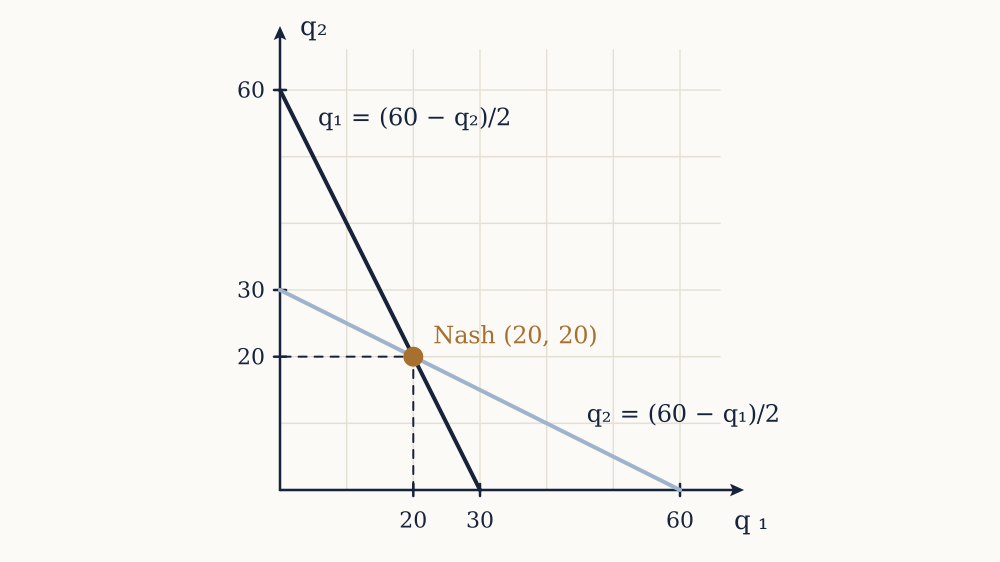
Hold fixed and read that as a function of alone. It is a downward parabola through the origin, zero at and again at , so its peak sits halfway between those roots. That gives the best-response function without a single derivative:
The interpretation is worth pausing on. If firm 2 produces nothing, firm 1 produces 30, which is exactly the monopoly quantity: a monopolist maximises , another parabola with roots 0 and 60, peaking at and yielding a price of £70 and a profit of £900. Every unit firm 2 adds pushes firm 1 back by half a unit. Quantities are strategic substitutes: more of yours makes me want less of mine.
Firm 2's best response is the mirror image, . In equilibrium both hold at once, and by symmetry :
So each firm produces 20, total output is 40, the price is , and each firm earns .
Line the three market structures up. A monopolist produces 30 at £70 and earns £900. The Cournot duopolists produce 40 between them at £60 and earn £800 between them. Perfect competition would drive the price to marginal cost, £40, with output 60 and no profit at all. Duopoly sits between monopoly and competition on every measure, which is the result Cournot was after and the reason the model survived.
Example. With the same demand and costs, what is firm 1's best response if firm 2 produces 30, and what does firm 1 earn?
The best-response function gives . Total output is 45, so the price is , and firm 1 earns . Firm 2, which flooded the market, earns . Producing more than the equilibrium quantity is profitable for firm 2 here precisely because firm 1 is expected to accommodate it, which is a hint about what happens when one firm can move first.
Now you. Demand is and each unit costs £30. What is the Cournot equilibrium quantity per firm, the price, and each firm's profit?
Answer
Firm 1's profit is , a parabola with roots at and , so the best response is . Setting gives , so . Total output is 30, the price is , and each firm earns .
The cartel and why it does not hold
The two firms would both prefer the monopoly outcome. Splitting the monopoly quantity of 30 gives each 15 units at a price of £70, so each earns , against the £400 of the Cournot equilibrium. Every pound of that gain is available for the taking, and yet it is not an equilibrium.
Check it with the best-response function. If firm 2 sticks at 15, firm 1's best response is . Total output becomes 37.5, the price falls to £62.50, and firm 1 earns while firm 2 earns . Firm 1 gains £56.25 by cheating and firm 2 loses £112.50.
That is a prisoner's dilemma with a continuum of strategies. Both firms prefer the cartel to the equilibrium, each gains by defecting from the cartel while the other holds, and the unique equilibrium of the one-shot game is the outcome both like less. The numbers £450, £506.25 and £400 are the , and of the second lesson, computed rather than assumed, and they return in the lesson on repetition, where they determine exactly how patient a cartel has to be to survive.
Example. Suppose the two firms agree to hold at 15 each and firm 1 cheats by producing 25 rather than its best response of 22.5. Does firm 1 still gain, and by how much?
Total output is 40, so the price is £60 and firm 1 earns , which beats the £450 of holding but falls short of the £506.25 available from cheating optimally. The interesting part is firm 2, which now earns , worse than the £337.50 it lost under optimal cheating. Overshooting hurts the cheat a little and the victim a lot.
Now you. With the same demand and costs, at what quantity for firm 1 would the cartel-breaking profit fall back to the £450 the cartel promised, given firm 2 holds at 15?
Answer
Firm 1's profit against is , and setting that equal to 450 gives . The roots are , so or . Cheating pays for every quantity strictly between 15 and 30, and beyond 30 the firm has flooded its own market so badly that it would have done better keeping the agreement.
More firms, less market power
Nothing restricts the model to two firms. With identical firms the same argument runs: firm 's profit is , a parabola in with roots 0 and , peaking halfway. Imposing symmetry, so that each of the other firms produces the same , gives
With the running numbers, and . One firm produces 30 at £70. Two produce 20 each at £60. Three produce 15 each at £55 and earn £225 each. Five produce 10 each at £50 and earn £100 each. Ten produce about 5.45 each at £45.45, earning under £30 each. As grows the price approaches marginal cost from above, so perfect competition is not a separate model but the limit of this one.
The markup over cost is , so most of it goes early: the second firm removes £10 of the monopolist's £30, the third another £5, while doubling from ten firms to twenty removes only £2.60. Competition policy in concentrated industries is fighting for the steep part of that curve, which is also where mergers do their damage.
Bertrand, and the paradox
In 1883 Joseph Bertrand reviewed Cournot's book and objected that firms do not choose quantities, they choose prices, and that changing the strategy variable changes the answer completely.
Two firms sell an identical good, both with marginal cost , and each posts a price. Consumers buy from the cheaper, splitting evenly on a tie. What is the equilibrium?
Suppose firm 2 posts £60. Firm 1 posting £60 splits the market and earns half the profit; firm 1 posting £59.99 takes all of it and earns nearly twice as much. So £60 is not an equilibrium, and neither is any price above £40 by the same argument. Nor is any price below £40, which loses money on every unit. The only equilibrium is both firms pricing at exactly £40, marginal cost, earning nothing at all, while consumers buy 60 units at the competitive price.
This is the Bertrand paradox: two firms are enough to produce the perfectly competitive outcome. It is a paradox because real duopolies plainly do not price at marginal cost, so one of the assumptions must be doing damage. Three of them are, and each repair is a real industry.
Capacity. The undercutting argument assumes the winner can serve the entire market. If each firm can supply only 35 units of a 60-unit market, undercutting no longer captures everything, and the residual demand left to the loser supports a price above cost. David Kreps and José Scheinkman showed in 1983 that firms choosing capacity first and prices afterwards reproduce the Cournot outcome exactly, which reconciles the two models: Cournot describes competition when capacity is the real decision, Bertrand when it is not.
Differentiation. If the goods are not identical, a small price cut does not steal the whole market. Suppose firm faces demand , so its sales fall with its own price and rise with its rival's. Its profit is , a parabola in with roots at and , peaking halfway, so the best response is . Symmetry gives , so , each firm sells 40 units and earns £800. Prices are strategic complements here, in contrast to Cournot quantities: a rival's price rise makes you want to raise yours. Nothing about the goods changed except that they stopped being interchangeable, and the margin came back.
Repetition. Undercutting is profitable today and provokes a price war tomorrow, and the lesson on repeated games shows precisely how patient firms have to be for the threat of that war to sustain a price above cost.
Example. In the differentiated model above, what is firm 1's best response if firm 2 prices at £50, and what does firm 1 sell?
. Its sales are units, and its profit is . Note that firm 1 does not match the £50: with differentiated goods, being dearer than your rival is compatible with selling a lot.
Now you. In the same differentiated model, suppose firm 2 prices at £80. What is firm 1's best response, and does firm 1 want to undercut all the way?
Answer
, selling units for a profit of . Firm 1 raises its own price when firm 2 does, rather than undercutting, because the extra margin outweighs the sales lost to a differentiated rival. That is what makes prices strategic complements, and it is the reason price rises spread through a differentiated industry in a way quantity increases do not.
What the models assume
Both models assume the two firms move at the same time and know each other's costs and the demand curve exactly, and both are one-shot. Each of those assumptions is doing real work, and each is repaired in a later lesson: sequence in the next one, repetition three lessons on, and private information near the end.
Two further limits deserve naming now. Constant marginal cost is a strong assumption, and rising marginal cost changes the best-response slopes without changing the method. And the equilibrium concept still delivers a single prediction here only because these particular payoff functions are concave with a unique intersection of best responses. Add capacity limits, fixed costs or discrete plant sizes and multiple equilibria come back.
The most interesting assumption to drop is simultaneity. The example above showed firm 1 accommodating a rival who produced 30, which suggests that a firm able to commit to a large output first might do very well out of that accommodation. Working out whether it can, and by how much, requires a way of writing down who moves when. That is the next lesson.