Every game so far has assumed that neither player learns anything before choosing, and the moment one player can see what the other did, the analysis and the answer both change.
The extensive form
A game in which moves happen in a known order is written as a tree rather than a grid. The tree starts at a single node, each node is labelled with the player who moves there, each branch leaving it is an action, and every path through the tree ends at a terminal node carrying one payoff for each player. This is the extensive form.
Take the game that runs through this lesson and the next. An entrant decides whether to enter a market. If it stays out, the entrant earns 0 and the incumbent keeps its monopoly, worth 10. If it enters, the incumbent decides whether to fight a price war or accommodate. Fighting leaves the entrant with -2 and the incumbent with 2. Accommodating gives the entrant 2 and the incumbent 5. Two decision nodes, three terminal nodes, six numbers, and the whole strategic situation is specified.
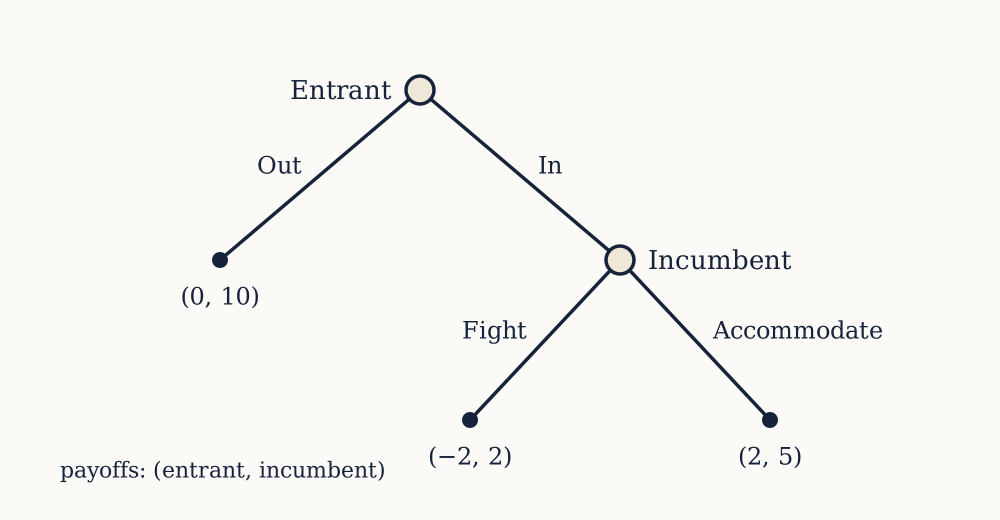
Simultaneous moves fit in the same picture using an information set: a group of nodes the player on move cannot tell apart. If the incumbent must choose without knowing whether entry has occurred, its two nodes are enclosed in one information set and it must choose the same action at both, which is exactly the normal form again. A game in which every information set is a single node is a game of perfect information, and those are the games this lesson solves.
A strategy is a complete plan
The definition of a strategy from the first lesson now earns its keep. A strategy for a player is a complete contingent plan: an action at every information set where that player might have to move, including ones that will not be reached.
In the entry game the entrant has two strategies, In and Out. The incumbent has one decision node and so also has two, Fight and Accommodate. But suppose the incumbent could react differently to two different kinds of entry, say small and large: it would then have two decision nodes and four strategies, one for each combination of replies. In general a player with decision nodes and two actions at each has strategies, which is why the normal form of a chess-like game is a theoretical object rather than a table anyone writes.
The insistence on specifying an action at unreached nodes looks like bookkeeping and is the opposite. It is what makes the sentence "the incumbent would have fought if the entrant had come in" a statement with a truth value, and the whole of the next lesson turns on whether such statements are believable.
Writing the entry game as a grid gives:
| Entrant | Incumbent fights | Incumbent accommodates |
|---|---|---|
| In | -2, 2 | 2, 5 |
| Out | 0, 10 | 0, 10 |
The row Out is flat, because when the entrant stays out the incumbent's plan never gets used. Mark the best responses. Against Fight the entrant prefers Out; against Accommodate it prefers In; against In the incumbent prefers Accommodate; against Out it is indifferent, so both of its strategies are best responses. Two cells carry both marks: (In, Accommodate) and (Out, Fight). The grid says both are Nash equilibria. The tree, as the next section shows, says only one of them can happen.
Example. A tree has player 1 choosing A or B at the first node. After A, player 2 chooses between C and D; after B, player 2 chooses between E and F. How many strategies does each player have, and how large is the normal form?
Player 1 has one decision node with two actions, so two strategies. Player 2 has two decision nodes with two actions at each, so four strategies: (C if A, E if B), (C if A, F if B), (D if A, E if B) and (D if A, F if B). The normal form is a two-by-four grid with eight cells, describing a tree that has only four terminal nodes.
Now you. Player 1 moves first with three actions. After each, player 2 chooses between two actions. How many strategies does player 2 have?
Answer
Player 2 has three decision nodes with two actions at each, so strategies. The count multiplies across nodes rather than adding, which is why strategy sets in extensive games explode: a player with ten binary decision nodes has 1,024 strategies.
Backward induction
A game of perfect information is solved from the leaves inward. Find a decision node all of whose branches lead straight to terminal nodes, and settle what the player there would do, which is a simple comparison of numbers. Replace that node with the payoffs it produces. The tree is now shorter by one layer. Repeat.
In the entry game there is one node to settle: the incumbent, having been entered upon, compares 2 from fighting with 5 from accommodating, and accommodates. Replace that subtree with the pair (2, 5). Now the entrant chooses between 0 from staying out and 2 from entering, and enters. The prediction is entry followed by accommodation, paying 2 and 5.
This is backward induction, and it is the single most-used technique in applied game theory. Its logic is that a plan for the future has to be one you would actually carry out when the future arrives, which is why the (Out, Fight) equilibrium of the grid does not survive: it requires the incumbent to fight, and if entry ever happened, it would not.
Two classical results underwrite the method. Ernst Zermelo proved in 1913 that in chess either White can force a win, or Black can, or both can force at least a draw, entirely by this kind of argument and without knowing which. Harold Kuhn generalised it in 1953: every finite game of perfect information has a Nash equilibrium in pure strategies, and backward induction finds one. No mixing is needed, which is a striking contrast with the simultaneous games of the earlier lessons, and the reason is that a player who moves second never faces uncertainty about what came before.
Example. Player 1 chooses A or B. After A, player 2 chooses C, paying (3, 1), or D, paying (1, 2). After B, player 2 chooses E, paying (2, 4), or F, paying (0, 0). Solve it.
Work from the leaves. At the node after A, player 2 compares 1 from C with 2 from D and chooses D, so A is worth (1, 2). At the node after B, player 2 compares 4 from E with 0 from F and chooses E, so B is worth (2, 4). Player 1 now compares 1 from A with 2 from B and chooses B. The outcome is (2, 4), and player 2's full strategy is "D if A, E if B", which specifies a choice at the node that is never reached.
Now you. Player 1 chooses L or R. After L, player 2 picks between (5, 1) and (2, 3). After R, player 2 picks between (3, 2) and (4, 4). Solve it, and say what player 1 would get if player 2 could somehow commit in advance to the other action after L.
Answer
After L, player 2 takes 3 rather than 1, so L is worth (2, 3). After R, player 2 takes 4 rather than 2, so R is worth (4, 4). Player 1 chooses R and the outcome is (4, 4). If player 2 could commit to the (5, 1) branch after L, player 1 would prefer L, earning 5 rather than 4, and player 2 would earn 1 rather than 4. So player 2 has no interest in making that commitment here, but a player who could commit to a worse-for-themselves action can sometimes make the other side move their way. That is the subject of the next lesson.
The value of moving first
Return to the two firms of the previous lesson: demand , unit cost £40, and simultaneous quantity choices giving 20 each, a price of £60 and £400 each. Now let firm 1 choose first, publicly and irreversibly, before firm 2 chooses. This is Heinrich von Stackelberg's 1934 model, and it is solved by backward induction.
Start at the end. Firm 2 sees and plays its best response, which the previous lesson derived: . Firm 1 knows this, so it does not treat as fixed; it substitutes the reaction into its own profit:
That is a parabola in with roots at 0 and 60, so it peaks at . Firm 2 then produces , total output is 45, the price is £55, and profits are for the leader and for the follower.
Compare the two regimes. The leader earns £450 against the £400 it would get moving simultaneously, so there is a genuine first-mover advantage of £50. The follower earns £225, well short of £400. Total output rises from 40 to 45 and the price falls from £60 to £55, so consumers gain, while total industry profit falls from £800 to £675.
Why does moving first help? Not because of information, since the follower learns something the leader does not. It helps because moving first is a commitment. Firm 1 produces 30, which is not a best response to 15, and it gets away with it because 15 is already fixed by the time firm 2 responds. In the simultaneous game, threatening to produce 30 would be empty: firm 2 would produce 15 anyway and firm 1 would then wish it had produced 22.5. Sequence converts a wish into a fact.
Example. Demand is and unit cost is £30. Solve the Stackelberg game and compare the leader's profit with the £450 each firm earns in the simultaneous equilibrium.
The follower's best response, from the previous lesson, is . The leader's profit is , and substituting gives , a parabola peaking at . Then , total output is 33.75, the price is , and profits are for the leader and £253.13 for the follower. The leader gains £56.25 over the simultaneous outcome and the follower loses £196.88.
Now you. In the original Stackelberg game, what would the leader earn if it ignored the reaction function and simply produced the Cournot quantity of 20?
Answer
The follower would respond with , total output would be 40, the price would be £60 and the leader would earn £400, exactly the simultaneous-game profit. Moving first is worth nothing unless the leader exploits it, and exploiting it means deliberately producing more than the quantity that would be a best response after the fact.
Moving first is not always better
The Stackelberg result is often quoted as though first movers always win, and the previous lesson supplies the counterexample. The advantage comes from committing to something that pushes the follower's best response in your favour, and whether that is possible depends on whether the strategic variables are substitutes or complements.
With quantities, more of yours makes the rival want less, so committing to a lot is aggressive and profitable. With differentiated prices it is the other way round: a rival's higher price makes you want a higher price too. A price leader in the differentiated model of the previous lesson, where each firm faces with cost £40, maximises and sets £61.43, which is above the simultaneous £60. The follower then prices at £60.36 and earns £828.83, while the leader earns £803.57. Both do better than the £800 of the simultaneous game, and the follower does best of all. Announcing a high price first is an invitation the rival accepts while slightly undercutting.
So the useful statement is not "move first" but "commit to something the other side must accommodate", and whether such a commitment exists is a property of the game rather than of the clock.
Where backward induction becomes uncomfortable
The method is only as good as the assumption that every player will apply it at every future node, and there is a small game designed to make that assumption look ridiculous.
In Robert Rosenthal's centipede game, two players alternate. A pot starts at 50 pence, split 40 to the player on move and 10 to the other. Passing doubles the pot and hands the move over. In the four-move version used by Richard McKelvey and Thomas Palfrey in 1992, taking at the first node gives (0.40, 0.10), at the second (0.20, 0.80), at the third (1.60, 0.40) and at the fourth (0.80, 3.20), with (3.20, 0.80) if the last player passes.
Backward induction is brutal. At the last node player 2 takes 3.20 rather than passing for 0.80. Knowing that, at the third node player 1 takes 1.60 rather than the 0.80 that passing would bring. At the second node player 2 takes 0.80 rather than 0.40. So at the first node player 1 takes 0.40 rather than the 0.20 that passing would bring, and the game ends immediately with 50 pence on the table when four pounds was available.
Almost nobody plays this way. In McKelvey and Palfrey's experiments only a small minority took at the first opportunity, most games ran several nodes, and the pot regularly grew. The theory's own logic explains the discomfort: player 2's move at the second node is only reached if player 1 has already done something backward induction says is irrational, and player 2 then has to decide what to believe about a player who has just violated the assumption the whole argument rests on. Backward induction has no answer to that, and the final lesson of this course returns to what the experiments show and what the models built to fit them look like.
Where this leaves us
The tree solved the entry game and threw away one of its two Nash equilibria. The one it threw away, in which the incumbent's plan to fight keeps the entrant out, is exactly the kind of arrangement that real firms, unions, governments and parents rely on: a threat that would be costly to carry out but works if believed.
Making the distinction precise, which means saying which Nash equilibria of the grid survive when the tree is taken seriously, is the concept of subgame perfection. And once threats are classified into credible and empty, the natural follow-up is how a player might make an empty threat into a real one by destroying their own options. That is the next lesson.