A branching history makes a prediction so demanding that it is surprising it survives contact with the data at all.
The previous lesson established that populations divide and that the halves then diverge without rejoining. Repeat that indefinitely and every living thing is related to every other through a unique branching pattern. The first lesson of this course noticed that living characters fall into groups within groups and called it a fact needing explanation. This lesson shows why that fact is a severe test rather than a description, and works the test on a case where the answer was known in advance and could have been wrong.
Homology, and how to tell it from resemblance
Richard Owen's 1843 distinction is the tool. Homology is sameness of structure regardless of function; analogy is sameness of function regardless of structure. A bat's wing and a whale's flipper are homologous; a bat's wing and an insect's wing are analogous. Only homology carries information about ancestry, so everything depends on telling them apart, and the criteria are older than the theory they now support.
Position is the first. A structure is identified by what it is connected to, not by what it looks like: the mammalian malleus and incus are homologous with the reptilian articular and quadrate because they occupy the same position in the developing jaw joint and are supplied by the same nerves, even though one pair hinges a jaw and the other transmits sound. Composition is the second: homologous parts are built of the same tissues in the same arrangement. Continuity through intermediates is the third: two very different structures are homologous if a series of forms connects them, which is how the ear bones were settled, since embryos and fossils both show the transition in progress.
Convergence is the failure mode, and it can be spectacular. Ichthyosaurs, sharks and dolphins share a fusiform body, a dorsal fin and a tail fin because water imposes the same requirements on anything that swims fast, and their internal anatomy is not remotely similar. Cephalopod and vertebrate eyes both have a cornea, an iris, a lens and a retina, and the cephalopod retina faces the light while the vertebrate one faces away from it, with the nerve fibres running across the front and leaving through a hole. Two independent solutions, one of them built backwards. Convergence is common enough that no single character is trustworthy, which is exactly why the test below uses thousands at once.
The nested hierarchy is a prediction
Here is the claim in its strong form. If life has a branching history, then any character that arose once on that history and was inherited thereafter marks out a set of species: the descendants of the branch it arose on. Two such sets must either be nested one inside the other or be entirely separate. They can never overlap partially, because that would require a species to be descended from two different branches.
Nothing outside a branching history forces this. Characters are logically free to be distributed any way at all, and most artificial collections of objects have no such structure: cars have engines, wheels and seats in overlapping combinations that no tree accounts for, and neither do the properties of chemical elements or the features of computer programs.
Example. For twenty species, how many distinct branching diagrams are possible, and what does that number do to the argument?
The number of distinct unrooted branching patterns for tips is the double factorial . For that is , and if the tree is rooted, .
That number is the strength of the test. A single character sorts the twenty species into two groups and is compatible with a large fraction of those trees, so one character proves nothing. But an independent character has no reason to pick the same tree out of possibilities unless something is constraining both. When anatomy, embryology, biochemistry and DNA sequence, gathered by different people using different methods across two centuries, converge on one diagram out of , either they are recording a real history or an extraordinary coincidence has occurred repeatedly. This is why the nested pattern, and not adaptation, is the evidence that actually settled the question: adaptation is compatible with design, and a shared nested hierarchy across independent character sets is not obviously compatible with anything except common descent.
Now you. The claim is falsifiable, so state what would falsify it. Give a concrete observation.
Answer
Systematic, irreducible conflict between large independent character sets. Not the odd disagreeing character, which convergence guarantees, but a case where the anatomical tree and the molecular tree of the same twenty species are simply different trees, and adding data does not bring them together.
Concrete single observations would do it too, and they are the ones usually quoted because they are vivid: a mammal with feathers grown the way a bird grows them, an animal that is genuinely half insect and half vertebrate, a placental mammal in Devonian rock. J. B. S. Haldane's rabbit in the Precambrian is the same idea. None has been found, and the significance of that is easy to understate: for a century and a half every new species described and every genome sequenced has been another chance to break the pattern, and the pattern has instead absorbed groups nobody could place, such as the whales below.
Parsimony, worked by hand
The practical problem is to pick a tree when characters disagree. The oldest usable criterion is parsimony: prefer the tree that requires the fewest independent origins of the characters, on the ground that a tree needing many convergences is asking you to believe in many coincidences.
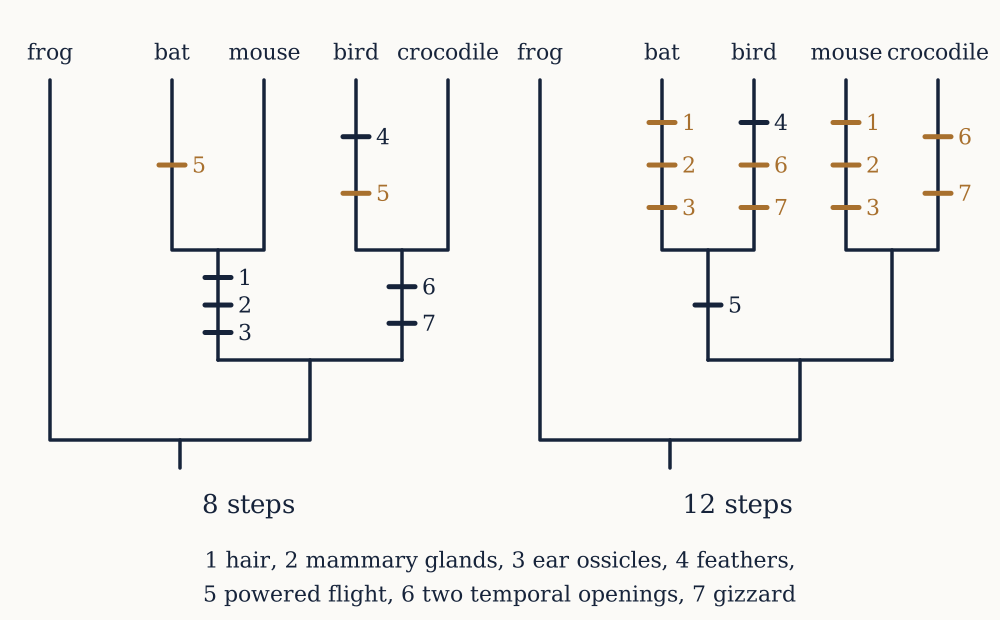
Example. Score seven characters across four animals: a bat, a mouse, a bird and a crocodile, with a frog as the outgroup so that "absent" is the ancestral state. Hair, mammary glands and three ear ossicles are present in the bat and the mouse only. Feathers are present in the bird only. Powered flight is present in the bat and the bird. Two temporal openings in the skull and a muscular gizzard are present in the bird and the crocodile. Compare the tree that groups bat with mouse against the tree that groups bat with bird.
On the tree grouping bat with mouse and bird with crocodile: hair, mammary glands and ear ossicles each arise once on the branch leading to the two mammals, three steps. Feathers arise once, one step. The two skull and gizzard characters each arise once on the branch leading to bird and crocodile, two steps. Powered flight cannot arise once, because bat and bird are not neighbours here, so it costs two. Total: steps.
On the tree grouping bat with bird and mouse with crocodile: flight now costs one step and feathers one, but hair, mammary glands and ossicles each cost two, and the skull and gizzard characters each cost two. Total: steps.
The first tree wins by four steps. What decided it is not the number of characters supporting each grouping but their weight of evidence taken together: flight is one character and it loses to six. The consistency index, the minimum possible number of steps divided by the actual number, is for the first tree and for the second, and a low index is a warning that the tree is demanding a lot of convergence.
Now you. Parsimony assumes that convergence is rare. Where does that assumption fail badly enough to give the wrong tree?
Answer
In two places, and both are known and correctable. The first is strong convergent selection: if several unrelated lineages enter the same way of life, parsimony will group them, which is precisely how whales were placed with fish for centuries and how swifts and swallows were once grouped. The remedy is to score structure rather than function, and to use characters unlikely to be shaped by the same pressure.
The second is subtler and is called long-branch attraction. On a molecular sequence with only four possible states at each site, two rapidly evolving lineages will match each other by chance at a predictable fraction of sites, and parsimony reads those chance matches as shared inheritance and pulls the two long branches together. Joe Felsenstein demonstrated in 1978 that parsimony is not merely inefficient here but statistically inconsistent: adding more data makes it converge on the wrong tree with increasing confidence. The remedy is a model that expects multiple substitutions at the same site, which is what maximum likelihood and Bayesian methods provide, and this is the main reason molecular phylogenetics moved away from parsimony.
Molecules as an independent witness
Anatomical characters are scored by a person who knows what answer is expected, and the sceptical reading of the nested hierarchy is that anatomists produced it by deciding in advance which resemblances counted. Sequence data breaks that circle, because the character is a base or an amino acid and there is nothing to interpret.
The first test was done before anyone could sequence DNA. Cytochrome c is a 104-residue protein present in every aerobic organism, doing the same job in the same place in the mitochondrion. Counting differences between species gives a distance table, and the numbers are striking on their own: human and chimpanzee cytochrome c are identical, human and rhesus monkey differ at 1 residue, human and horse at 12, human and tuna at 21, human and yeast at 44. In 1967 Walter Fitch and Emanuel Margoliash built a tree from such a table for twenty species and recovered the classical zoological arrangement almost exactly, having used no anatomy at all.
That is the shape of the test as it has been run ever since, now with whole genomes. The molecular tree is built by people who never look at the animal, from characters an anatomist has never considered, and it lands on the same diagram.
The whale problem
The best demonstration is a case where the two witnesses disagreed and one of them was proved right by a subsequent discovery.
Whales are obviously mammals, and the question is which mammals. Nineteenth and twentieth-century morphologists, working from teeth and skull characters, placed them with the mesonychians, an extinct group of hoofed carnivores, and outside the even-toed ungulates. From 1994 molecular data said something else: whales fall inside Artiodactyla, and their closest living relatives are hippopotamuses. That is not a small adjustment. It means the order Artiodactyla as classically defined is not a real group unless whales are put in it, and it means cows are more closely related to whales than to horses.
Example. Two lines of evidence disagree. What observation would decide it, and why would that observation be decisive rather than merely suggestive?
The decisive observation is an anatomical character in an early fossil whale that is diagnostic of artiodactyls and of nothing else. Artiodactyls have a distinctive ankle bone, the astragalus, with a pulley-shaped groove at both ends, above and below. No other mammal group has it. If the earliest whales, which still had hind legs, possessed that bone, then the molecular placement is confirmed by the very kind of character the morphologists trusted, on a specimen predicting nothing about hippos.
It is decisive because it is a prediction made before the fact. The molecular result is a claim about relationship, and the double-pulley astragalus is a consequence of that claim that could easily have failed: an early whale could have had a mesonychian ankle, or no useful ankle at all, and either would have counted against the molecules.
Now you. The prediction was tested in September 2001, when two teams published hind limb material from Eocene whales in Pakistan. What did they find, and what should be concluded about the original morphological placement?
Answer
Both found the double-pulley astragalus. Philip Gingerich's team described it in Rodhocetus and Artiocetus, and Hans Thewissen's team described it in Pakicetus and Ichthyolestes, within weeks of each other. Early whales had artiodactyl ankles, and the molecular placement was confirmed by anatomy. Independent work using shared insertions of retrotransposable elements had already placed whales next to hippos in 1997, so three independent character systems now agree.
What should be concluded about the morphologists is not that anatomy is unreliable. It is that they had been reasoning from teeth, which are the parts most subject to convergent selection because they are shaped directly by diet, and from a fossil sample that lacked the relevant bones. Once the relevant bones existed, anatomy gave the same answer as the molecules. The case is often told as molecules beating morphology; it is better read as one character set correcting another and then being confirmed by it, which is what the nested hierarchy predicts should happen.
When characters disagree
Real data sets always contain conflict, and pretending otherwise would be dishonest. What matters is whether the conflict has known causes that are themselves consequences of the theory.
Three do. Convergence produces shared characters without shared ancestry, and is why any one character is untrustworthy. Incomplete lineage sorting produces gene trees that differ from the species tree: when two speciation events occur close together, an ancestral polymorphism can be sorted differently at different loci, so roughly 15 per cent of the human genome is closer to gorilla than to chimpanzee even though chimpanzee is our sister lineage. And horizontal gene transfer moves genes between unrelated lineages outright, which is common enough in bacteria and archaea that the deep prokaryotic tree is better described as a network than a branching diagram.
Notice that the first two are predicted by the theory, and the third is measurable and largely confined to a part of the tree where its mechanisms are known. That is the difference between conflict a theory explains and conflict it cannot survive.
What the tree establishes, and what it does not
The nested hierarchy establishes relationship. It does not, by itself, establish anything about time: a tree topology says who is closer to whom, not when the branches happened or in what order the earth saw them. Nor does it show any of the intermediate forms; it infers that they existed.
Both of those gaps are filled by evidence of a different kind, and the tree makes sharp predictions about both. It predicts that fossils will appear in strata in the order the branching pattern requires, so that no group ever turns up before its ancestors, and it predicts that intermediates with specified combinations of characters lie in specified rocks of specified ages. The next lesson goes to the rocks to collect on that.