An inverse square attraction has now been established, and the last question the subject can ask is what such a force does to a body given any starting position and any starting velocity.
Everything needed is in place: the gravitational force and its potential energy , the conservation of energy and of angular momentum, and the centripetal condition for circular motion.
The circular orbit
Start with the easiest case, where the force is exactly what a circle needs. A satellite of mass at radius from the centre of a body of mass requires a centripetal force , and gravity supplies . Setting them equal, the satellite mass cancels and
The higher the orbit the slower it goes, which is the first thing about orbits that contradicts intuition. Squaring the period relation gives
which is Kepler's third law with its constant now identified. The constant depends only on the mass of the central body, which makes it a scale: measure the period and radius of any satellite of anything, and its primary's mass falls out. That is how the mass of the Sun, of Jupiter and of the black hole at the centre of the galaxy are all known.
Example. The International Space Station orbits at an altitude of 408 km. Find its speed and period, taking m³ s⁻².
The orbital radius is m. Then m s⁻¹, and s, which is 92.6 minutes. The measured period is about 92.7 minutes, and the small discrepancy is the atmosphere the station is still skimming, which is why it needs reboosting several times a year.
Now you. At what radius does a satellite orbit the Earth once every sidereal day, 86164 s, and what is that altitude and speed?
Answer
From , m. Subtracting the Earth's radius gives an altitude of 35792 km, and the speed is m s⁻¹. A satellite there keeps pace with the ground beneath it, which is the geostationary orbit every television broadcast satellite occupies, and it is why satellite dishes never move.
Energy decides everything
The interesting classification comes from energy. A body at radius moving at speed has
and since gravity is conservative, is fixed for the whole motion. The potential term is negative and tends to zero as grows, so the sign of says whether the body can ever get away.
If the body is bound: there is a maximum radius, where the kinetic term would have to go negative, and it cannot pass it. The orbit is an ellipse, or a circle in the special case. If the body just barely escapes, arriving at infinity with no speed left, on a parabola: this is the escape velocity condition of the previous lesson. If the body escapes with speed to spare, on a hyperbola, which is the path of an interstellar object such as 1I/ʻOumuamua, seen passing through in 2017 and never returning.
For a circular orbit the numbers are tidy. Substituting gives and , so
The total energy is exactly minus the kinetic energy. This has a consequence that catches everyone out: a satellite that is slowed by atmospheric drag loses energy, so becomes more negative, falls, and the new orbit is faster. Drag speeds satellites up. The energy lost to drag comes out of the potential term, which drops by twice as much as the kinetic term gains.
For an elliptical orbit the same expression holds with the semi-major axis in place of :
which says that the energy of an orbit depends on its size alone, and not at all on how elongated it is. A nearly circular orbit and a long thin cigar with the same semi-major axis cost exactly the same to reach.
Kepler's first law
The general solution of the inverse square problem is that the path is a conic section with the centre of force at one focus. The proof requires either a clever substitution, writing the orbit equation in terms of against angle, or a vector argument using a conserved quantity called the Laplace-Runge-Lenz vector. Both are beyond what this course has built, and it is more honest to say so than to wave at them.
What can be said without the proof is why the result is remarkable. Almost no force law gives closed orbits at all. A body under a general central force traces a path that fails to close on itself, so the orbit slowly rotates and eventually fills an annulus. Bertrand's theorem, proved in 1873, says there are exactly two force laws for which every bound orbit closes: the inverse square, and the linear spring force . Nothing else. That the gravitational law is one of the two is the reason the planets trace stable, repeating ellipses instead of drifting rosettes, and it is why any small departure from the inverse square shows up immediately as a slow rotation of the orbit.
The ellipse is described by its semi-major axis , which sets the size and the energy, and its eccentricity between 0 and 1, which sets the shape. The nearest and furthest points are and . The Earth's orbit has , which is so nearly circular that a drawing of it to scale looks like a circle; the difference between perihelion and aphelion is 3.3 per cent of the distance and the seasons owe nothing to it.
The vis viva equation
Combining the energy expression with gives one formula that covers every orbit:
This is the vis viva equation, from Leibniz's old name for kinetic energy, living force. It gives the speed at any point of any orbit knowing only the current radius and the size of the orbit. The circular case has and returns ; the escape case has and returns .
Example. A satellite is in an elliptical orbit with perigee 300 km and apogee 3000 km above the Earth's surface. Find its speed at each end and its period.
The radii are m and m, so m. At perigee, , giving m s⁻¹; at apogee, m s⁻¹. The check is angular momentum: and , equal as Kepler's second law demands. The period is s, or 119 minutes.
Now you. A satellite in a circular orbit of radius m has what speed, and how does it compare with the two speeds above?
Answer
m s⁻¹. It lies between the elliptical orbit's perigee and apogee speeds, and the two orbits have the same period and the same total energy, since they share a semi-major axis.
Getting from one orbit to another
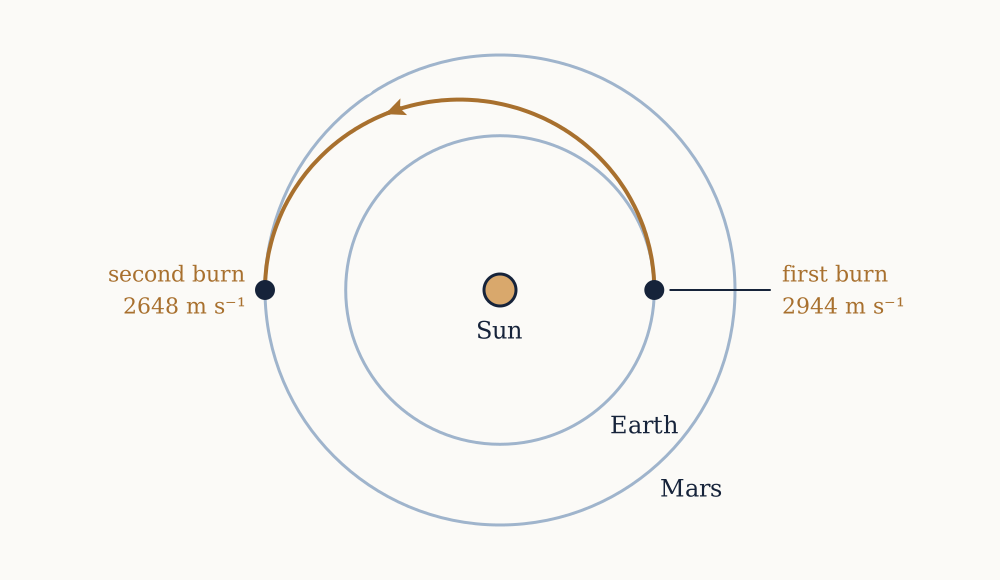
The cheapest transfer between two circular orbits, worked out by Walter Hohmann in 1925, is an ellipse touching both: fire once to raise the apoapsis to the target orbit, coast half an orbit, then fire again to circularise.
Take Earth to Mars, with orbital radii m and m about the Sun, for which m³ s⁻². The transfer ellipse has m. The Earth moves at m s⁻¹, while the transfer orbit needs m s⁻¹ at its perihelion, so the first burn is 2944 m s⁻¹. At the far end the ship arrives at m s⁻¹ while Mars is moving at 24135 m s⁻¹, so the second burn is 2648 m s⁻¹, and the total is 5592 m s⁻¹ on top of whatever it took to leave the Earth.
The trip takes half the period of the transfer ellipse, s, which is 259 days. Mars must be where the ship will arrive rather than where it is at launch, which is what confines launches to a window every 26 months.
Example. What velocity change is needed to go from a 408 km circular orbit to escape from the Earth entirely?
The circular speed there is 7668 m s⁻¹, and escape requires times that, since demands . So m s⁻¹ and the burn is m s⁻¹. Reaching low orbit from the ground costs about 9400 m s⁻¹, so the first stage of any journey uses three quarters of the velocity budget to get out of the atmosphere and up to orbital speed, and leaving the Earth from there is comparatively cheap.
Now you. What velocity change would take a satellite from a circular orbit of radius m to escape?
Answer
The circular speed is 7050 m s⁻¹ and escape needs m s⁻¹, so the burn is 2921 m s⁻¹.
Where Newton fails
Newtonian gravitation is the most successful theory in the history of science, and the way it failed is as instructive as the way it worked.
Its greatest triumph came from a discrepancy. Uranus, found in 1781, refused to follow its predicted path. Urbain Le Verrier and John Couch Adams independently assumed an unseen planet was pulling it and computed where that planet must be, and in September 1846 Johann Galle found Neptune within a degree of Le Verrier's position. A theory that predicts an entire planet from an error in a table has earned considerable trust.
Le Verrier then applied the same method to Mercury, whose perihelion advances. Of the observed 5600 arcseconds per century, about 5025 is the precession of the Earth's own equinoxes, a bookkeeping effect of the coordinate system, and about 532 is the pull of the other planets, chiefly Venus and Jupiter. That leaves 43 arcseconds per century unaccounted for: an angle of about one three-hundredth of a degree per century, and far larger than the observational error. Le Verrier proposed a planet inside Mercury's orbit, named it Vulcan, and it was never found.
The resolution came in November 1915, when Einstein computed the perihelion advance from general relativity and obtained 43 arcseconds per century with no adjustable parameters. Gravity is not a force but the curvature of spacetime, and the inverse square law is the weak field approximation to it. Newton's law is wrong in exactly the way a good approximation is wrong: it fails where the field is strong or the speeds are high, which is why Mercury, the innermost and fastest planet, shows it first.
The correction is not confined to astronomy. GPS satellites at a radius of m carry clocks that run fast by 45 microseconds a day from the weaker gravity and slow by 7 from their speed, a net 38 microseconds. Left uncorrected, that would put positions out by about 10 km after one day, so every receiver in every phone depends on a correction this course cannot derive.
What has been built
Fourteen lessons started from a function of time and its two derivatives, which contained no physics at all. Newton's laws supplied the missing input, forces were named one at a time, and integrating the second law over distance and over time produced two conserved quantities that solve problems the direct method cannot touch. Extending to many particles justified the point mass, rotation gave the motion about that point its own variables and its own conservation law, and every stable system turned out to oscillate. Finally one force law, inferred from Kepler and confirmed against the Moon, was solved completely.
That is enough to predict the motion of anything from a thrown stone to a spacecraft, which was the purpose. It is worth being exact about the boundaries. The scheme fails at speeds near light, where velocities stop adding; at atomic scales, where the trajectory itself stops being a meaningful notion; and in strong gravitational fields, where 43 arcseconds a century become the whole story. Inside those boundaries it is not merely a useful approximation but the working physics of every bridge, engine, satellite and machine ever built.