The rules of the previous lesson differentiate anything built from powers by algebra, and neither the sine nor an exponential is built that way, so each has to be taken back to the difference quotient.
What comes out is more interesting than a pair of formulas. The sine calculation only works in radians, and shows why. The exponential calculation produces a constant that depends on the base, and asking which base makes that constant equal to is where the number comes from, definitionally rather than as a decimal to memorise. This lesson assumes the unit circle definitions of sine and cosine and the exponential and logarithm laws from the earlier course.
Where the difference quotient leads
Apply the definition to . The numerator is , and the addition formula turns it into . Dividing by and grouping:
Both bracketed quotients are at , and neither factors or rationalises. Neither depends on , though, which is the important structural fact: two numbers settle the derivative of the sine at every point at once.
Numerically the two limits are not hard to guess. For , and . So the candidates are and , giving as the derivative of . Guessing is not proving, and the first of the two needs a genuine argument.
The squeeze that settles
Take between and and draw the unit circle. Mark the angle at the centre, and compare three regions: the triangle with vertices at the centre, at the point and at the point on the circle; the circular sector between the same two radii; and the triangle formed by extending the radius to meet the tangent line at .
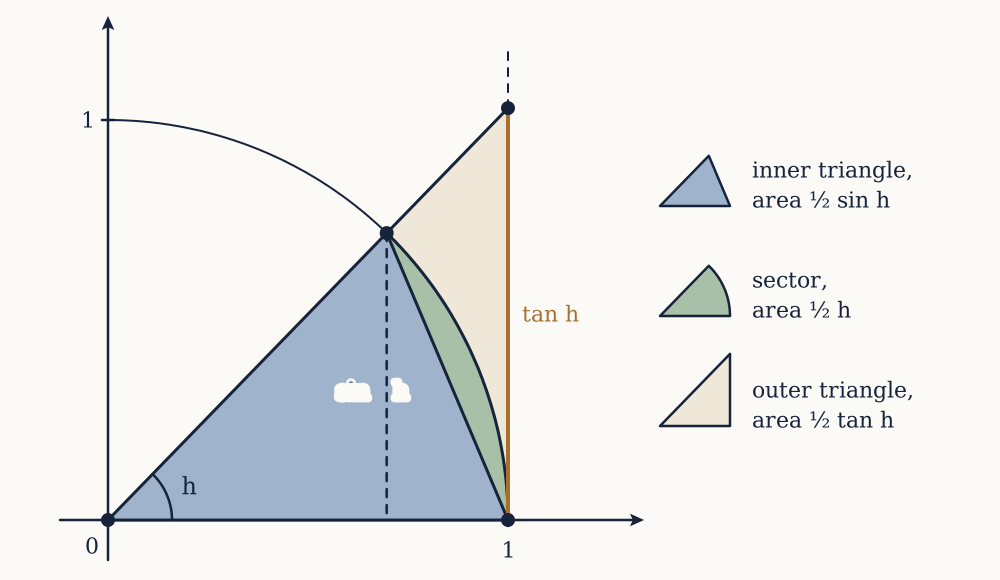
Each region contains the previous one, so their areas are ordered. The first triangle has base and height , so its area is . The sector is the fraction of the whole disc of area , so its area is : this is the step that requires to be measured in radians, since it is the radian measure that makes the arc length and the angle the same number. The outer triangle has base and height , so its area is . Therefore
Divide throughout by , which is positive, to get , and invert to get . As the left bound tends to because cosine is continuous, and the right bound is . The squeeze theorem from the limits lesson does the rest:
The same holds from the negative side, since both and change sign together and the quotient is unchanged.
The second limit now follows by the conjugate trick. Multiply above and below by : the numerator becomes , so the quotient is . The first factor tends to and the second to , so the limit is , confirming the numerical guess.
The radian requirement is not a formality. Measure angles in degrees and the sector area argument gives instead of , so the limit becomes and the derivative of the sine becomes . That constant would then infest every formula in physics and engineering that involves an oscillation. Radians are used in calculus because they are the units in which this constant is .
The derivatives of the trigonometric functions
Substituting the two limits into the grouped difference quotient gives, immediately,
with the second obtained the same way from the addition formula for cosine, and the minus sign coming from .
Differentiating repeatedly cycles with period four: sine goes to cosine, to minus sine, to minus cosine, and back. The consequence is that satisfies
and so does , and so does any combination . That equation is the mathematical content of simple harmonic motion: a mass on a spring obeys , so by Newton's second law its acceleration is proportional to minus its displacement, which is this equation with a constant attached. The reason pendulums, tuning forks, LC circuits and molecular vibrations all produce sinusoids is that they all satisfy it.
The other trigonometric functions follow from the quotient rule. For ,
which at equals , since the cosine there is . The derivative is never less than , matching the graph of the tangent, which rises everywhere and steepens without bound at the asymptotes.
Example. Differentiate and evaluate at .
The product rule gives . At the sine is and the cosine is , so the second term vanishes and the derivative is .
Now you. Differentiate and evaluate at .
Answer
The chain rule gives , which at is . The value is negative because radians is past the first quarter turn, where the sine is falling.
Where comes from
Now the exponential. For with , the difference quotient is
using only the index law . The factor is the original function, and the remaining quotient does not involve at all. So if that limit exists, it is some constant depending on the base alone, and
This is already a remarkable statement: an exponential is proportional to its own derivative, whatever the base. It is the reason exponentials describe every process whose rate of change is proportional to the amount present, from radioactive decay to compound interest to a population with unlimited food.
The constant is easy to estimate. For , the quotient at is ; for , it is . Neither is , and they straddle it, so somewhere between and there is a base for which the constant is exactly . Define to be that base. Then
and is, up to a constant multiple, the only function that is its own derivative. Its value is , and the earlier course reached the same number from compound interest as the limit of , which gives at and at . The two descriptions agree, and this one explains why the number keeps appearing: it is selected by a derivative condition, not chosen for convenience.
The constants for other bases are then identified by writing , so , and the chain rule gives
Compare the numbers: and , exactly the two quotients measured above. The mystery constant was the natural logarithm of the base all along.
The derivative of the logarithm
The logarithm can be done directly from the definition, using the limit that defines . For with ,
Write , which grows without bound as . The last two factors are , and the bracket tends to , whose logarithm is . So
This fills a hole left by the power rule. Differentiating gives , so the derivatives of powers produce every power except : to get it you would need , and that term differentiates to zero instead. The function whose derivative is is not a power at all, it is the logarithm, and that gap will reappear as the one exception in the integration rules later.
For other bases, , so the derivative is . Once again the natural base is the one with no stray constant.
Example. Differentiate and evaluate at .
The chain rule with inside gives . At that is . The derivative is negative everywhere, as it must be for a decaying quantity, and its magnitude is proportional to the value, which is the defining property of decay.
Now you. Differentiate and evaluate at .
Answer
The product rule gives , which at is .
Decay, and reading a rate off a curve
The formula is the whole of radioactive dating, and the numbers are worth doing once.
Carbon-14 has a half-life of years, meaning , so per year. A sample containing atoms of carbon-14 therefore decays at an initial rate of atoms per year, which is about decays per second. That rate is directly measurable in a counter, and since the rate is proportional to the amount remaining, counting decays measures the amount, which dates the sample. The derivative is not a theoretical adornment here: it is the quantity the instrument reads.
Example. Caffeine leaves the bloodstream with a half-life of about hours. For a mg dose, find the rate of elimination at and at hours.
The decay constant is per hour, and the amount is mg. The rate is . At that is mg per hour. At hours the amount has halved to mg, so the rate is mg per hour, exactly half. The elimination slows in proportion to what is left, which is why the tail of such a curve is so long.
Now you. A drug has a half-life of hours and an initial dose of mg. What is the elimination rate at , and how much remains after hours?
Answer
Here per hour, so the initial rate is mg per hour. After hours, three half-lives have passed, so mg remains.
The library, and what it still cannot do
Between the algebraic rules and this lesson, the standard functions are all differentiable by inspection: powers, roots, rational functions, sines and cosines and tangents, exponentials to any base, and logarithms to any base, in any combination assembled by sums, products, quotients and composition.
Two things are still out of reach, and they turn out to be the same thing. Inverse functions have no derivative formula yet: nothing above differentiates or , and the derivative of had to be extracted by a special argument rather than obtained from the exponential it inverts. And curves that are not graphs of functions, such as the circle , cannot be handled at all, because every technique so far assumes an explicit .
One idea fixes both, and it amounts to differentiating an equation rather than a function. That is the next lesson.