Rutherford's nuclear atom solved one problem and created a far worse one, because the picture it forces on us is one that classical physics says cannot exist for even a hundredth of a nanosecond.
The atom that should collapse
The nuclear atom leaves electrons outside a tiny positive core, and they cannot simply sit there: an electrostatic attraction with nothing opposing it would pull them straight in. The obvious repair is orbital motion, with the Coulomb attraction supplying the centripetal force exactly as gravity does for a planet. That is what Rutherford proposed, and what every textbook diagram still draws.
The trouble is that an electron is not a planet, because it carries charge, and Maxwell's electrodynamics is unambiguous on the point: an accelerating charge radiates. The Larmor formula gives the radiated power for a non-relativistic charge of acceleration as
and a body in circular motion is accelerating continuously, since its velocity is changing direction even at constant speed. An orbiting electron must therefore leak energy without pause.
Energy lost means a smaller orbit, a smaller orbit means larger acceleration, and larger acceleration means faster loss still, so the collapse runs away with itself. Integrating the Larmor result for an electron starting at a typical atomic radius of about pm gives a lifetime of roughly s, with a continuous smear of ever-rising frequency radiated on the way down. This is not a rough edge to be tidied up later. It is a falsification: classical physics, applied honestly to the atom that experiment had just revealed, says no atom survives ten picoseconds and matter cannot exist. Since matter conspicuously does exist, one of the assumptions feeding that calculation is wrong.
The light atoms emit
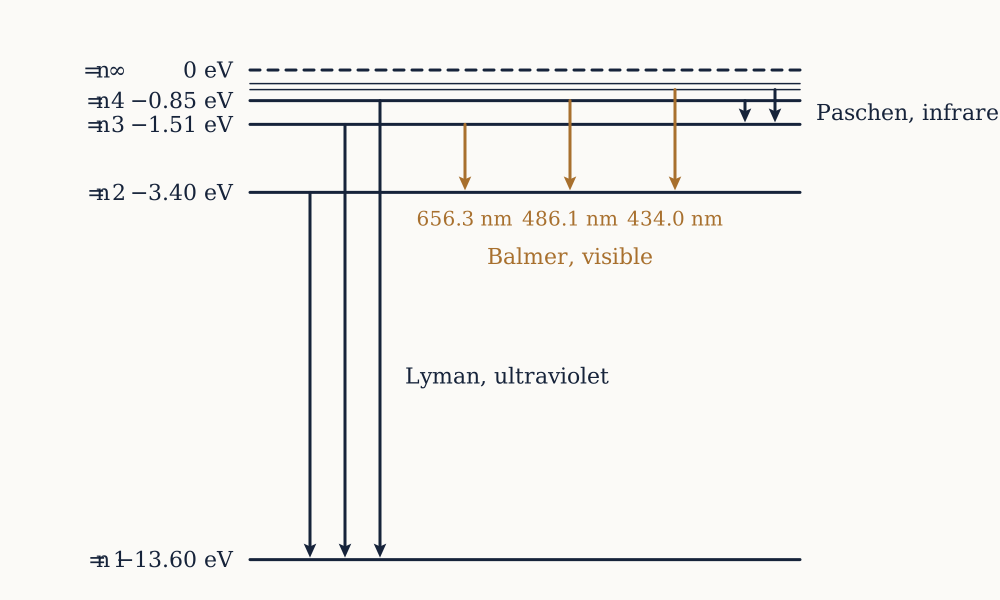
A second failure was already sitting in the laboratory, decades old and equally unexplained. Pass a discharge through a low-pressure gas and it glows; disperse that glow through a prism and you do not get the continuous rainbow a spiralling electron would produce. You get sharp, isolated lines at fixed wavelengths, and the pattern is a fingerprint of the element. Hydrogen gives a red line at nm, a blue-green one at nm, then violet lines crowding towards a limit.
In Johann Balmer, a Swiss schoolmaster with no theory in mind, found that those visible hydrogen wavelengths were fitted by a simple formula involving small integers. Johannes Rydberg generalised it to cover every hydrogen line, ultraviolet and infrared as well as visible:
where and are positive integers with , and m⁻¹. Setting recovers Balmer's visible series, gives the ultraviolet Lyman series, the infrared Paschen series.
The formula matches measured wavelengths to five or six significant figures. It was also, at the time, entirely unexplained. Nobody could say what was made of, why integers should appear at all, or why an atom would care about the difference of two reciprocal squares. Empirical numerology of this precision is a signpost: something deep is going on, and the theory that explains it will not be a small adjustment.
Bohr's quantum condition
In Niels Bohr took the two failures together and made a single radical assumption. Electrons, he proposed, may occupy only certain stationary states, orbits in which, by fiat, they do not radiate. Radiation happens only when an electron jumps between two of them, carrying away exactly the energy difference as one photon, . The rule picking out the allowed orbits is that angular momentum comes in whole multiples of :
Everything else is ordinary mechanics. Setting the Coulomb attraction equal to the centripetal force required for a circular orbit gives
Eliminating using and rearranging for the radius yields
Put and every symbol on the right is a measured constant, so the answer is a pure prediction with nothing fitted: pm. That is the Bohr radius , the size of a hydrogen atom, a quantity classical physics could not produce at all.
The energy follows just as directly. The kinetic energy is and the potential energy is , so the total is exactly half the potential energy, negative and therefore bound. Substituting gives
Take the difference between two levels, set it equal to , and the Rydberg formula falls out of the algebra with . Evaluate that combination of constants and you get m⁻¹. Balmer's schoolroom fit had been derived from first principles, and the ionisation energy of hydrogen, eV, came free with it.
What Bohr could not explain
The triumph was real and it was also narrow. Apply the same treatment to helium, with its two electrons, and it fails outright: the predicted spectrum is simply wrong, and no patching with elliptical orbits or relativistic corrections rescued it. A theory of the atom that works only for the one atom with a single electron is not yet a theory of the atom.
It was silent on other observables too. Spectral lines differ enormously in brightness, and the model offers no way to calculate the intensity of a transition, or to say why some occur readily and others hardly at all. Nor could it handle line splitting in magnetic fields beyond the crudest cases.
Deeper than either failure is the conceptual incoherence. Bohr uses classical mechanics to fix the orbits, then forbids classical electrodynamics from acting on them, with no principle deciding when each applies. The quantisation of angular momentum is asserted, not explained. And the electron is still a particle on a definite track at a definite radius, exactly the picture the following decade would destroy.
Matter waves
The missing principle arrived in in Louis de Broglie's doctoral thesis. Light had already been forced to be both wave and particle, with a photon of momentum carrying wavelength . De Broglie proposed that the symmetry runs both ways, so that any particle of momentum has a de Broglie wavelength
For a cricket ball the wavelength is around m and unobservable. For an electron in an atom it is comparable to the atom itself, so wave behaviour ought to dominate. Davisson and Germer confirmed it in by diffracting electrons off a nickel crystal.
The payoff is immediate. If the electron is a wave running round a circular orbit, the only stable arrangement is one where the wave joins smoothly onto itself after a complete circuit, a standing wave containing a whole number of wavelengths. That condition is , and substituting gives , which is . Bohr's arbitrary postulate is nothing more than the requirement that a wave fit round a loop.
The wavefunction and what it means
Erwin Schrödinger took the idea seriously enough to ask what equation such a wave obeys. His answer, in , plays for quantum mechanics the role Newton's second law plays for classical mechanics. For a single electron in the field of a nucleus, the time-independent form is
where is the Coulomb potential. This is an eigenvalue problem: for most values of the only solution that stays finite and vanishes at infinity is . Acceptable solutions exist only for a discrete set of energies, and for hydrogen those come out as . Quantisation is no longer postulated. It is what happens when you demand well-behaved solutions to a wave equation in a confining potential, just as a string fixed at both ends can sound only a discrete set of harmonics.
What remains is to say what , the wavefunction, actually is. Max Born supplied the answer: itself is not observable, but is a probability density, so is the probability of finding the electron in a small volume there. The electron is not smeared out as a substance; the theory simply does not assign it a trajectory, only a distribution of outcomes for a measurement of position. What replaces the orbit is the orbital, a one-electron wavefunction whose squared modulus says where that probability lies, and which has no edge, since decays exponentially without ever reaching zero.
Werner Heisenberg's uncertainty principle, , explains why nothing sharper is on offer. Confining an electron to a region the size of an atom forces a momentum spread large enough to make a definite orbit meaningless. Asking exactly where the electron is, and how fast it is going, is not a hard question awaiting better apparatus. It is a question the physics declines to answer.
The four quantum numbers
Solving the equation in spherical coordinates produces three integers automatically, one from each coordinate. The principal quantum number , taking values , fixes the energy in hydrogen and sets the overall size of the orbital. It is the same that appeared in Balmer's formula and Bohr's derivation.
The azimuthal quantum number controls the orbital angular momentum, whose magnitude is , and with it the shape of the orbital. It runs from to , and the values are labelled , , and for spectroscopic reasons. So permits only , while permits , and .
The magnetic quantum number fixes the component of angular momentum along a chosen axis, and therefore the orientation of the orbital in space. It takes the integer values from to , which is why there are three orbitals and five orbitals. Orientation affects energy only when an external field breaks the symmetry, which is what Zeeman splitting reveals.
The fourth label does not come from the equation at all. The spin quantum number takes the values and , and spin is an intrinsic angular momentum with no classical analogue and no relation to any spatial coordinate. It was forced on physics by the Stern-Gerlach experiment and by the doubling of spectral lines, and it completes the specification of an electron's state.
The shapes of orbitals
An orbital has , no angular momentum and no preferred direction, so it is spherically symmetric: depends on alone. The orbitals have one unit of angular momentum and a nodal plane through the nucleus, giving the familiar two-lobed dumbbell aligned along , or , with opposite algebraic sign in the two lobes, a detail that becomes essential for bonding. Four of the five orbitals have two nodal planes and the resulting four-lobed clover shape.
The nodes are where the physics shows through. A node is a surface on which vanishes, and the electron is never found there. Every orbital has in total: angular nodes, the planes or cones that carve out the lobes, and radial nodes, spherical shells where the wavefunction changes sign. A orbital therefore has two radial nodes and no angular ones, a sphere within a sphere within a sphere.
To ask how far the electron is from the nucleus you need the radial distribution function, , which weights the probability density by the surface area of a shell at radius . For hydrogen , is largest at the nucleus itself, yet there is almost no volume there. With the factor included, , and differentiating shows the maximum sits at , precisely the pm Bohr had calculated. The most probable distance survives; the definite orbit does not.
Every result here is exact, and that is its limitation. The Schrödinger equation has a closed-form solution for hydrogen because it is a two-body problem, one electron and one nucleus. Add a second electron and it repels the first, so the potential depends on both positions at once and no exact solution exists for helium or anything beyond it. Whether the language of orbitals and quantum numbers survives the move to the other ninety-odd elements, and what must be added to make it work, is the subject of the next lesson.