Hydrogen is the only atom whose Schrödinger equation can be solved exactly, and everything we know about the other ninety or so elements is built on approximations to that one clean result.
The problem with the second electron
The hydrogen solution worked because of a symmetry: one electron, one nucleus, a potential depending only on the separation . The equation splits into radial and angular parts and the energy depends on alone, so and come out exactly degenerate: costs nothing. Now write the Hamiltonian for electrons around a nucleus of charge :
The first sum is harmless: every term refers to a single electron, so it separates into hydrogen-like problems. The second, the electron-electron repulsion, ruins everything. The distance between two electrons cannot be split into a piece belonging to electron and a piece belonging to electron , so the variables will not separate and the equation has to be solved whole. This is not a failure of ingenuity: helium simply has no closed-form solution.
Chemistry uses the orbital approximation instead. Pretend each electron moves not in the jittering field of individual neighbours but in the smooth averaged field of the nucleus plus the smeared-out cloud of the others. The problem becomes one-electron problems, solved self-consistently, and we keep the hydrogen labels and can still speak of an electron as being in an orbital. What we lose is that the energies no longer depend on alone.
Spin and the exclusion principle
The previous lesson introduced a fourth quantum number with no classical counterpart. Spin is an intrinsic angular momentum carried by the electron itself, quantised so that or and nothing else. It is not a rotating ball, a picture that fails on dimensional grounds, but it is measurable: a beam of silver atoms in an inhomogeneous magnetic field splits into exactly two.
The Pauli exclusion principle states that no two electrons in an atom may share all four quantum numbers , , and . Its deeper form is that the total wavefunction must change sign when any two electrons are exchanged. It is not a force, and no energy is transferred when it operates. It restricts which states can exist at all, and it is the reason matter takes up space.
The counting follows. For a given , runs from to ; each has values of ; each spatial orbital takes two electrons of opposite spin. A subshell therefore holds electrons, two for and six for , ten for , fourteen for , and over a whole shell,
which gives 2, 8, 18 and 32. These capacities are not fitted to the periodic table: they follow from counting and symmetry, and the table has to live with them.
Shielding and the effective nuclear charge
In the orbital approximation an outer electron never feels the bare nuclear charge, because the inner electrons stand between it and the nucleus and cancel part of it. The bookkeeping device is the effective nuclear charge , where the shielding constant counts the units of charge cancelled. Gauss's law gives the intuition: charge lying inside radius acts as though it sat at the centre, and charge outside contributes nothing.
Sodium's outer electron would see if shielding were perfect. It does not, because orbitals overlap. Slater's rules estimate crudely: for an or electron of shell , each other electron in that shell contributes , each electron in shell contributes , and each deeper one a full . For sodium's valence electron in that gives , so . Put into eV that predicts eV against a measured eV: the right scale, the wrong detail.
The trends matter more than the values. Across the second period each added proton is only partly offset by the added electron, since same-shell shielding is worth a mere of a unit:
| Element | |||
|---|---|---|---|
| Li | 3 | 1.70 | 1.30 |
| Be | 4 | 2.05 | 1.95 |
| B | 5 | 2.40 | 2.60 |
| C | 6 | 2.75 | 3.25 |
| N | 7 | 3.10 | 3.90 |
| O | 8 | 3.45 | 4.55 |
| F | 9 | 3.80 | 5.20 |
| Ne | 10 | 4.15 | 5.85 |
Neon's valence electrons feel an effective charge four and a half times lithium's, which is why atoms shrink and grow harder to ionise from left to right.
Penetration and the end of the degeneracy
Shielding also breaks the hydrogen degeneracy, through penetration: the extent to which an orbital places density inside the region occupied by the core. In hydrogen and are identical in energy. In lithium lies about eV below , which is why the ground state is . Nothing about the nucleus distinguishes those two orbitals. The other two electrons do.
To see why, use the radial distribution function , the probability of finding the electron in a thin shell between and . It matters more than the wavefunction because it weights density by the volume available at each radius. An orbital has radial nodes, so has one and none, and that node gives a small subsidiary lobe at short range while rises smoothly to a single maximum.
Lithium's density peaks at a fraction of the Bohr radius. The inner lobe of overlaps it; is essentially absent there. A electron therefore spends part of its time inside the core, unscreened, feeling nearly the full . That fraction is small, but the potential there is enormously deep, so the average comes out decisively lower.
Hence the rule that governs everything from here: within a shell the ordering is . Higher brings fewer radial nodes and a larger centrifugal term in the effective radial potential, a barrier pushing the electron out. High- orbitals cannot get in, are screened efficiently and lie high; low- orbitals sneak in, feel more of the nucleus and lie low.
Building up the ground state
The aufbau principle builds a ground state by adding electrons one at a time to the lowest orbital Pauli still allows, in the order given by the rule: increasing , with ties broken by the lower . That yields , , , , , , , , , , , , .
The famous case is before , since is for one and for the other, and the physics behind the arithmetic is penetration. Three radial nodes give inner lobes reaching deep into the argon core, where they are barely shielded. The orbital is compact, its main density closer in, but it has no inner lobes and the centrifugal barrier keeps it out of the core. Screened by eighteen electrons and penetrating none of them, sits above in potassium and calcium.
Hund's rule of maximum multiplicity settles the case where a subshell offers several orbitals of equal energy: the ground state is the one with the greatest number of unpaired parallel spins. Carbon puts its two electrons in different orbitals with parallel spins rather than pairing them, nitrogen has three unpaired, and only at oxygen does pairing begin.
The reason usually given, that separated electrons repel less, is the less interesting half of it. The real mechanism is exchange energy, a purely quantum effect. Antisymmetry requires that two electrons with parallel spins have an antisymmetric spatial function, and such a function vanishes when their positions coincide, so parallel electrons carry a built-in Fermi hole and keep apart by symmetry rather than by force. The stabilisation scales with the number of parallel pairs, : three for nitrogen's , ten for manganese's .
Configurations, and the awkwardness of the d block
Writing a configuration is now mechanical. Phosphorus is , with three unpaired electrons by Hund's rule. Noble-gas shorthand replaces a completed core with the preceding noble gas, so that becomes , sodium is and bromine . Iron is : fill , then start on .
Here is the subtlety that catches everyone. Although fills first, its electrons are the first to leave on ionisation. Fe²⁺ is , with emptied and the population untouched, and every first-row transition metal behaves the same way. How can an orbital be filled first and emptied first?
Because orbital energies are not fixed properties of a shell. They depend on the nuclear charge and on which orbitals are already occupied. As rises across the d block the poorly shielded orbitals contract and fall, so by scandium already lies below in the neutral atom. The atom keeps two electrons in anyway, because what is minimised is the total energy rather than the sum of orbital energies, and those contracted orbitals are compact enough that filling them costs a heavy repulsion penalty. Ionise, and you take the outermost and least tightly bound electron, which is .
Chromium and copper break the pattern outright, coming out as and . The usual explanation, that half-filled and filled shells are especially stable, is a mnemonic dressing up the exchange argument, not a law. Here and lie within a fraction of an electronvolt of each other, so the outcome turns on small quantities: the cost of pairing in a compact orbital, the exchange stabilisation of parallel spins, and - repulsion. How narrowly it tips shows in the elements that ignore it. Niobium is , palladium with an empty , and tungsten reverts to despite sitting directly below chromium and molybdenum.
The evidence: successive ionisation energies
All of this is a model, and models need testing. The cleanest test is to strip an atom of its electrons one at a time. The th successive ionisation energy detaches the th electron from the -fold charged ion, so the sequence reads out directly how the electrons were organised.
Take sodium. In kilojoules per mole its eleven values are , then , , , , , , , , and finally and . The first electron leaves for a modest price; the second costs more than nine times as much. Seven further removals raise the price steadily but never abruptly, until the tenth demands almost five times the ninth. The groupings run one, eight, two: the electron, the shell, the pair, with sizes exactly the capacities Pauli demands.
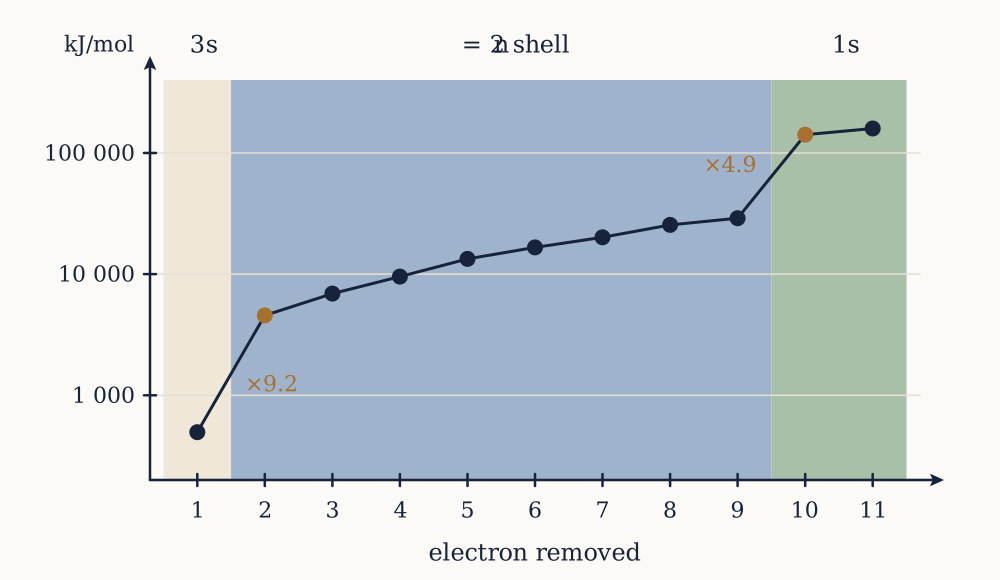
The size of the jumps is as telling as their position. Within a shell, each removal leaves the rest at roughly the same radius while raising by a little under a unit, so the cost climbs smoothly. Breaking into a new shell means reaching an electron at a far smaller radius held by a much larger effective charge, and the energy leaps by a factor of five to ten. Magnesium says the same in a different signature: and , then .
We now have a procedure that takes an atomic number and returns a configuration, with a physical account of why that one and not another. The next lesson lays those configurations out in order of and finds that the periodic table, discovered decades before any of this theory existed, is the aufbau sequence written on a grid.