Sign in

Libre University uses your GitHub account. Signing in is only needed to sit a final test, so the score is kept on your profile.

Thermodynamics

The four laws that govern energy: what heat and work are, why energy is conserved but not freely reusable, and what entropy counts.

Systems, states and equilibrium

Thermodynamics is unusual among physical theories in that almost all of its difficulty is in the bookkeeping: deciding what you are talking about, what counts as a property of it, and when a number written down about it means anything at all.

The subject grew out of a practical question: steam engines worked, and nobody could say what limited them. Sadi Carnot's Reflections on the Motive Power of Fire of 1824 attacked that, and the theory that came out of it governs chemical reactions, refrigerators, stars and the direction of time. It only works if the words are used precisely, so this lesson is about the words, and none will be restated later.

System, surroundings and boundary

A system is whatever region of matter or space you have decided to analyse. The surroundings are everything else, and the boundary is the surface separating them. The boundary is a choice, not an object: it can follow a fixed lump of matter or sit still while matter flows through it, and it can be real (a cylinder wall) or imaginary (a surface across a turbine inlet). Choosing it well is most of the skill in a problem, because every term you write is a flow across that surface or a change inside it.

Systems are classified by what the boundary lets through. A closed system exchanges energy but no matter, so its mass is fixed: a sealed can of soup heating in a pan, where heat crosses the tin and nothing else does. An open system, or control volume, exchanges both: a kettle with the lid off, losing steam from the top while the element pushes energy in at the bottom, its mass visibly falling. An isolated system exchanges neither, which a vacuum flask approximates over an afternoon, its silvered double wall cutting conduction, convection and radiation until the coffee cools by a degree an hour rather than in minutes.

Isolation is always an approximation, and the honest statement is about a timescale: the flask leaks, just slowly compared with the hour you care about. What the subject does not tolerate is silence about which system you meant, since half the wrong answers in it come from quietly changing the system halfway through a calculation.

Example. A pressure cooker is heating on a stove with its valve rattling and releasing steam. Taking the contents as the system, is it open, closed or isolated?

Open. Energy crosses the boundary as heat from the stove, and matter crosses it too: every rattle of the valve lets steam out, so the mass inside is falling. Before the valve first lifts, the same cooker is a closed system, which is a reminder that the classification belongs to the boundary's behaviour during the interval you are analysing, not to the pot.

Now you. A sealed can of fizzy drink chills in a refrigerator overnight. Taking the drink and its headspace gas as the system, is it open, closed or isolated?

Answer

Closed. Energy leaves through the aluminium as heat, so it is not isolated, but the can is sealed and no matter crosses the boundary: the mass is fixed. Gas moving between the drink and the headspace stays inside the system, so it does not change the classification.

Properties, extensive and intensive

A property is any characteristic to which a value can be assigned when the system is settled: pressure, volume, temperature, mass, energy. An extensive property scales with the amount of stuff, so cutting the system in half halves volume, mass and energy. An intensive property does not: pressure, temperature and density are unchanged, because each half already had them. The test is exactly that, an imaginary partition and a look at which numbers survive.

The ratio of two extensive properties is therefore always intensive: if both halve when the system halves, their quotient is untouched. This is why specific properties, meaning per unit mass, are the working currency of the subject. Specific volume v=V/m is intensive, and so is its reciprocal, density ρ=m/V. Working in them lets you solve a problem once for a kilogram and apply it to any quantity, which is why property tables are printed per kilogram.

For air as an ideal gas, pv=RT with R=287 J kg⁻¹ K⁻¹. At 101.325 kPa and 20 degrees Celsius, which is 293.15 K,

v=287×293.15101325=0.830m3kg-1

giving ρ=1/v=1.20 kg m⁻³, the familiar density of air. The same 0.830 holds for a gram of air in a syringe and for the tonne of it in a room, which is the point of dividing by mass.

Example. Air in a compressed-air line sits at 200 kPa absolute and 350 K. What are its specific volume and density?

From pv=RT, v=287×350/200000=0.502 m³ kg⁻¹, and ρ=1/v=1.99 kg m⁻³. Doubling the pressure from atmospheric has roughly doubled the density, moderated a little by the higher temperature.

Now you. Air outside an aircraft cruises past at 80 kPa absolute and 250 K. What are its specific volume and density?

Answer

v=287×250/80000=0.897 m³ kg⁻¹, so ρ=1/v=1.11 kg m⁻³.

State, and the state postulate

The state of a system is the complete set of values of its properties at a moment. Two systems in the same state are thermodynamically interchangeable, whatever their histories. That would be useless if you had to measure every property, and the state postulate says you do not: for a simple compressible system the state is fixed by two independent intensive properties. Both qualifiers carry weight. Simple compressible means the only work mode available is compression or expansion, so surface tension, magnetisation, polarisation and elastic stress are absent or negligible. Each extra work mode adds one more property you must specify: a stretched rubber sheet needs its area, a magnetic salt needs the field. The count is one per independent way of doing work, plus one.

Independent is the trickier word. Two properties are independent when one can be varied while the other is held fixed. Pressure and temperature are independent for steam at 200 degrees Celsius and 1 bar. They are emphatically not independent for boiling water at 100 degrees Celsius, because at that temperature the pressure of a liquid and its vapour in contact is pinned at 101.325 kPa. Quoting both tells you nothing about how much of the sample is liquid and how much steam, so the pair fails to fix the state. That is no edge case: it is the region every power station and refrigerator operates in, and a later lesson introduces a new property, quality, to repair it.

So the states of a simple compressible substance form a two-dimensional surface, and any two independent coordinates can draw it. Every diagram in this course is a projection of that surface.

Equilibrium, and why the theory needs it

Every property named so far assumes a single value exists to be named. Ask for the pressure of a gas just struck by a shock wave and there is no answer: it is 3 bar at one end and 1 bar at the other. A bar with a blowtorch on one end has no temperature, only a temperature field. Equilibrium is the condition in which a system has no unbalanced driving force inside it, so that a single value of each intensive property describes the whole of it.

It comes in kinds, and full equilibrium means all at once. Mechanical equilibrium means no pressure imbalance, so nothing is accelerating or moving a boundary. Thermal equilibrium means no temperature difference, so no heat flows internally. Chemical equilibrium means the composition has stopped changing, with no reaction or diffusion running, and phase equilibrium is the case where the amounts of liquid and vapour have stopped shifting. A system can sit in one and not the others: a warm cup of water is in mechanical equilibrium while its temperature gradients are still relaxing.

Here is the awkwardness at the centre of the subject. Classical thermodynamics defines its properties only for equilibrium states, and every process worth studying is a departure from equilibrium. A gas expands because its pressure exceeds the load on the piston; heat flows because a temperature difference exists. Remove the imbalance and nothing happens. So the theory describes exactly the situations in which nothing is happening, and is asked about the ones in which something is.

The escape is care about what is claimed. Where a process starts and ends in equilibrium, quantities depending only on the endpoints can be computed exactly however violent the middle was: the energy change of an exploding gas is well defined even though its pressure during the explosion is not. For quantities that do depend on the middle, an idealisation is needed.

Quasi-static and reversible processes

A process is any change of state, and the states it passes through are its path. A quasi-static process is carried out so slowly that the system is never measurably far from equilibrium: at every instant it has one pressure and one temperature, so the path is a continuous line on the state surface and can be drawn. The image is compressing a gas by laying grains of sand on the piston one at a time. Slam the piston down instead and the gas near the face is compressed before the far end knows anything has happened, so no single state exists during the transit and there is no line to draw.

Reversible is stronger: a reversible process can be run backwards so that system and surroundings both return exactly to their original states, leaving no trace anywhere. Quasi-static is necessary but not sufficient, because dissipation can still occur. Slide the piston slowly against friction and every state is well defined, yet the frictional heat cannot be gathered up and turned back into the work that made it. Reversibility requires a process that is quasi-static and free of friction, unrestrained expansion, mixing, and heat flow across any finite temperature difference.

No real process meets that standard. Heat flow needs a temperature difference to drive it, so a reversible heat transfer takes infinite time; friction is never zero; every real expansion is somewhat unrestrained. Reversibility is unattainable in the strict sense in which a frictionless plane is unattainable.

It is nevertheless the most valuable idea in the subject, for a reason that becomes a theorem later in the course: reversible processes bound the real ones. The reversible route between two states delivers the most work a real route could deliver and demands the least it could require, so it sets a target no engineering can beat. A steam plant achieving 42% thermal efficiency means little in isolation; measured against the reversible limit for its temperatures it becomes a judgement.

State functions and path functions

Here is the idea that structures everything after it: some quantities depend only on the state a system is in, and some depend on how it got there.

Pressure, volume, temperature, internal energy and entropy are state functions, also called point functions. Their change over a process is the end value minus the start value, ΔV=V2-V1, and nothing about the route survives, so around any complete cycle the change of a state function is exactly zero. Work and heat are path functions. They are not properties at all: a system does not contain work or heat. They are modes of energy transfer that exist only during a process, and their size depends on the route. This is why the increments are written δW and δQ rather than dW and dQ: the differential is inexact, and there is no function W to differentiate.

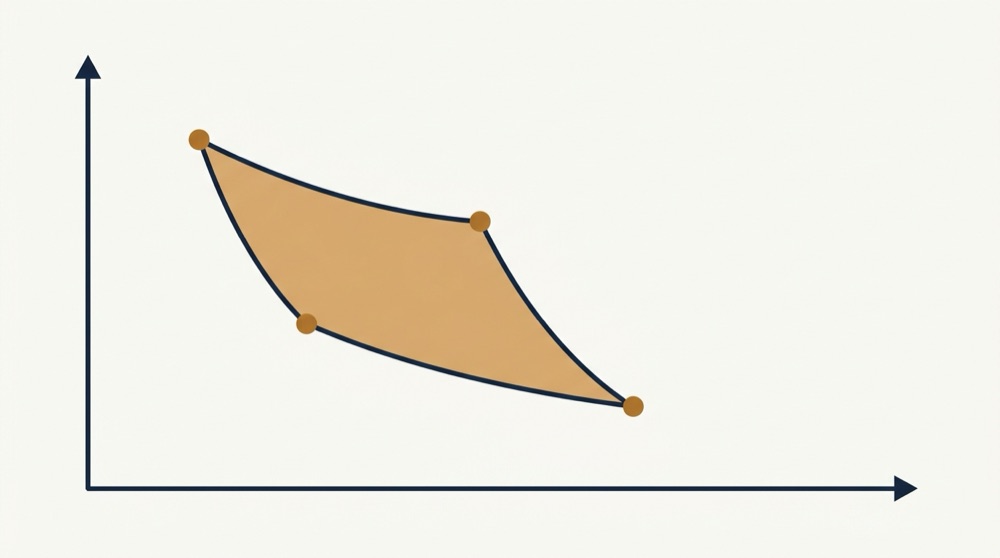
The pressure-volume plane makes it visible. For a quasi-static expansion the work done by the system is δW=pdV, so the total is pdV, the area under the path. Two paths from the same state 1 to the same state 2 enclose an area between them, and that area is exactly the difference in the work.
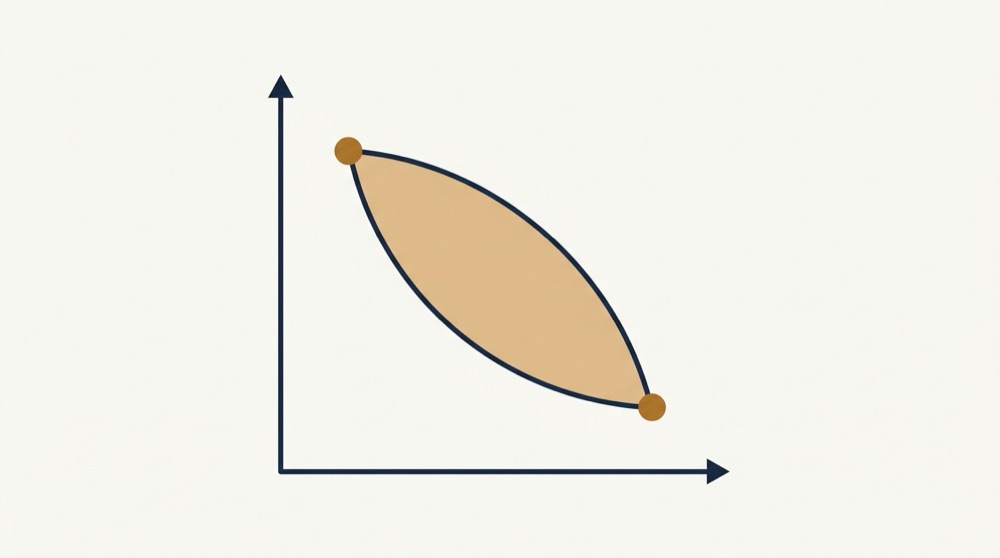
Two different paths between the same two states on a pressure-volume diagram, one running along a high-pressure route and one along a low-pressure route, with the area between them shaded to show that the work differs even though the start and end states are identical.

Put numbers on it. Take state 1 at p1=200 kPa, V1=0.020 m³ and state 2 at p2=100 kPa, V2=0.040 m³. Path A expands at constant 200 kPa to 0.040 m³, then drops the pressure at fixed volume, which does no work since dV=0: its work is 200×103×0.020=4000 J. Path B drops the pressure first, then expands at constant 100 kPa, giving 100×103×0.020=2000 J. Same start, same end, 4 kJ against 2 kJ. The difference is the rectangle the paths enclose, (200-100)×103×(0.040-0.020)=2000 J, as it must be. Meanwhile ΔV is 0.020 m³ on both routes, because volume is a state function and does not care.

The whole of engine design lives in that gap. A cycle returns to its starting state, so every state function returns to its original value and the net work is the area enclosed by the loop on the p-V diagram. An engine is a device for going out along a high-pressure path and back along a low-pressure one.

Getting the numbers right

Most errors in thermodynamics are unit errors rather than conceptual ones. The SI base quantities in play are the kilogram, metre, second and kelvin. Force is derived: one newton accelerates one kilogram at one metre per second squared. One pascal is one newton per square metre, which is very small, so kPa, bar (105 Pa) and MPa are the practical units. Energy is the joule, one newton metre.

The mass and force distinction is the classic trap. A kilogram is an amount of matter; its weight is a force, F=mg, and depends on where it is. A 70 kg person weighs 70×9.807=686 N on Earth and 114 N on the Moon while remaining 70 kg. Bathroom scales report mass by silently assuming Earth's gravity, and the pound-mass and pound-force of imperial practice differ by the factor g, the confusion that destroyed the Mars Climate Orbiter in 1999.

The second trap is the pressure datum. Most gauges measure the difference from local atmospheric pressure, so they read gauge pressure: pabs=pgauge+patm, and a tyre at 2.2 bar gauge holds 3.2 bar absolute. Every equation of state in this course, pv=RT included, needs absolute pressure. A vacuum gauge reads the other way, pabs=patm-pvac.

A worked case ties it together. A vertical cylinder is closed by a freely sliding piston of mass 50 kg and face area 0.010 m², roughly 113 mm across, with atmospheric pressure 101.325 kPa above it. The piston is not accelerating, so mechanical equilibrium fixes the gas pressure: the upward force from the gas balances the piston's weight plus the atmosphere pushing down. The weight is 50×9.807=490.4 N, and spread over 0.010 m² that is 49040 Pa, or 49.04 kPa. So the absolute pressure is 101.325+49.04=150.4 kPa, and a gauge on the cylinder would read 49.0 kPa. It does not depend on how much gas is under the piston or how hot it is: heat the gas and it expands at constant pressure, because the piston's weight and the atmosphere are unchanged. Constant-pressure processes in this course almost always arise this way.

Example. A heavier arrangement uses a piston of mass 120 kg on a face area of 0.020 m², with the same 101.325 kPa atmosphere above. What absolute pressure does the trapped gas hold, and what does a gauge on the cylinder read?

The weight is 120×9.807=1176.8 N, and spread over 0.020 m² that is 58842 Pa, or 58.84 kPa. The absolute pressure is 101.325+58.84=160.2 kPa, and the gauge reads the difference from atmospheric, 58.8 kPa.

Now you. A piston of mass 25 kg slides freely in a cylinder of face area 0.0080 m², atmosphere at 101.325 kPa above it. Find the absolute pressure of the gas and the gauge reading.

Answer

Weight 25×9.807=245.2 N, over 0.0080 m² gives 30647 Pa, or 30.65 kPa. Absolute pressure 101.325+30.65=132.0 kPa, gauge reading 30.6 kPa.

Two independent intensive properties now fix that gas completely, and one of them, temperature, has been used throughout this lesson as though everybody knows what it means. Making it a measurable property rather than a sensation is the business of the next lesson.
Temperature and the Zeroth Law

Temperature feels like the most obvious quantity in physics and is one of the hardest to define honestly, because the thing everyone starts from, the feeling of hot and cold, turns out not to measure anything.

Hot and cold are sensations

The previous lesson described a system by its state variables: pressure, volume, composition, each with an operational definition anyone can carry out with a ruler or a balance. Temperature is different. The usual first definition, that a hot thing is one that feels hot, collapses under a demonstration that takes two minutes and a kitchen.

Fill three bowls: one at about 40 °C, one of iced water near 5 °C, one tepid at 22 °C. Put your left hand in the hot bowl and your right in the cold one, wait half a minute, then plunge both into the tepid bowl. The same water, at one temperature, feels cold to the left hand and hot to the right. John Locke described the experiment in 1690, and it is decisive: two answers about a single body means the hands are not measuring a property of that body alone.

What the skin responds to is the rate at which heat crosses it, which depends on the size and direction of the temperature difference and on how fast the material conducts. This is why, at 20 °C, a steel bench feels colder than a wooden one that has sat beside it all night: steel draws heat from a finger perhaps four hundred times faster, so the nerve endings cool faster and report "colder", while a thermometer laid on each reads the same. Sensation gives an ordering that is subjective and confounded with conductivity. If temperature is to be a state variable, it has to be built from something more robust: a single experimental fact about how systems left in contact behave.

Thermal equilibrium and the walls that allow it

Take two systems, each separately in equilibrium, and put them in contact through a rigid wall that lets nothing pass but allows their states to influence each other. In general something happens: the pressure of a sealed gas on one side drifts, the resistance of a wire on the other drifts, and after a while the drifting stops and nothing further changes, however long you wait. The two systems are then in thermal equilibrium.

A wall that permits this interaction is diathermal: a thin sheet of copper is close to ideal. A wall that prevents it, so each system keeps its state indefinitely, is adiabatic: a good vacuum flask approximates one. No real wall is perfectly adiabatic, since a flask eventually lets its contents reach room temperature, so it is a limit approached rather than reached, and every argument built on it inherits that caveat.

Thermal equilibrium is defined by an observation, that changes cease, and needs no prior notion of temperature or of heat. It is a relation between two systems, written AB, and so far nothing more. Two of its properties are trivial: any system is in equilibrium with itself, and if AB then BA, so the relation is reflexive and symmetric by construction. The third is neither trivial nor guaranteed by logic: whether it is transitive is a question about the physical world, to be settled by experiment.

The Zeroth Law

Experiment settles it. If A is in thermal equilibrium with C, and B is separately in thermal equilibrium with the same C, then bringing A and B into diathermal contact produces no change at all. This is the Zeroth Law of Thermodynamics, a statement of transitivity.

A relation that is reflexive, symmetric and transitive is an equivalence relation, and an equivalence relation partitions the set it acts on into disjoint classes. Every system falls into exactly one class, whose members are in thermal equilibrium with each other and with nothing outside it. Attach a label to each class, any label, and the rule follows: two systems are in thermal equilibrium if and only if they carry the same label. That label is what a temperature is. The numbers, the degrees, the scale, all of it is bookkeeping laid on top of a class label.

This is what licenses a thermometer to exist. A thermometer is the system C above, small enough to disturb what it touches very little and carrying an easily read property that shifts when its class does. Without transitivity it would be useless: that a mercury column matched a bath yesterday and a furnace today would say nothing about the bath and the furnace. The Zeroth Law is the permission to compare two bodies without ever putting them in contact.

Example. A mercury thermometer left in bath A settles and reads 20.0 °C. Moved to bath B, it settles at the same 20.0 °C. The baths are then connected through a thin copper sheet. What happens, and which principle guarantees it?

Nothing drifts. Each bath was in thermal equilibrium with the same system C, the thermometer, so by the Zeroth Law the two baths are in thermal equilibrium with each other: they carry the same class label, and diathermal contact between members of one class produces no change. Without transitivity the two matching readings would license no prediction at all.

Now you. A platinum wire is lowered into bath X and its resistance settles at 108.3 Ω. In bath Y it settles at 108.3 Ω again. The baths are brought into diathermal contact. What happens, and why?

Answer

Nothing changes. The wire is the shared system C: both baths are in thermal equilibrium with it, so by the Zeroth Law they are in thermal equilibrium with each other, and contact between systems in the same equivalence class leaves every state variable where it was.

The name is an accident of history. The first, second and third laws were formulated and numbered through the nineteenth century and into the early twentieth, by which time it was noticed that all three quietly assumed a prior principle nobody had stated. Ralph Fowler named it in the 1930s, and since the numbering was settled, the law that logically precedes the rest got the only number left.

Empirical scales disagree with each other

The Zeroth Law says a temperature exists. It says nothing about how to number the classes, and the obvious method is less innocent than it looks. Pick a property varying monotonically with hotness, mercury in a capillary, say; mark the column at the ice and steam points at one standard atmosphere; call those 0 and 100; divide the space between into a hundred equal parts. Anders Celsius did something of this kind in 1742.

The choice buried in that recipe is the word "equal". Nothing in nature says the temperature interval between two marks is proportional to the length of glass tube between them. Declaring it so defines a scale rather than discovering one, in terms of the expansion of one particular liquid. The consequence appears with the second thermometer. An alcohol thermometer, a platinum resistance wire and a mercury thermometer all read 0 and 100 at the fixed points, because they are forced to. Put all three in the same bath in between and they disagree: mercury and platinum by a few tenths of a degree mid-range, and alcohol, whose expansion is markedly more curved, further still. Each is reproducible; they simply order the classes with different numbers.

So an empirical temperature is a property of the instrument, not of the system measured. To say a bath is at 50 °C is incomplete unless you say by which thermometer, which is intolerable for a quantity meant to appear in the laws of physics. One scale has to be selected as the real one, on grounds that mention no particular substance.

The gas thermometer and the disappearance of the substance

Gases offer the first way out. Take a fixed quantity of gas in a rigid bulb, connect it to a manometer, and use its pressure as the thermometric property, holding the volume constant with a mercury reservoir. This is a constant-volume gas thermometer: slow, bulky, awkward, and possessed of one virtue nothing else has.

Fill it with nitrogen, calibrate at the ice and steam points, and measure a bath. Refill with oxygen or hydrogen or helium, recalibrate, and measure the same bath: the readings differ, though by much less than mercury and alcohol did. Now repeat with less gas in the bulb, so the ice point pressure is halved, and halved again. The disagreements shrink each time, roughly in proportion to the gas left, and extrapolating to vanishing pressure they disappear altogether. What makes gases differ is the interaction between their molecules, and interactions become negligible as the molecules are moved apart. The scale defined by that limit belongs to no substance in particular, which is exactly what an empirical scale could not manage.

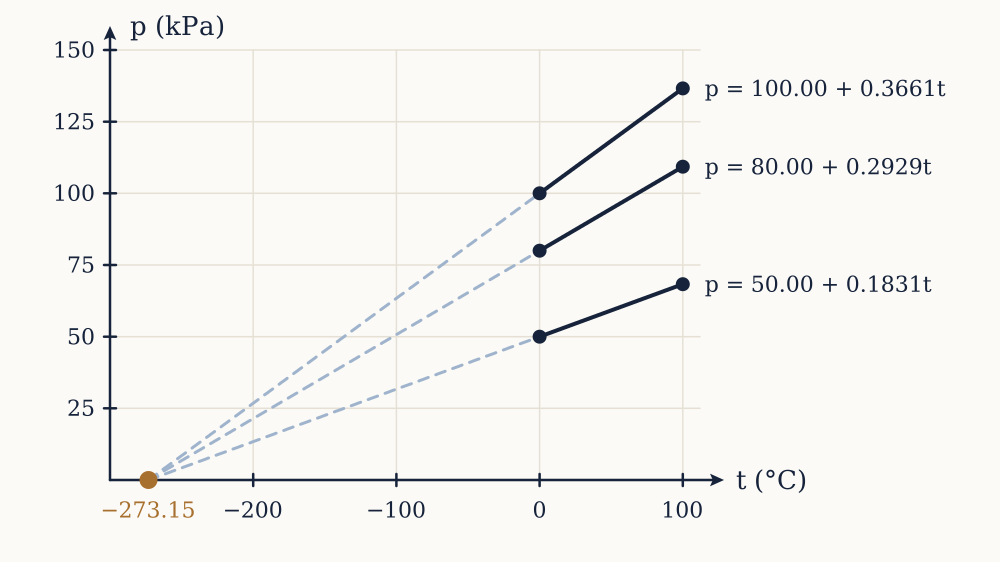
The same limit does something else besides. Plot the pressure of a dilute gas at constant volume against Celsius temperature and the points lie on a straight line. Extend it backwards and it crosses zero pressure at a definite temperature, the same for every gas. That intercept is not a temperature anything has been cooled to; it is where a strictly linear law would run out of pressure.

Working out where the line crosses zero

Guillaume Amontons noticed the effect around 1702; the modern number follows from one measured ratio. For a dilute gas at constant volume, the steam point pressure divided by the ice point pressure is

psteampice=1.3661

Suppose the bulb is charged so that pice=100.00 kPa exactly. The steam point pressure is then 1.3661×100.00=136.61 kPa. Two points fix the line, so the slope in pressure per Celsius degree is

136.61-100.00100.00-0.00=36.61100.00=0.3661kPa per °C

The line through those points is p=100.00+0.3661t, with p in kilopascals and t in degrees Celsius. Set p=0 and solve for t:

t0=-100.000.3661=-273.15°C

The division gives 273.1494, which rounds to 273.15. The assumed 100 kPa never mattered, since only the ratio enters: t0=-100/(1.3661-1). Doubling the charge of gas doubles both pressures and leaves the intercept where it was, which is the sign that it belongs to the scale rather than to the apparatus.

Example. A constant-volume gas thermometer is charged so that it reads pice=80.00 kPa at the ice point and psteam=109.29 kPa at the steam point. Where does its straight line cross zero pressure?

The slope is (109.29-80.00)/100.00=0.2929 kPa per °C, so the line is p=80.00+0.2929t. Setting p=0 gives t0=-80.00/0.2929=-273.1 °C, the same intercept the 100 kPa charge gave, as it must be.

Now you. The bulb is partly evacuated so that pice=50.00 kPa, and the steam point then reads 68.31 kPa. Find the slope of the line and the temperature at which it crosses zero pressure.

Answer

Slope =(68.31-50.00)/100.00=0.1831 kPa per °C, so t0=-50.00/0.1831=-273.1 °C. Halving the charge halves both pressures and the slope together, and the intercept stays put.

Shift the origin to that intercept and every dilute gas obeys pT with T=t+273.15, which defines the ideal gas temperature, measured in kelvins. Be blunt about what has not been shown: the linear law is exact only in the extrapolated limit, and a real gas liquefies long before its pressure reaches zero. Helium, the last to give up, condenses at 4.22 K under one atmosphere. The straight line is honest arithmetic about a limit, not a description of any gas near the intercept.

The thermodynamic scale and the 2019 redefinition

The Second Law later supplies a scale defined by the efficiency of a reversible engine, with no working substance in the definition at all. That is the thermodynamic or Kelvin scale, proposed by William Thomson, Lord Kelvin, in 1848. Its merit is that it can be derived rather than stipulated; its inconvenience is that nobody can build a reversible engine. It is a theorem that the ideal gas and thermodynamic scales coincide wherever both are defined, so the gas thermometer is the practical realisation of a scale defined by engines.

Fixing the size of the kelvin then takes one number chosen by convention. From 1954 to 2019 that number was the triple point of water, exactly 273.16 K, which with absolute zero sets the whole scale. The triple point was chosen over the ice point because it is fixed by the substance itself, independent of pressure and of dissolved air, reproducible in a sealed cell to a few tenths of a millikelvin.

The trouble is that this ties the unit to a substance again, and to its isotopic composition, since ocean water and Antarctic ice have measurably different triple points. It also degrades away from the fixed point: realising 1000 K by ratio to 273.16 K carries far more uncertainty than the point itself. Since 20 May 2019 the kelvin has instead been defined by fixing the Boltzmann constant at exactly k=1.380649×10⁻²³ J/K, so the unit is defined through an energy, kT, and any experiment relating energy to temperature can realise it directly. The cost is a swap of which quantity carries the uncertainty: the triple point of water is now a measured quantity, 273.1600 K with a standard uncertainty of about 0.0001 K. Nothing measurable changed on the day, because k was chosen so that the new kelvin matched the old to within the best measurements then available.

Example. What is the thermal energy kT for a laboratory at 25.0 °C?

Convert to kelvin first: T=25.0+273.15=298.15 K. Then kT=1.380649×10-23×298.15=4.12×10⁻²¹ J. The conversion is not optional: using 25.0 directly would be wrong by a factor of twelve, since kT is defined on the absolute scale.

Now you. A furnace runs at 1000.0 °C. What is kT there, in joules?

Answer

T=1000.0+273.15=1273.15 K, so kT=1.380649×10-23×1273.15=1.76×10⁻²⁰ J.

Thermometers people actually use

None of this is done with a gas bulb in practice. The International Temperature Scale of 1990, ITS-90, approximates thermodynamic temperature with instruments that are quick to use. It assigns values to fixed points, each a phase transition of a pure substance: the triple point of hydrogen at 13.8033 K, of neon at 24.5561 K, of water at 273.16 K, the freezing point of zinc at 692.677 K, of silver at 1234.93 K. Between them it prescribes the instrument and the interpolating equation.

From about 14 K to the freezing point of silver, that instrument is the standard platinum resistance thermometer. Pure platinum is used because its resistance varies smoothly and reproducibly and can be annealed to a state that does not drift; a good one resolves a millikelvin. Its limits are practical: it is fragile, slow because the sensor has real mass, and above about 1235 K platinum contaminates and its calibration wanders, so ITS-90 hands that range to radiation thermometry using Planck.s law. Below 14 K, rhodium-iron and germanium resistance thermometers take over.

For everyday work the thermocouple is more common. Join two dissimilar metals and a voltage of tens of microvolts per kelvin appears across the junction, the Seebeck effect. A type K couple, chromel against alumel, gives about 41 µV/K from around 70 K to 1500 K; type S, platinum against a platinum-rhodium alloy, reaches 1800 K. They are cheap, rugged and fast, but an order of magnitude less accurate, typically a degree or two, and they measure a difference, so they need a known reference junction. Every one of these instruments is calibrated against the fixed points, which is how a number read off a hand-held probe inherits its meaning from an equivalence relation.

Temperature is now a state variable on a scale independent of the thermometer. What it does not explain is what the thermometer was watching: something crossed the diathermal wall while the readings drifted, and stopped when they stopped. Naming that quantity, distinguishing it from work, and finding what is conserved when both act on a system is the business of the next lesson.
Work, heat and the First Law

Two ways of changing a system, pushing on it and warming it, look nothing alike, and the whole of the First Law rests on the discovery that they are interchangeable currencies of the same quantity.

Work, from mechanics to thermodynamics

Mechanics defines work as force acting through a displacement: if a force F moves its point of application a distance dx along its own line, the work done is Fdx. Nothing in that definition mentions temperature, gases or equilibrium, and it carries into thermodynamics unchanged. What changes is only that the force is now exerted by, or against, the boundary of a system.

Take the standard case: a gas in a cylinder closed by a frictionless piston of area A. The gas presses on the piston face with force pA, where p is the pressure at the boundary, and if the piston moves outward by dx the gas has done pAdx of work on its surroundings. The volume swept out is Adx, which is the increase dV in the gas volume. Substituting, the work done by the gas is pdV, and the work done on the gas is the negative of it:

δW=-pdV

The sign needs a decision, and this lesson makes it once and keeps it. Work done on the system is positive. Compress a gas and dV is negative, so δW is positive: you have put energy in, and the sign says so. Heat added to the system is positive on the same convention, and the First Law reads ΔU=Q+W. The alternative treats work done by the system as positive, giving ΔU=Q-W, and much of the engineering literature uses it, because engineers are usually selling the work a machine produces rather than paying for the work done on it. Neither is more correct. What is fatal is switching between them halfway through a problem.

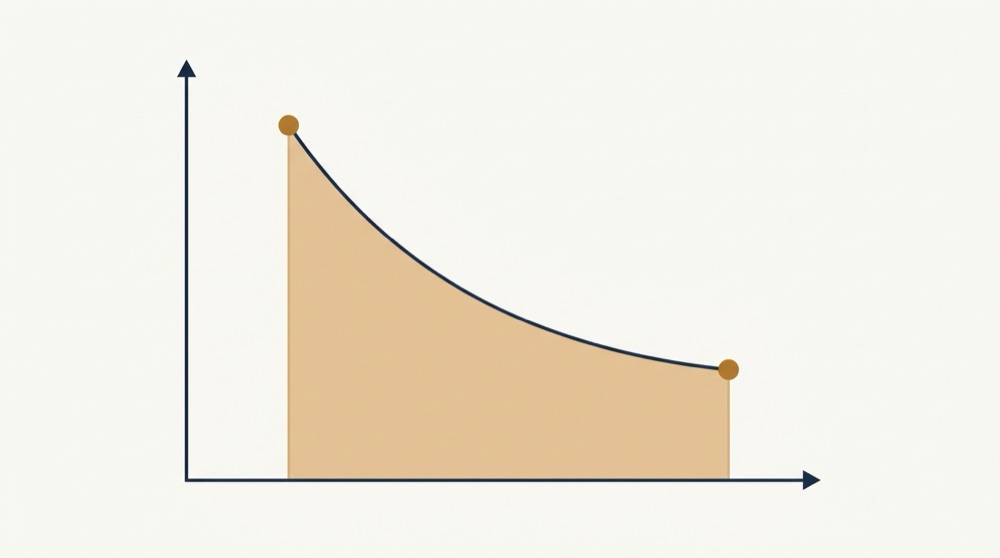
Two conditions hide in the derivation. First, p must be the pressure at the moving boundary, and only in a quasi-static process, slow enough that the gas stays uniform, is that the pressure of the gas as a whole. Burst a diaphragm and let a gas rush into a vacuum and it does no work at all, because there is nothing at the boundary to push against. Second, -pdV can only be integrated once the path p(V) is known: the work is the area under the curve traced on a pressure-volume diagram, and two curves between the same endpoints enclose different areas.

The work done by an expanding gas as the area under its path on a pressure-volume diagram, with the region between the curve and the volume axis shaded from the initial volume to the final volume.

Example. A gas is compressed at a constant pressure of 150 kPa from 3.0 L to 1.2 L. How much work is done on the gas?

At constant pressure the integral is just W=-pΔV. Here ΔV=(1.2-3.0)×10-3=-1.8×10⁻³ m³, so W=-(1.5×10⁵)(-1.8×10⁻³)=+270 J. The volume shrank, the surroundings pushed the piston in, and the positive sign says energy went into the gas, exactly as the convention promises.

Now you. A gas expands at a constant pressure of 250 kPa from 2.0 L to 5.0 L. How much work is done on the gas?

Answer

ΔV=(5.0-2.0)×10-3=+3.0×10⁻³ m³, so W=-(2.5×10⁵)(3.0×10⁻³)=-750 J. The gas expanded, so the work done on it is negative: it delivered 750 J to the surroundings.

Work that is not pdV

It is easy to leave a first course believing that thermodynamic work means a piston. The piston is one instance of a general pattern: work is always an intensive quantity, a generalised force, multiplied by the change in an extensive quantity, a generalised displacement.

Stir a liquid with a paddle wheel and the shaft does work on it through the torque it exerts, δW=τdθ. Notice what this pair cannot do: a paddle can put energy into a fluid, but no arrangement of paddles will pull it back out of a still fluid and lift the weight again. Pass a current through a resistor immersed in the system and the electrical work in time dt is EIdt. Stretch a wire by dL against tension F and the work is FdL, positive now rather than negative, because tension and extension point the same way while pressure resists expansion. Increase the area of a liquid film by dA against surface tension γ and the work is γdA. So ΔU=Q-pdV is not the First Law but a special case of it, valid when the only work is boundary displacement, and forgetting the other terms is how a perfectly good energy balance ends up not balancing.

Caloric, and why it had to die

For most of the eighteenth century heat was understood as a substance. Caloric was an invisible, weightless, self-repelling fluid that flowed from hot bodies to cold ones, and the theory was not foolish: it explained why heat runs downhill in temperature, since caloric particles repel and spread out, and it explained thermal expansion, since adding fluid to a body should swell it. Joseph Black's distinction between temperature and quantity of heat, and his discovery of latent heat in the 1760s, were made in caloric language and are still correct. Lavoisier listed caloric among the chemical elements in 1789, and Sadi Carnot's 1824 analysis of heat engines assumed that caloric passes through an engine undiminished.

The fatal property of caloric is that, being a substance, it must be conserved. You can move it, concentrate it or release it from where it lies latent, but you cannot make it. That is what Benjamin Thompson, Count Rumford, attacked at the Munich arsenal in 1798. Supervising the boring of brass cannon, he noticed that the process produced heat without apparent end: as long as the horses turned the borer, heat kept coming. He immersed a cannon blank and its borer in water and, by friction alone, brought it to a boil in about two and a half hours, with no fire anywhere near it.

The measurements he made to close the loopholes matter more than the boiling water. If the metal were releasing stored caloric its capacity to hold heat should have changed, so he compared the specific heat of the borings with that of the parent metal and found no difference. If caloric were a substance it should weigh something, so he weighed bodies hot and cold and found no change. Above all the supply was inexhaustible, and, as he wrote, anything which an insulated body can continue to furnish without limitation cannot possibly be a material substance. His own conclusion, that heat is a form of motion, was not accepted quickly: he could show caloric was wrong without saying what the exchange rate was between the work the horses did and the heat that appeared.

Joule and the mechanical equivalent of heat

James Prescott Joule, a Manchester brewer's son with good instruments and an obsessive standard of care, spent 1843 to 1850 measuring that exchange rate by as many independent methods as he could contrive: forcing water through narrow tubes, compressing air, running current through a resistance (which gave him the law I2R). Each gave a similar figure, and their agreement was the argument.

The famous apparatus is the paddle wheel. Two weights on cords fall a measured height, turning a spindle carrying vanes that stir water inside an insulated copper vessel fitted with fixed baffles, so the water is churned rather than spun. The energy input is known exactly: mgh for the falling weights, corrected for the small kinetic energy they retain at the bottom and for friction in the pulleys. The output is a temperature rise, and the difficulty is that the rise is tiny. Joule was resolving a few hundredths of a degree Fahrenheit with mercury thermometers he had calibrated himself, at a time when that precision was close to unheard of.

His 1850 paper gives the mechanical equivalent of heat as 772.692 foot-pounds of work per British thermal unit, about 4.159 joules per calorie against a modern 4.1855 for the 15 degree calorie, low by roughly six parts in a thousand. The significance is not the digits but the claim behind them: a fixed amount of work always produces the same amount of heat, whatever mechanism converts it. Heat is not a substance. It is energy in transit, and work is the same energy arriving by a different route.

Adiabatic work, and where internal energy comes from

Joule's result can be turned into a definition, and this is the honest route into the First Law, because it introduces heat as a derived quantity rather than assuming everyone already knows what heat is.

Start with an adiabatic process, one in which the system is thermally insulated so that its only interaction with the surroundings is work. That can be said without mentioning heat: an adiabatic boundary is one across which the state of the system is unaffected by anything outside except displacement of the boundary itself. Now take two equilibrium states, 1 and 2, and connect them adiabatically in every way you can devise: stir a fluid, compress it, run a current through a resistor inside it, do all three in various orders. The experimental finding, Joule's finding generalised, is that the work required is the same for every adiabatic path. Churn a kilogram of water from 20 to 21 degrees, or compress it, or heat it electrically; the same 4.18 kilojoules are needed each time.

A quantity whose change is the same along every path is the difference of a function of state. So define the internal energy U by

ΔU=U2-U1=Wad

the adiabatic work between the two states. This fixes U up to an additive constant, exactly as gravitational potential energy is fixed only up to a choice of zero. Note what has been achieved: U is a property of the state, while work is a property of a process.

Now remove the insulation and take the system between the same two states by some other route. The state change is the same, so ΔU is the same, but the measured work W is generally different. Energy has crossed the boundary by a route that is not work, and that quantity is what we define heat to be:

QΔU-W

Heat is not assumed, not defined by feeling warm, and not a fluid. It is the residual: the amount by which the actual work falls short of the adiabatic work between the same two states. Calorimetry and the rest follow from that definition plus a way of measuring work.

The First Law and inexact differentials

Rearranged, the definition becomes the statement usually called the First Law of Thermodynamics:

ΔU=Q+W

The energy of a closed system changes by exactly the heat added to it plus the work done on it, and by nothing else: no third channel, no leak. The law is a definition of U plus one empirical claim, the path independence of adiabatic work, and that claim is what makes U exist as a state function. It cannot be proved from mechanics. It is a summary of what experiment has never contradicted in nearly two centuries of looking.

Example. A gas absorbs 850 J of heat while a piston compresses it, doing 300 J of work on it. What is ΔU?

On this lesson's convention both entries are positive as given: heat in is positive, work done on the system is positive. So ΔU=Q+W=850+300=+1150 J. The internal energy rises by 1150 J, and it does not matter in what order or by what mechanism the two contributions arrived.

Now you. A gas loses 420 J of heat to its surroundings while 640 J of work is done on it. What is ΔU?

Answer

Heat leaves, so Q=-420 J; work is done on the system, so W=+640 J. Then ΔU=-420+640=+220 J. The internal energy rises even though the gas is losing heat, because the work put in more than covers the loss.

The differential form exposes the asymmetry. Write it as dU=δQ+δW, with a d on the left and a δ on the right. The d marks an exact differential: dU is the differential of a function that exists, U(T,V), so integrating it between two states gives U2-U1 regardless of route. The δ marks an inexact one. No function Q of the state has δQ as its differential: it makes no sense to ask how much heat a system contains, only how much crossed its boundary during a process. Writing ΔQ is therefore a category error.

The cyclic integral makes the distinction concrete. Take a system round a closed loop back to its starting state. Since U depends on the state alone,

dU=0

always, for every cycle, in every substance. But δQ need not vanish, and in a working engine it had better not: an engine runs precisely because it absorbs more heat over a cycle than it rejects. What the First Law demands is that the two inexact integrals cancel, δQ=-δW. Over one cycle the net heat absorbed equals the net work delivered, which is the entire budget of every engine ever built.

Perpetual motion of the first kind

A perpetual motion machine of the first kind is a device that runs in a cycle and delivers net work while absorbing no net heat: energy from nothing, forever. The First Law kills it in one line. Round a cycle dU=0, so δQ=-δW, and if no net heat is absorbed then no net work can be delivered. A machine returned to its initial state has no store left to draw on, because U is back where it started. The argument runs both ways: accept that no cyclic device can create energy and you can reconstruct the existence of U.

Be clear about what the law does not forbid, because it forbids less than beginners expect. It has no objection to a machine that takes heat from the ocean and turns all of it into work, with the books balancing perfectly. Such a device, a perpetual motion machine of the second kind, would power a ship from seawater and violate no conservation principle. That it is nonetheless impossible needs a second, independent law, which is where this course goes shortly.

Two paths, one state change

Here is the whole lesson in numbers. Take one mole of an ideal monatomic gas at T1=300 K and p1=200 kPa, so V1=RT1/p1=(8.314)(300)/(2.00×105)=1.2471×10-2 m³, or 12.47 litres. Bring it to state 2 with V2=2.4942×10⁻² m³ at T2=300 K, so p2=100 kPa. Since the temperature of an ideal gas fixes its internal energy, ΔU=0 for this state change whatever route is taken.

Path A, reversible isothermal expansion. Hold the gas at 300 K and let it expand slowly against a pressure matched to its own at every instant, with p=RT/V. Then W=-pdV=-RTln(V2/V1). With RT=(8.314)(300)=2494.2 J and ln2=0.6931, the work is WA=-1728.9 J. Since ΔU=0, the First Law gives QA=+1728.9 J: the gas absorbs 1729 J of heat and hands every joule straight out as work.

Path B, expand at constant pressure, then cool at constant volume. Hold p at 200 kPa and expand from V1 to V2: the work is W=-pΔV=-(2.00×10⁵)(1.2471×10⁻²)=-2494.2 J, and the temperature at the end of the leg is T=pV2/R=(2.00×105)(2.4942×10-2)/8.314=600 K. For a monatomic ideal gas ΔU=32RΔT=(1.5)(8.314)(300)=3741.3 J, so Q=ΔU-W=6235.5 J, which the check Q=CpΔT=52(8.314)(300) confirms. Now cool at fixed volume from 600 K back to 300 K, dropping the pressure to 100 kPa. No volume change means no work, so W=0 and Q=ΔU=-3741.3 J.

Add the legs: WB=-2494.2 J and QB=6235.5-3741.3=+2494.2 J. The work differs from path A by 765 J, more than forty per cent, and so does the heat. Yet ΔU=Q+W is zero on both. Neither Q nor W is a property of the endpoints, and their sum is nothing else.

Example. 2.0 mol of an ideal gas at 350 K expands reversibly and isothermally from 10.0 L to 30.0 L. Find W and Q.

The method is path A's. For a reversible isothermal expansion W=-nRTln(V2/V1), and with nRT=(2.0)(8.314)(350)=5819.8 J and ln3=1.0986, W=-6393.7 J. The temperature is unchanged, so for an ideal gas ΔU=0, and the First Law gives Q=ΔU-W=+6393.7 J: every joule of heat absorbed leaves again as work.

Now you. 0.50 mol of an ideal gas at 400 K expands reversibly and isothermally from 5.0 L to 20.0 L. Find W and Q.

Answer

nRT=(0.50)(8.314)(400)=1662.8 J and ln(20/5)=ln4=1.3863, so W=-nRTln(V2/V1)=-2305.1 J. Since ΔU=0 at constant temperature, Q=+2305.1 J.

That is the result the rest of the subject is built on, and it leaves an obvious question. The constant-pressure leg needed 6235.5 J for a 300 K rise, while the constant-volume leg gave up only 3741.3 J over the same 300 K, a ratio of exactly 5/3. What a temperature change costs depends on what is held fixed while you make it, and the bookkeeping for constant-pressure processes is tidy enough to deserve a state function of its own. That function is enthalpy, and it is next.

Enthalpy and heat capacity

Almost no chemistry and almost no engineering happens in a sealed rigid box, which is awkward, because the First Law is written for internal energy and internal energy is what a sealed rigid box measures.

Heat capacity is not one number

Ask how much heat it takes to warm something by a degree and the answer is a heat capacity, C=δQ/dT. The notation already contains a warning. Heat is written δQ rather than dQ because it is not the change in any property of the system: it depends on the path taken, as the previous lesson established. So a ratio built out of it cannot be a property either, not until the path is pinned down.

Pin it down two ways and you get the two heat capacities that matter. Hold the volume fixed and no pdV work is possible, so the First Law dU=δQ-pdV collapses to δQ=dU, and

CV=(UT)V

This is a genuine partial derivative of a state function, so it is a property of the substance. Hold the pressure fixed instead and the system may expand while it warms, doing work on its surroundings, so some of the heat supplied never becomes internal energy at all. The constant-pressure heat capacity Cp is therefore a different number, and it must be the larger of the two.

Both are extensive: double the sample and you double the capacity. Divide by mass to get specific heat capacity (liquid water is 4.18 J g⁻¹ K⁻¹, which is remarkably large and is why oceans moderate climate) or by amount of substance to get molar heat capacity, in J mol⁻¹ K⁻¹. Molar values are the ones to compare across substances, because they count the same number of particles each time.

Enthalpy, and why the combination is worth a name

Now do the constant-pressure case properly rather than by hand-waving. Take a system at fixed external pressure p, doing only expansion work. Over a finite change the First Law gives ΔU=Qp-pΔV, since p is constant and comes out of the integral. Rearranged,

Qp=ΔU+pΔV=(U2+pV2)-(U1+pV1)

The heat is the change in the quantity U+pV, evaluated at the two end states and nowhere else. That combination is worth naming, so define the enthalpy

H=U+pV

Every symbol on the right is a state function, so H is one too, and the result just derived reads ΔH=Qp: at constant pressure, with only expansion work, the heat absorbed is the change in a state function. That is the whole point. Heat is normally path-dependent, but constrain the path to constant pressure and the ambiguity disappears, because the pΔV term that the surroundings absorb has been folded into the bookkeeping in advance.

This is why enthalpy dominates chemistry. A reaction in an open flask is at constant pressure, held there by the atmosphere, and the heat it gives out is therefore a property of the reaction rather than of the flask. Enthalpy is not a new form of energy and nothing is stored in the pV term in any physical sense: it is the correct accounting for the commonest constraint. The corresponding heat capacity is

Cp=(HT)p

which stands in exactly the same relation to H as CV does to U.

Why Cp exceeds CV

For an ideal gas the difference can be derived exactly, with no appeal to intuition. Start from the definition and substitute the equation of state: H=U+pV=U+nRT. Differentiate with respect to temperature at constant pressure. The internal energy of an ideal gas depends on temperature alone, a fact Joule's expansion experiment established, so dU/dT is CV whichever variable is held fixed, and the second term differentiates to nR. Hence

Cp-CV=nR

or per mole, Cp,m-CV,m=R=8.314 J mol⁻¹ K⁻¹. The physical reading is the one anticipated above. Warm a gas by one kelvin at constant volume and all the heat raises U. Warm it by one kelvin at constant pressure and it must expand by ΔV=nRΔT/p to keep the pressure constant, doing work pΔV=nRΔT on the surroundings. The extra R per mole per kelvin is exactly that work.

Example. 2.00 mol of nitrogen (CV,m=20.81 J mol⁻¹ K⁻¹, Cp,m=29.12 J mol⁻¹ K⁻¹) is warmed from 300 K to 350 K, once at constant volume and once at constant pressure. How much heat does each path take, and where does the difference go?

At constant volume, QV=nCV,mΔT=2.00×20.81×50=2081 J. At constant pressure, Qp=nCp,mΔT=2.00×29.12×50=2912 J. The difference, 2912-2081=831 J, is exactly nRΔT=2.00×8.314×50=831 J: the work the expanding gas does on the surroundings to hold its pressure steady.

Now you. 3.00 mol of argon (CV,m=12.47 J mol⁻¹ K⁻¹, Cp,m=20.79 J mol⁻¹ K⁻¹) is warmed by 50 K. Find QV, Qp, and check that their difference is nRΔT.

Answer

QV=3.00×12.47×50=1871 J and Qp=3.00×20.79×50=3119 J. The difference is 3119-1871=1248 J, matching nRΔT=3.00×8.314×50=1247 J to within rounding.

The ratio γ=Cp/CV appears throughout gas dynamics and in the adiabatic relation pVγ=constant, so it is worth tracking alongside the capacities themselves.

For a solid or a liquid the same difference exists but is tiny, because the thermal expansion is tiny: copper's Cp and CV differ by under two per cent at room temperature. For gases the difference is never negligible, and using the wrong one is a standard way to be wrong by forty per cent.

Equipartition and the size of CV

Kinetic theory gives the values, not merely the difference. The equipartition theorem of classical statistical mechanics says that each independent quadratic term in a molecule's energy carries an average of 12kBT, and therefore contributes 12R per mole to CV,m.

A monatomic gas has three such terms, the kinetic energies along x, y and z. So CV,m=32R=12.47 J mol⁻¹ K⁻¹, Cp,m=52R=20.79, and γ=5/31.67. Argon at 298 K measures CV,m=12.5 and γ=1.67. The agreement is essentially exact, and it holds for helium, neon and krypton too.

A diatomic molecule adds rotation about the two axes perpendicular to the bond (rotation about the bond itself involves negligible moment of inertia) for two more terms, predicting CV,m=52R=20.79 and γ=7/5=1.40. Nitrogen at 298 K measures Cp,m=29.12 J mol⁻¹ K⁻¹, hence CV,m=29.12-8.31=20.81, and γ=1.40. Again the prediction lands.

Carbon dioxide breaks the pattern. It is linear, so on the same counting it should also give 52R. Its measured Cp,m at 298 K is 37.1 J mol⁻¹ K⁻¹, giving CV,m=28.8 and γ=1.29. Something is absorbing energy that the count of translations and rotations does not include.

Where the classical picture fails

The missing contribution is vibration, and the interesting question is not why carbon dioxide has it but why nitrogen does not. A vibrating bond has two quadratic terms, kinetic and potential, so classical equipartition says every diatomic should show CV,m=72R=29.1 at all temperatures. Nitrogen shows 52R. The classical theory is not slightly off here; it predicts a contribution that is simply absent.

Cooling makes it worse. Hydrogen's molar CV is 52R near room temperature, falls as it is cooled below about 100 K, and reaches 32R near 60 K, the value for a monatomic gas. The rotational contribution vanishes. Nothing in classical mechanics permits a degree of freedom to switch off: a mode either exists or it does not.

Quantum mechanics supplies what is missing. The energy of each mode is quantised, and a mode contributes fully only when kBT is comfortably larger than its level spacing, and freezes out when it is not. The characteristic temperature of a mode is the spacing divided by kB. Hydrogen's rotational spacing corresponds to about 85 K, which is why its rotation dies at the temperature it does. Nitrogen's bond vibrates at 2359 cm⁻¹, a characteristic temperature near 3390 K, so at 298 K the mode is almost entirely in its ground state and contributes nothing. Carbon dioxide's bending vibration sits at only 667 cm⁻¹, around 960 K, low enough to be partly excited at room temperature, which is precisely the excess seen in its Cp. Heat capacity is one of the places where the quantum nature of matter is visible in a bench measurement.

Formation enthalpies and Hess's law

Enthalpy has no absolute zero, so what gets tabulated is always a difference. The convention fixes one: the standard enthalpy of formation ΔfHominus is the enthalpy change forming one mole of a substance from its elements in their standard states at 105 Pa, and an element in its standard state is assigned zero by definition. Graphite is zero and diamond is +1.9 kJ mol⁻¹, because graphite is the stable form.

Because H is a state function, ΔH around any closed path is zero, and a reaction enthalpy is the same whether the reaction runs in one step or twenty. That is Hess's law, stated by Germain Hess in 1840, before the First Law itself was settled. It is not an extra postulate. It is what "state function" means, applied to chemistry, and it lets a reaction enthalpy be computed for a reaction nobody can run cleanly, by routing through elements:

ΔrHominus=ΔfHominus(products)-ΔfHominus(reactants)

Take the combustion of methane, C(g)+2(g)C(g)+2O(l). The tabulated values at 298 K are ΔfHominus=-74.6 kJ mol⁻¹ for methane, -393.5 for carbon dioxide, -285.8 for liquid water, and zero for oxygen, an element in its standard state. The products sum to -393.5+2(-285.8)=-965.1 kJ mol⁻¹ and the reactants to -74.6, so ΔrHominus=-965.1-(-74.6)=-890.5 kJ mol⁻¹, against a directly measured value of -890.8. Note that the water must be liquid: taking it as vapour changes the answer by 2×44=88 kJ, the difference between the higher and lower heating values of natural gas, and a real source of confusion in engineering data.

Example. Find the standard enthalpy of combustion of ethanol, OH(l)+3(g)2C(g)+3O(l), given ΔfHominus=-277.7 kJ mol⁻¹ for liquid ethanol.

The products sum to 2(-393.5)+3(-285.8)=-1644.4 kJ mol⁻¹ and the reactants to -277.7, oxygen being zero. So ΔrHominus=-1644.4-(-277.7)=-1366.7 kJ mol⁻¹, against a measured -1366.8.

Now you. Do the same for propane, (g)+5(g)3C(g)+4O(l), given ΔfHominus=-104.7 kJ mol⁻¹ for propane.

Answer

Products: 3(-393.5)+4(-285.8)=-2323.7 kJ mol⁻¹. Reactants: -104.7. So ΔrHominus=-2323.7-(-104.7)=-2219.0 kJ mol⁻¹.

The Born-Haber cycle for sodium chloride is the same argument applied to an ionic lattice, where it extracts a lattice enthalpy that cannot be measured directly at all. It is worked through in lesson six of the Atoms and Elements course, and there is no point repeating it here.

Calorimetry: two vessels, two quantities

Measuring these numbers means choosing which constraint to impose. A bomb calorimeter seals the sample in a rigid steel vessel under excess oxygen and immerses it in a stirred water bath. The volume is fixed, so no work is done and the measured heat is ΔU, not ΔH. A coffee-cup calorimeter, an insulated vessel open to the atmosphere, holds the pressure fixed instead and measures ΔH directly, which suits dissolutions and neutralisations.

A bomb is calibrated rather than computed, by burning a substance whose energy of combustion is known to high precision. Benzoic acid is the international standard for this, at -26.43 kJ g⁻¹. Burning 1.000 g of it and observing the bath rise by 2.641 K gives a calorimeter constant Ccal=26.43/2.641=10.01 kJ K⁻¹. Now burn 1.000 g of glucose in the same apparatus and suppose the rise is 1.555 K. The heat released is 10.01×1.555=15.57 kJ, and glucose has molar mass 180.16 g mol⁻¹, so ΔcU=-15.57×180.16=-2805 kJ mol⁻¹.

To convert, note that ΔH=ΔU+Δ(pV), and for a reaction where the condensed phases contribute negligible volume, only the gases matter: Δ(pV)=ΔngasRT if they are ideal. So

ΔH=ΔU+ΔngasRT

For glucose, (s)+6(g)6C(g)+6O(l), six moles of gas are consumed and six produced, so Δngas=0 and ΔcH=ΔcU=-2805 kJ mol⁻¹. The value from formation enthalpies is 6(-393.5)+6(-285.8)-(-1273.3)=-2802.7 kJ mol⁻¹, which agrees to within the precision of the temperature reading.

Methane shows the correction biting. There Δngas=1-3=-2, and RT=8.314×298.15=2479 J mol⁻¹, so ΔcU=ΔcH-ΔngasRT=-890.5+4.96=-885.5 kJ mol⁻¹. Half a per cent, which is far larger than a good calorimeter's error, so the conversion is never optional.

Example. Ethanol burns as OH(l)+3(g)2C(g)+3O(l) with ΔcH=-1366.7 kJ mol⁻¹ at 298.15 K. What would a bomb calorimeter measure?

The gas count is 2-3, so Δngas=-1, and RT=2.479 kJ mol⁻¹. The bomb measures ΔcU=ΔcH-ΔngasRT=-1366.7-(-1)(2.479)=-1364.2 kJ mol⁻¹.

Now you. Propane burns as (g)+5(g)3C(g)+4O(l) with ΔcH=-2219.0 kJ mol⁻¹ at 298.15 K. Find ΔcU.

Answer

Gas moles go from 1+5=6 to 3, so Δngas=-3 and ΔcU=-2219.0-(-3)(2.479)=-2211.6 kJ mol⁻¹.

Exothermic is not the same as spontaneous

A reaction with ΔH<0 releases heat and is exothermic; one with ΔH>0 absorbs it and is endothermic. It is very tempting to go one step further and say that reactions happen because they release energy, and for most of the nineteenth century respectable chemists did say exactly that. Marcellin Berthelot's principle of maximum work, stated in 1867, held that every spontaneous change is the one that releases the most heat.

It is false, and the counterexamples are on any bench. Dissolve ammonium nitrate in water and it dissolves eagerly while cooling the beaker sharply: ΔsolHominus=+25.7 kJ mol⁻¹, which is how instant cold packs work. Put ice in a room at 10 degrees Celsius and it melts, absorbing 6.01 kJ mol⁻¹, entirely spontaneously. Both processes go uphill in enthalpy and both go anyway.

So enthalpy cannot be the criterion for change. Something else is being maximised alongside it, something that the dissolved ions and the liquid water have more of than the crystal did, and it is not energy. Naming that quantity, measuring it, and combining it with ΔH into a single criterion is the work of the second half of this course. The Second Law arrives first, and entropy after it.

Real substances

Everything so far has quietly assumed that the working substance obeys pv=RT, and that assumption has to be abandoned before any real machine can be analysed.

Where the ideal gas runs out

The ideal gas model comes from two physical statements: molecules occupy no volume of their own, and they exert no force on one another except during collisions. Both are excellent at low density, because the molecules are then far apart, and both are worthless at high density, because they are then not.

Look at what the model cannot do. Solve v=RT/p for any temperature and any pressure and you always get exactly one answer, a single specific volume that shrinks smoothly as you squeeze. There is no pressure at which the substance suddenly collapses to a thousandth of its volume, so the model has no liquid phase and no condensation. With no condensation there is no boiling, no latent heat, and no critical point at which the distinction between liquid and vapour disappears. A model of matter that cannot boil is not a small idealisation of water. It is a different substance.

The failure lands exactly where engineering lives. A steam power plant boils water at high pressure and condenses it at low pressure, and both processes happen at states the ideal gas model denies exist. A refrigerator does the same with R-134a. Even where the substance is genuinely a vapour, the errors near saturation are large: saturated steam at 10 MPa has a measured specific volume of 0.018026 m³/kg, while RT/p with R=0.4615 kJ/kg K and Tsat=584.1 K gives 0.02695 m³/kg, an overestimate of fifty per cent.

So pv=RT is a limiting law, exact only as density goes to zero, and a real substance has to be described by measurement instead. What follows is the geometry those measurements have.

The p-v-T surface and its shadows

For a pure substance p, v and T are tied by one relation, so the accessible states form a two-dimensional surface in p-v-T space rather than filling the volume. Every equilibrium state of water is a point on one particular surface, measured once and for all.

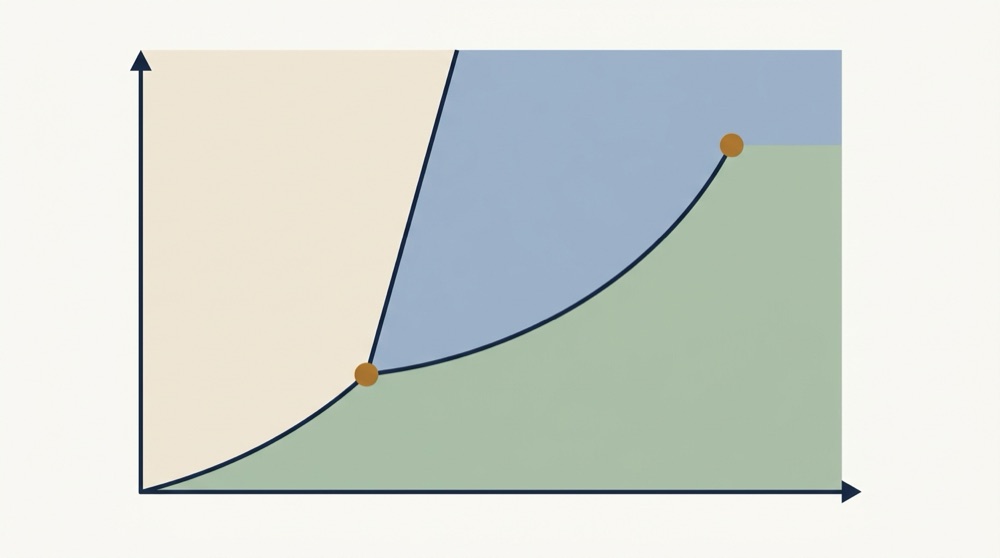
That surface is awkward to draw, so it is used through its two shadows. Project it onto the p-T plane, looking along the volume axis, and every horizontal phase-change line collapses to a single curve, because pressure and temperature do not change while a substance boils. The result is the phase diagram: three regions, solid, liquid and vapour, separated by the sublimation, fusion and vaporisation lines. All three meet at the triple point, which for water sits at 273.16 K and 611.7 Pa, the only condition at which ice, water and steam coexist. That point is so reproducible that it defined the kelvin until 2019.

The phase diagram of water on pressure and temperature axes, with the sublimation, fusion and vaporisation lines meeting at the triple point, the vaporisation line ending at the critical point, and the fusion line leaning backwards to the left because ice is less dense than liquid water.

The vaporisation line does not run on forever. It stops at the critical point, at 373.95 degrees Celsius and 22.06 MPa for water, first observed for carbon dioxide by Thomas Andrews in 1869. Beyond it liquid and vapour are not distinguishable: the meniscus vanishes, the latent heat falls to zero, and a path that loops around the critical point takes a liquid to a vapour with no phase change anywhere along it. The fusion line, by contrast, has no known end.

Water's fusion line leans the wrong way. For almost every substance it slopes up and slightly to the right, so squeezing a liquid freezes it. For water it slopes up and to the left, because ice is less dense than liquid water (917 against 999.8 kg/m³ near 0 degrees Celsius), so melting a gram of ice makes it occupy less space, not more. Squeezing ice therefore favours the liquid, and the melting point falls with pressure. The magnitude is small: with a specific volume change on melting of about 9.0×10⁻⁵ m³/kg and a latent heat of 333.5 kJ/kg, the slope is roughly -7.4×10⁻⁸ K per pascal, so a hundred atmospheres depresses the melting point by less than a kelvin. Enough to make ice float and to let glaciers creep at their beds, nowhere near enough to explain ice skating, which is a friction and surface-layer effect.

The other projection, onto the p-v plane, keeps what the phase diagram hid. Each phase-change line reopens into a wide region, the saturation dome, bounded on the left by the saturated liquid line and on the right by the saturated vapour line, meeting at the top at the critical point. Inside it, liquid and vapour coexist, and this is the region property tables exist to describe.

Quality, and why two properties are still needed

Inside the dome an isotherm on the p-v diagram is a horizontal line. Boiling water at 100 kPa stays at 99.61 degrees Celsius from the first bubble to the last drop, and adding heat only converts more liquid to vapour. So within the dome, pressure and temperature are not independent: knowing one fixes the other. Give me 100 kPa and 99.61 degrees Celsius and I still cannot tell you the volume or the enthalpy, because I do not know how much of the mass has boiled.

The state postulate is not violated, it is being misread. It demands two independent properties, and here p and T are one property wearing two hats. The second must distinguish states along the horizontal line, and the natural choice is the quality

x=mgmg+mf

the fraction of the total mass that is vapour. It runs from 0 on the saturated liquid line to 1 on the saturated vapour line, and it is meaningless outside the dome.

Because volume is extensive, the mixture's specific volume is the mass-weighted average of the two saturated values vf and vg. The total volume is mfvf+mgvg, and dividing by the total mass gives v=(1-x)vf+xvg, which rearranges to the form worth memorising:

v=vf+x(vg-vf)

The same argument works unchanged for internal energy and enthalpy, since those are extensive too, so u=uf+xufg and h=hf+xhfg, where the subscript fg denotes the difference across the dome. This one relation, plus a table of vf and vg, replaces the equation of state entirely inside the saturation region.

Example. A mixture of liquid water and steam at 100 kPa has a quality of 0.35. What is its specific volume, given vf=0.001043 m³/kg and vg=1.694 m³/kg?

Apply the mixing rule directly: v=vf+x(vg-vf)=0.001043+0.35×(1.694-0.001043)=0.001043+0.35×1.692957=0.5936 m³/kg.

Now you. The same mixture at 100 kPa has a quality of 0.80. What is its specific volume, in m³/kg?

Answer

v=0.001043+0.80×1.692957=0.001043+1.354366=1.355 m³/kg.

Reading the tables

Property tables come in two families. Saturated tables list, for each saturation state, the temperature, the corresponding pressure, and the values of vf, vg and the internal energies and enthalpies alongside. The identical data is printed twice, once indexed by round temperatures and once by round pressures, purely so that whichever you are given is a row rather than an interpolation. Superheated tables cover states outside the dome, where p and T are independent again, and are laid out as a block per pressure with temperature running down the rows.

For water at 100 kPa the saturated row reads Tsat=99.61 degrees Celsius, vf=0.001043 m³/kg and vg=1.694 m³/kg. Notice the ratio: the vapour occupies 1624 times the volume of the liquid it came from, which is why a boiler is a pressure vessel and a leak is violent.

Between rows, interpolate linearly, which for a smooth property over a small interval is accurate to a fraction of a per cent. Superheated water at 100 kPa is tabulated at 1.6959 m³/kg for 100 degrees Celsius and 1.9367 m³/kg for 150 degrees Celsius. For 120 degrees Celsius the fraction of the way across is (120-100)/(150-100)=0.4, so

v1.6959+0.4(1.9367-1.6959)=1.7922m3/kg

The ideal gas value, RT/p=0.4615×393.15/100=1.814 m³/kg, is 1.2 per cent high, which is the residual non-ideality of steam a few degrees above its own boiling point.

Interpolation is a convenience, not a physical claim, and it fails wherever the property is not nearly linear: near the critical point, or between widely spaced pressure blocks. Never interpolate across a phase boundary.

A rigid vessel of water

Take a rigid, sealed vessel of volume 0.100 m³ containing 1.00 kg of water at 100 kPa. What is inside it?

The first move is always the same: compute the specific volume, which the geometry hands you directly, v=V/m=0.100/1.00=0.100 m³/kg, then compare it with the saturation values at the given pressure. Since vf=0.001043<0.100<1.694=vg, the state lies inside the dome and the vessel holds a saturated mixture at 99.61 degrees Celsius. Had v come out below vf it would be compressed liquid; above vg, superheated vapour. That single comparison settles the phase.

The quality follows from the mixing rule, solved for x:

x=v-vfvg-vf=0.100-0.0010431.694-0.001043=0.0989571.692957=0.0585

So 58.5 grams of the water is vapour and 941.5 grams is liquid. The volumes tell the opposite story: the vapour fills 0.0585×1.694=0.0991 m³ and the liquid only 0.9415×0.001043=0.00098 m³. Ninety-nine per cent of the vessel is steam while six per cent of the contents is, which is why quality can never be guessed by eye from a sight glass.

Example. A rigid, sealed vessel of 0.250 m³ holds 2.00 kg of water at 100 kPa. What phase is inside, and how much of the mass is vapour?

The specific volume is v=V/m=0.250/2.00=0.125 m³/kg. Since vf=0.001043<0.125<1.694=vg, this is a saturated mixture at 99.61 degrees Celsius. Solving the mixing rule for quality, x=(0.125-0.001043)/(1.694-0.001043)=0.123957/1.692957=0.0732, so the vapour mass is 0.0732×2.00=0.146 kg.

Now you. A rigid, sealed vessel of 0.050 m³ holds 1.00 kg of water at 100 kPa. What phase is inside, and how many grams of it are vapour?

Answer

v=0.050/1.00=0.050 m³/kg, which lies between vf and vg, so it is a saturated mixture at 99.61 degrees Celsius. Then x=(0.050-0.001043)/1.692957=0.0289, so 28.9 grams of the water is vapour.

Now heat the vessel. Rigid means constant V, sealed means constant m, so v stays pinned at 0.100 m³/kg and the state moves vertically up a line of constant specific volume on the p-v diagram. Pressure and temperature both rise together along the saturation curve, and since our fixed v is far to the right of the critical specific volume of water (0.003106 m³/kg), the vertical line exits the dome through the saturated vapour side. The quality therefore increases, the liquid level falls, and the last drop evaporates where vg=0.100 m³/kg, which the tables place at about 2.0 MPa and 212.4 degrees Celsius. Beyond that the vessel holds superheated steam and its pressure climbs steeply.

The direction of that result depends entirely on which side of the critical volume you start. Fill the same vessel with 50 kg of water instead, giving v=0.002 m³/kg, and the vertical line exits through the saturated liquid side: the liquid level rises and the vessel fills completely with compressed liquid, which is how a sealed, over-filled system bursts.

The compressibility factor

Tables are exact but they are also a different book for every substance. A compact alternative starts by asking how badly a gas violates pv=RT, and calls the answer the compressibility factor

Z=pvRT

By construction Z=1 for an ideal gas, Z<1 where attraction pulls molecules closer than ideal, and Z>1 where their own volume keeps them apart. Saturated steam at 100 kPa has Z=1.694/1.720=0.985; the same steam at 10 MPa has Z=0.018026/0.02695=0.669.

The useful discovery, made by van der Waals himself, is that Z is not a private fact about each gas. Plot Z against the reduced pressure pR=p/pcr and the reduced temperature TR=T/Tcr, measuring each state as a fraction of that substance's own critical values, and the data for nitrogen, methane, carbon dioxide, water and a dozen others collapse onto very nearly a single chart. This is the principle of corresponding states: two substances at the same reduced conditions are in mechanically similar states. The generalised chart built from it is good to a few per cent for most gases, and worst for strongly polar or hydrogen-bonded ones, water and ammonia included.

The rule of thumb then becomes concrete. Z is within one per cent of unity when pR is below about 0.1 at any temperature, or when TR is above roughly 2 and the pressure is not extreme. Room-temperature air is safe on both counts, with TR=298/132.5=2.25 and, at atmospheric pressure, pR=0.1/3.77=0.027. Steam near its own saturation line satisfies neither.

Example. Superheated steam at 100 kPa and 150 degrees Celsius is tabulated at v=1.9367 m³/kg. Compute Z and decide whether the ideal-gas model is safe here.

With R=0.4615 kJ/kg K and T=423.15 K, the ideal value is RT/p=0.4615×423.15/100=1.9528 m³/kg, so Z=pv/RT=1.9367/1.9528=0.992. The error is under one per cent: fifty degrees of superheat is enough to make the ideal gas model acceptable for this steam.

Now you. Superheated steam at 100 kPa and 100 degrees Celsius is tabulated at v=1.6959 m³/kg. Compute Z and decide whether the ideal-gas model is safe here.

Answer

RT/p=0.4615×373.15/100=1.7221 m³/kg, so Z=1.6959/1.7221=0.985. The error is 1.5 per cent, so this close to the saturation line the ideal gas model is already marginal, and it only gets worse at higher pressure.

Van der Waals, and what one equation can buy

In his 1873 doctoral thesis, Johannes Diderik van der Waals asked what minimal repair to pv=RT would let a gas condense, and made two corrections on physical grounds. First, molecules have size, so the volume available for them to move in is not v but v-b, where b is roughly the volume the molecules themselves occupy. Second, a molecule about to strike the wall is pulled back by its neighbours behind it, so the measured pressure is less than the ideal one. That pull scales with the density of the pullers and with the density of the pulled, so it goes as (1/v)2. Together:

(p+av2)(v-b)=RT

The two constants are fixed by a neat observation: at the critical point the critical isotherm has both a zero slope and an inflection, so p/v and 2p/v2 both vanish there. Imposing that gives a=27R2Tcr2/64pcr and b=RTcr/8pcr, so the constants come from two measured numbers per substance and nothing is fitted to the bulk of the data.

Qualitatively the payoff is large. Below the critical temperature the equation is a cubic in v with three real roots at a given pressure, the smallest a liquid-like volume and the largest a vapour-like one, so a single algebraic expression now contains both phases and predicts condensation. That is genuinely more than the ideal gas can do.

Quantitatively it is poor. The same critical-point conditions force the equation to predict a critical compressibility factor of exactly 3/8=0.375 for every substance, whereas the measured values cluster near 0.27 to 0.29 for simple gases (nitrogen is 0.289) and reach down to 0.229 for water. An equation thirty per cent wrong about the point it was calibrated on is not trusted for design work, and it is not used for any.

There is one further embarrassment. The middle root of the cubic makes the subcritical isotherm double back, so that over a range of volumes p/v is positive: compressing the fluid would lower its pressure, which is mechanically unstable and does not happen. James Clerk Maxwell repaired it in 1875 by replacing the loop with a horizontal line drawn so that the two areas it cuts off are equal, a construction later shown to follow from equality of the Gibbs function in the two phases. That flat line is the saturation pressure, and the dome is recovered from theory. The equation explains why the dome exists; the tables say where it lies.

Nothing in this lesson said which direction a process runs. The tables would happily let a lukewarm vessel spontaneously separate into ice and steam, and the First Law would not object either. Finding the principle that forbids it is the work of the next lesson.

The Second Law and the Carnot limit

The First Law counts energy and finds it always balances, which turns out to say almost nothing about what actually happens in the world.

The gap the First Law leaves

Put a hot cup of coffee on a desk in a cool room and it cools. Energy leaves the coffee and enters the room, and the books balance to the last joule. Now imagine the reverse: the room gives up a little of its enormous store of internal energy, the coffee heats back to scalding, and the room drops by a few thousandths of a degree. The energy books balance there just as exactly, and the First Law has no objection to it whatsoever.

Nobody has ever seen it happen. The same asymmetry is everywhere. A dropped ball bounces lower each time, warming the floor; a floor has never cooled and thrown a ball into the air. Both directions conserve energy perfectly, and only one of them occurs.

So the previous lesson's law is a bookkeeping constraint, not a law of behaviour. If something happens the ledger must balance, but it is silent on which of the balanced ledgers nature will write. Something else picks the direction, and it is not in the energy equation.

The Second Law is that missing statement, and it is unusual in being stated as an impossibility: not a formula predicting a result, but a declaration that certain processes never occur, however the apparatus is built. From that negative statement a specific positive number will follow.

The engine as the historical problem

The law arrived from steam engines. By the 1820s engines were doing real work in mines and mills, and their builders had found by trial that a hotter boiler gave more work from the same coal. Nobody knew why, or whether there was a ceiling.

In 1824 a young French military engineer, Sadi Carnot, published Reflexions sur la puissance motrice du feu, roughly a hundred pages that founded the subject. His question was practical. Given a quantity of heat passing from a hot body to a cold one, is there a limit to the work you can extract, and does that limit depend on what fluid the engine uses? If steam were fundamentally better than air, engine design was a search for the right substance. If not, it was a search for the right process.

What makes the achievement remarkable is that Carnot got the answer right while holding a theory of heat that was wrong. He believed the caloric theory: heat was an indestructible fluid, and an engine produced work by letting caloric fall from a high temperature to a low one, as a water wheel does with water. On that picture the caloric arriving at the condenser equals the caloric that left the boiler, which is false, and the First Law was still twenty years away. The wrong model nonetheless carried a right instinct: the flow from hot to cold is the essential thing, and the temperatures are what matter.

Carnot's book sold poorly and he died of cholera in 1832 at thirty-six. Emile Clapeyron rescued it a decade later, and in the 1850s Rudolf Clausius and William Thomson (later Lord Kelvin) rebuilt the argument on the conservation of energy, giving the law its modern form.

Two statements, and why they are one

Kelvin and Planck stated it as a limit on engines. No cycle can take heat from a single reservoir and convert it entirely into work, with no other effect. Every qualifier matters. A cycle means the device returns to its starting state, so nothing is used up, and "no other effect" rules out permanent changes elsewhere: a gas expanding isothermally does turn heat entirely into work, but it ends larger than it started, so it is not a cycle.

Clausius stated it as a limit on refrigeration. No cycle can transfer heat from a colder body to a hotter one with no other effect. Refrigerators plainly move heat up a temperature gradient, but they consume electrical work to do it, and that is the other effect. What Clausius forbids is doing it for free.

These look like statements about two different machines. They are one statement, and the proof is the cleanest reasoning in the subject: assume one is violated, bolt a legal machine onto the violator, and show that the composite violates the other.

Suppose Clausius is false, so a device C exists that moves heat QC from the cold reservoir to the hot one using no work. Run an ordinary engine E between the same reservoirs, sized so it rejects exactly QC to the cold one while drawing QH from the hot one and producing W=QH-QC. Treat the two as one box. The cold reservoir gives QC to C and receives QC from E, so it ends unchanged and may be disconnected. The box now touches one reservoir only, draws QH-QC from it, and delivers all of that as work, which is exactly what Kelvin and Planck forbid.

Now the other direction. Suppose Kelvin-Planck is false, so a device K exists that takes Q from the hot reservoir and delivers work W=Q with nothing rejected. Feed that work into an ordinary refrigerator, which lifts QC out of the cold reservoir and dumps QC+W into the hot one. Work crosses only between the two internal machines, so none enters or leaves the box. The hot reservoir loses Q to K and gains QC+Q, a net gain of QC; the cold reservoir loses QC. The composite has moved QC from cold to hot with no other effect, violating Clausius. Each statement implies the other, so they are one law wearing two faces.

Example. An inventor proposes an ocean-powered ship: a cyclic device on the hull draws heat from the seawater, converts it entirely into propulsive work, and rejects nothing anywhere. Which statement does it violate?

The sea is a single reservoir, the device runs in a cycle, and every joule drawn comes out as work with no other effect. That is exactly what Kelvin and Planck forbid: a cycle taking heat from one reservoir and converting it entirely into work. The energy books would balance, so the First Law is untouched; it is the Second Law that sinks the ship.

Now you. A camping gadget claims to keep a cool-box cold by "passive thermal siphoning": a sealed cyclic unit with no battery or fuel that continuously transfers heat from the box's interior at 5 degrees Celsius to the warmer air outside at 30 degrees. Which statement does it violate?

Answer

It moves heat from a colder body to a hotter one in a cycle with no work input and no other effect, which is precisely what Clausius forbids. A real cool-box unit could do this, but only by consuming work, and that consumption would be the "other effect" that makes it legal.

Reversible and irreversible

To turn the impossibility into a number, one more idea is needed. A process is reversible if it can be run backwards so that both the system and everything around it return exactly to their initial states, leaving no trace anywhere. It is an idealisation, never achieved, but it is the yardstick against which real processes are measured.

Four mechanisms spoil it, and between them they cover essentially all real behaviour. Friction, including fluid viscosity and electrical resistance, converts organised work into internal energy, and running the motion backwards heats things further rather than undoing the heating. Unrestrained expansion: a gas bursting into a vacuum does no work on the way out, and pushing it back costs work that must then be removed as heat. Heat flow across a finite temperature difference, which by Clausius no free process returns. And mixing, which no one has seen reverse itself.

Reversibility therefore demands the opposite of anything practical: no friction, and every exchange made across a vanishing difference, so heat enters only from a reservoir infinitesimally hotter. Such a process is quasi-static, passing through a continuous succession of equilibrium states, and it takes infinite time. That is the price of the limit.

Internally reversible is the weaker and more useful notion: nothing irreversible happens inside the system, but the boundary heat may still cross a large temperature drop to reach the surroundings. A cycle can be internally reversible and still generate irreversibility outside itself.

Carnot's theorem

Now the payoff. No engine between two given reservoirs can be more efficient than a reversible engine between the same two, and all reversible engines between the same two have the same efficiency. Efficiency here means η=W/QH, work out over heat drawn from the hot reservoir, which by the First Law is 1-QC/QH.

Proof by contradiction. Let R be reversible and I be any engine, and suppose ηI>ηR. Because R is reversible it can be run backwards as a heat pump, so let I drive it. Scale the two so both exchange the same QH with the hot reservoir: I draws QH and R in reverse returns QH, leaving that reservoir unchanged and disconnectable.

Since both handle the same QH and ηI>ηR, the work produced by I exceeds the work needed by R. The composite delivers net work WI-WR>0, and since the hot reservoir nets zero, energy conservation says that work came entirely from the cold one. That is precisely the Kelvin-Planck violation, so ηIηR. If I is itself reversible, run the argument again with the roles swapped to get ηRηI, and the two are equal.

The corollary is the one Carnot was after. That efficiency cannot depend on the working substance, the engine's size, or any detail of its construction, because if it did, two reversible engines using different fluids would differ and the theorem would fail. The only things it may depend on are the two reservoir temperatures. So a universal function of two temperatures exists, measurable with an engine and independent of any thermometer's material, and Kelvin used exactly this to define absolute temperature thermodynamically: the ratio of two temperatures is the ratio of the heats exchanged by a reversible engine running between them.

The Carnot cycle

To find that function, take the simplest reversible cycle between two reservoirs and use an ideal gas, which the theorem says costs no generality. Carnot's cycle has four quasi-static stages.

The Carnot cycle on a pressure-volume diagram: a closed loop of four stages, isothermal expansion along the hotter isotherm, adiabatic expansion falling to the colder isotherm, isothermal compression along it, and adiabatic compression closing the loop, with the enclosed area shaded as the net work.

First, isothermal expansion at TH from V1 to V2 in contact with the hot reservoir: the temperature is constant, so an ideal gas holds its internal energy and all the heat absorbed leaves as work, QH=nRTHln(V2/V1). Second, adiabatic expansion from V2 to V3 with the gas insulated, so the work done comes out of internal energy and the temperature falls to TC. Third, isothermal compression at TC from V3 to V4, rejecting QC=nRTCln(V3/V4). Fourth, adiabatic compression from V4 back to V1, raising the temperature to TH and closing the loop.

The efficiency is 1-QC/QH, which is

η=1-TCln(V3/V4)THln(V2/V1)

and the logarithms are about to disappear. Along a reversible adiabat an ideal gas obeys TVγ-1=constant, so the second stage gives THV2γ-1=TCV3γ-1 and the fourth gives THV1γ-1=TCV4γ-1. Divide one by the other and the temperatures cancel, leaving (V2/V1)γ-1=(V3/V4)γ-1 and therefore V2/V1=V3/V4. The two logarithms are equal and cancel:

ηCarnot=1-TCTH

with both temperatures absolute. Everything about the gas has vanished: n, γ, the volumes, the pressures. By Carnot's theorem the result holds for every reversible engine whatever its substance, and caps every real one. Efficiency reaches one only if TC=0, and no cleverness raises the ceiling, which the two temperatures fix alone.

Example. A geothermal plant receives steam at 180 degrees Celsius and rejects heat to cooling water at 25 degrees. What is the Carnot ceiling on its efficiency?

The formula demands absolute temperatures, so convert first: TH=180+273.15=453.15 K and TC=25+273.15=298.15 K. Then η=1-298.15/453.15=0.342, a ceiling of 34.2 percent. Plugging in the Celsius values gives 1-25/180=0.861, a wildly wrong 86.1 percent; the classic error, and the reason the conversion comes first every time.

Now you. A steam turbine takes heat at 550 degrees Celsius and rejects it at 20 degrees. What is its Carnot ceiling?

Answer

TH=550+273.15=823.15 K and TC=20+273.15=293.15 K, so η=1-293.15/823.15=0.644, a ceiling of 64.4 percent.

Running the cycle backwards

Every stage of the Carnot cycle is reversible, so the whole thing runs the other way: absorb QC at TC, consume work, reject QH at TH. That is a refrigerator, and it is also a heat pump. The hardware is the same and only the purpose differs, so each gets its own figure of merit, a coefficient of performance: what you want divided by what you pay.

For a refrigerator you want the heat removed from the cold space, so COPR=QC/W, which for the reversible cycle is TC/(TH-TC). For a heat pump you want the heat delivered to the warm space, so COPHP=QH/W=TH/(TH-TC). Since QH=QC+W, the two differ by exactly one.

A heat pump's coefficient of performance is therefore always greater than one, often by a lot. A pump keeping a house at 21 degrees Celsius (294.15 K) from outside air at 2 degrees (275.15 K) has a reversible ceiling of 294.15/19.00=15.5. That violates nothing, because the number is not an efficiency: the pump uses one joule of work to move roughly fifteen joules that already exist in the cold outdoor air, and delivers sixteen. Real units reach three or four rather than fifteen, but even three beats an electric resistance heater, stuck at one by construction.

Example. A freezer holds its interior at -18 degrees Celsius in a kitchen at 22 degrees. What is the reversible refrigerator's coefficient of performance, and how much work does it need to remove 1000 J from the freezer?

Absolute temperatures first: TC=-18+273.15=255.15 K and TH=22+273.15=295.15 K, so TH-TC=40.00 K. Then COPR=TC/(TH-TC)=255.15/40.00=6.38. Since COPR=QC/W, the work is W=QC/COPR=1000/6.38=156.8 J.

Now you. A cold-storage room sits at 5 degrees Celsius with the surroundings at 25 degrees. Find the reversible COP and the work needed to remove 1000 J.

Answer

TC=278.15 K, TH=298.15 K, difference 20.00 K. COPR=278.15/20.00=13.9, and W=1000/13.9=71.9 J. The smaller temperature lift makes the job far cheaper.

A real power station against the ceiling

Take a modern supercritical coal-fired unit. Main steam leaves the boiler at about 600 degrees Celsius, and the plant rejects heat to a river or cooling tower at around 30 degrees. Published net thermal efficiencies for the best such units sit near 45 percent on a lower-heating-value basis. Convert first, since the formula demands absolute temperatures: TH=600+273.15=873.15 K and TC=30+273.15=303.15 K. Then

ηCarnot=1-303.15873.15=1-0.3472=0.653

so 65.3 percent, against an actual 45. Twenty points have gone missing, and they are not a mystery.

Most of the gap is not loss at all but a mismatch of shape. A Rankine steam cycle does not add its heat at 873 K. It adds heat from feedwater temperature upward, and only the superheat at the end is near 600 degrees. What governs the cycle is the mean temperature of heat addition, around 400 degrees Celsius (roughly 673 K) for a supercritical unit with reheat and regenerative feedwater heating. The condenser also sits above the cooling water, needing perhaps a 10 K approach, so call it 313 K. That pair gives 1-313.15/673.15=0.535, and the ceiling drops thirteen points before any component has been built badly.

The rest is ordinary engineering loss. Turbine expansion is irreversible enough that isentropic efficiencies run near 90 percent, taking 0.535 to about 0.48; the boiler loses hot flue gas up the stack and unburned carbon into the ash, roughly a further 0.95, giving 0.457; and the plant runs its own pumps, fans and mills, another 0.95, giving 0.434.

That estimate, 43 percent, sits just under the published 45, which is as close as a chain of round factors deserves to land. The structure matters more than the last two points: the Carnot figure assumes both reservoirs are single temperatures and every process reversible, and no power station has come near it. The best combined-cycle gas plants reach about 64 percent, and they do it by raising TH to roughly 1600 degrees in the gas turbine, not by cleverness at the cold end.

Every result in this lesson rests on comparing whole cycles. What is missing is a property of a state, evaluable at a point, that measures irreversibility directly instead of inferring it from an engine's performance. Clausius found it by asking what happens to the sum of Q/T around a cycle, and that is the next lesson.

Entropy

The Carnot limit of the previous lesson looks like a statement about engines, but hidden inside it is a quantity that depends only on the state of a substance, and finding that quantity is the whole business of this lesson.

From Carnot to a state function

Recall the result of the Carnot analysis: a reversible engine working between reservoirs at absolute temperatures TH and TC exchanges heat in the fixed ratio |QH|/|QC|=TH/TC. That was derived without reference to any working substance, so it holds for steam, for air, for a rubber band. It is a statement about temperature itself.

Now write it with signs taken carefully. Adopt the convention that Q is positive when heat enters the system, so for an engine QH>0 (absorbed from the hot reservoir) and QC<0 (rejected to the cold one). Then |QC|=-QC, and the Carnot ratio QH/TH=-QC/TC rearranges into something strikingly tidy:

QHTH+QCTC=0

The heats themselves do not cancel round the cycle, because the engine produces net work and QH+QC=W>0. It is the heats divided by the temperatures at which they are exchanged that sum to zero. Nothing in the derivation made that cancellation obvious, and it is the clue worth chasing.

Chase it by generalising. Take any reversible cycle at all, traced as a closed loop on a p against V diagram. Cover the interior with a fine mesh of adiabats and isotherms. Each cell of that mesh is bounded by two adiabats and two isotherms, which is exactly a miniature Carnot cycle, so each contributes zero to the sum of δQ/T. Add up every cell. Every interior boundary is traversed twice in opposite directions and cancels in pairs, so what survives is a zigzag approximation to the original loop. Refine the mesh without limit and the zigzag converges on the loop itself, leaving

δQrevT=0

for every reversible cycle whatsoever. A quantity whose integral vanishes round every closed path cannot depend on the path: the integral from state 1 to state 2 is the same along any reversible route, because two different routes joined head to tail form a closed loop that integrates to zero. That is precisely the defining property of a state function, in the way that a conservative force field has a potential. Rudolf Clausius reached this conclusion in the 1850s and in 1865 named the new quantity entropy, from the Greek for transformation, deliberately shaping the word to resemble energy because he thought the two belonged together.

The definition and how to use it

The new state function is defined by

dS=δQrevT

with T the absolute temperature of the system at the moment the heat δQrev crosses its boundary. The units follow immediately: joules divided by kelvin, J/K. Substances are usually tabulated as specific entropy in J/(kg K) or molar entropy in J/(mol K), which is why the property tables of the previous lesson list s alongside u, h and v.

The subscript on δQrev carries an enormous amount of weight, and misreading it is the commonest error in the subject. It does not mean that entropy is defined only for reversible processes. It means that the recipe for computing an entropy change uses reversible heat. Since S is a state function, ΔS=S2-S1 depends on the two end states and on nothing else: not on how fast the change happened, not on how much friction was involved, not on whether the process was violent enough that the system had no definable temperature partway through.

The practical consequence is a licence. To find ΔS for an irreversible process, discard the actual process entirely, invent any convenient reversible path linking the same two states, and integrate δQrev/T along that. The invented path need not resemble the real one and usually does not. A gas bursting into a vacuum does no work and exchanges no heat, so the real δQ/T is zero; the entropy change is not, because the correct calculation replaces the burst with a slow isothermal expansion between the same two states, which does absorb heat.

The Clausius inequality

What if the cycle is not reversible? Consider a system taken round any cycle, exchanging heat with its surroundings at various temperatures. Insert a thought device: instead of letting each parcel of heat δQ come directly from the surroundings, supply it through a small reversible Carnot engine drawing from a single reservoir held at T0. That engine delivers δQ to the system at the system's boundary temperature T, and to do so it must draw δQ0=T0δQ/T from the reservoir.

Now look at the composite of system plus auxiliary engines over one complete cycle. The system returns to its initial state and the engines are cyclic, so no internal energy has changed anywhere. The only net effects are that heat Q0=T0δQ/T has left the single reservoir and some net work has been produced. That is a device which, working in a cycle, takes heat from one reservoir and delivers work with no other effect, and the Kelvin-Planck statement of the Second Law forbids it. The only escape is that the work is not positive, which requires

δQT0

This is the Clausius inequality. Equality holds when every step is reversible, recovering the earlier result, and the inequality is strict whenever any irreversibility is present. Note that T here is the temperature at the boundary where the heat crosses, which for an irreversible process may differ sharply from the temperature deep inside the system.

The entropy balance

Split an irreversible cycle into an irreversible path from state 1 to state 2 and a reversible return from 2 to 1. The Clausius inequality applied to the whole loop gives 12δQ/T+21δQrev/T0, and the second integral is S1-S2 by definition. Rearranging,

ΔSδQT

which becomes an equation once the deficit is given a name:

ΔS=δQT+Sgen,Sgen0

Read this as an accounting statement and its meaning is clear. Entropy enters or leaves a system with heat, one joule per kelvin for every joule crossing at temperature T: that is the transfer term. On top of that, entropy is manufactured inside the system by every irreversibility present, by friction, by unrestrained expansion, by mixing, by heat flowing across a finite temperature difference: that is Sgen, the generation. Energy has no such term. Entropy is not conserved, and the Second Law is exactly the assertion that Sgen can be zero or positive but never negative.

For an isolated system the transfer term vanishes because no heat crosses the boundary, leaving ΔS0. That is the famous statement, and it is worth being blunt about how narrow it is. "Entropy always increases" is true for an isolated system and false as a general claim about anything else. A refrigerator lowers the entropy of its contents every day and breaks no law, because the contents are not isolated: the machine dumps more entropy into the kitchen than it removes from the food. The same is true of a freezing pond and a growing tree.

Example. A pipe leaks 60 kJ of heat from a reservoir at 600 K straight into a reservoir at 300 K. Each reservoir is large enough that its temperature does not move. What is the entropy change of each reservoir, and of the two together?

Each reservoir exchanges heat at a single temperature, so the transfer term is just Q/T and nothing is generated inside a reservoir. The hot one loses heat: ΔShot=-60000/600=-100 J/K. The cold one gains it: ΔScold=+60000/300=+200 J/K. Together they form an isolated pair, and the total is -100+200=+100 J/K. Positive, as the Second Law demands: the 60 kJ was divided by the larger temperature on the way out and the smaller one on the way in.

Now you. A different pipe leaks 45 kJ from a reservoir at 450 K into a reservoir at 300 K. Find the entropy change of each reservoir and show that the total is positive.

Answer

ΔShot=-45000/450=-100 J/K and ΔScold=+45000/300=+150 J/K, so the total is -100+150=+50 J/K, positive as required.

Computing entropy changes

For an ideal gas the recipe follows in three lines. The First Law for a reversible step is dU=δQrev-pdV, and for an ideal gas dU=nCVdT, so δQrev=nCVdT+pdV. Divide by T and use p/T=nR/V:

dS=nCVdTT+nRdVV

Integrating with constant CV gives ΔS=nCVln(T2/T1)+nRln(V2/V1). Both terms vanish when the state does not change, as they must. For a phase change at constant temperature the integral is trivial, since T comes out of it: ΔS=Q/T=mL/T, with L the latent heat. Melting and boiling therefore raise entropy sharply, and condensation lowers it.

Example. 2.0 mol of a monatomic ideal gas, CV=32R=12.471 J/(mol K), is taken from 300 K to 450 K while its volume doubles. What is ΔS?

Both terms contribute:

ΔS=2.0×12.471ln450300+2.0×8.314ln2=10.11+11.53=+21.64J/K

The heating and the expansion each raise the entropy, and because S is a state function this answer holds however the gas actually got from one state to the other.

Now you. 1.5 mol of the same gas goes from 250 K to 500 K while its volume triples. Find ΔS.

Answer
ΔS=1.5×12.471ln500250+1.5×8.314ln3=12.97+13.70=+26.67J/K

Combining the same First Law step with δQrev=TdS gives the fundamental relation

dU=TdS-pdV

It is derived from a reversible process, yet it holds for any process at all, because every symbol in it is a property. U, T, S, p and V are all state functions, so a relation among their differentials is a relation among the states, not among the paths. The reversible process was only the scaffolding used to find it. For an irreversible change TdS is no longer the heat and pdV is no longer the work, but their difference is still dU.

A block of ice melting in a warm room

Take one kilogram of ice at 0 °C in a room held at 25 °C, and let it melt completely. The latent heat of fusion of water is L=334 kJ/kg, so the ice absorbs Q=334 kJ. It stays at 273.15 K throughout the melt, so this is a constant-temperature heat addition and

ΔSice=334000273.15=+1222.8J/K

The room supplies that heat and is large enough that its temperature does not move, so it undergoes a constant-temperature heat removal at 298.15 K:

ΔSroom=-334000298.15=-1120.2J/K

The room's entropy falls, which is permitted, because the room is not isolated. Take the two together and the pair is isolated, so the total is the number that must obey the Second Law:

ΔStotal=1222.8-1120.2=+102.6J/K

Positive, as required. The origin of the surplus is visible in the arithmetic: the same 334 kJ was divided by the smaller number on the way in and the larger number on the way out. Heat crossing a finite temperature drop always generates entropy, and here Sgen=102.6 J/K appears in the thin layer of air and water where the drop actually occurs. Had the room been at 0.001 °C the melt would have taken forever and the surplus would have been negligible, which is the reversible limit.

Example. 0.75 kg of water boils away completely at 100 °C, where the latent heat of vaporisation is L=2257 kJ/kg. What is the entropy change of the water?

Boiling is a constant-temperature heat addition at 373.15 K, so the same recipe applies:

ΔS=mLT=0.75×2257000373.15=+4536.4J/K

Now you. 0.20 kg of ice melts completely at 0 °C, with L=334 kJ/kg. Find the entropy change of the ice.

Answer
ΔS=0.20×334000273.15=+244.6J/K

Two blocks of metal in contact

Now a case with no phase change. Take two identical one-kilogram blocks of copper, specific heat c=385 J/(kg K), one at 300 K and one at 400 K, and clamp them together inside perfect insulation.

Energy is conserved and no work is done, so the heat lost by the hot block equals the heat gained by the cold one: mc(400-Tf)=mc(Tf-300). The masses and specific heats cancel because the blocks are identical, giving Tf=(300+400)/2=350 K, the plain arithmetic mean.

Each block is heated or cooled at constant volume, so ΔS=mcdT/T=mcln(Tf/Ti), and the reversible path is easy to imagine: bring each block through a sequence of reservoirs differing infinitesimally in temperature. The total is

ΔS=mc[ln350300+ln350400]=385(0.15415-0.13353)=+7.94J/K

The cold block gains more entropy than the hot one loses, for a structural reason. As a single logarithm the sum is ΔS=mcln(Tf2/(T1T2)), where Tf is the arithmetic mean of T1 and T2 and T1T2 is their geometric mean. The arithmetic mean of two unequal positive numbers always exceeds the geometric mean, so the argument of the logarithm always exceeds one and ΔS>0 for any starting difference, vanishing only when the blocks start equal. This is heat flowing downhill, costed: the process runs one way and not the other, and entropy is the ledger that says which.

Isentropic processes and isentropic efficiency

A process that is both adiabatic and reversible has δQ=0 and Sgen=0, so ΔS=0 and the entropy is constant. Such a process is called isentropic, and it is the reference case for every device meant to exchange work rapidly and not heat: turbines, compressors, pumps and nozzles all run fast enough that heat loss through the casing is small compared with the work crossing the shaft.

The real device is not reversible. Friction in the bearings and turbulence in the blade passages generate entropy, so a real adiabatic turbine leaves the fluid at higher entropy than it entered with, and at a higher exit enthalpy than the isentropic case for the same exit pressure. Since the work delivered is the enthalpy drop, the real turbine delivers less. The isentropic efficiency compares the two directly: the ratio of actual work to ideal work for a turbine, and the ratio of ideal to actual for a compressor, where irreversibility makes the real machine demand more input than the ideal one.

Typical values are worth knowing: a large steam turbine reaches around 0.90, an axial compressor around 0.85, a small pump considerably less. That single number lets an engineer take an isentropic result, computable from property tables alone, and turn it into a prediction about a machine that exists. It is the workhorse calculation of the field, and the Applied Thermodynamics course that follows this one develops it in full for cycles, plant and refrigeration.

What has and has not been achieved

Entropy is now on the same footing as internal energy and enthalpy. It has a definition, dS=δQrev/T; it has units; it is tabulated for real substances; it can be computed for gases, for phase changes and for irreversible processes by substituting a reversible path. It supplies a criterion for which of two directions a process will run in, and a number, Sgen, for how much capacity to do work was thrown away in the running.

That is a great deal, and it is also entirely operational. Every statement above defines entropy by what it does, not by what it is. Nothing here explains why the quantity should exist at all, why it takes the particular form δQ/T, or why nature should care about it. Energy at least has an intuitive story behind it. Entropy so far has only a rule.

The gap closes when the question is asked at the scale of the molecules rather than the vessel. Counting the microscopic arrangements available to a system produces a quantity with exactly the properties derived here, along with an explanation of why the Second Law has the direction it does and what happens as temperature approaches absolute zero. That counting is the subject of the next lesson.

Irreversibility, the Third Law, and what entropy counts

The previous lesson defined entropy by what it does and admitted, at the end, that it had not said what entropy is; this lesson pays that debt, and then fixes the bottom of the temperature scale.

Three processes that will not run backwards

Take one mole of argon at 300 K in a rigid, insulated 10 litre vessel, joined by a closed valve to a second 10 litre vessel pumped to vacuum. Open the valve: the gas fills both halves and stops. No heat crosses the insulated walls, and the gas pushes on nothing as it expands into empty space, so the surroundings receive no work either. With Q=0 and W=0 the First Law gives ΔU=0, and since the internal energy of an ideal gas depends on temperature alone, the final temperature is still 300 K. Energetically, nothing has happened.

Entropy is a state function, so to find its change we may invent any reversible path between the same two states and integrate dS=δQrev/T along it. The convenient one is a slow isothermal expansion from 10 to 20 litres in a cylinder held against a 300 K bath. There ΔU=0 again, so the heat absorbed equals the work delivered, Qrev=nRTln(V2/V1)=(1)(8.314)(300)ln2=1729 J. Dividing by the constant 300 K,

ΔS=nRlnV2V1=(1)(8.314)(0.6931)=5.76J K-1

The free expansion transferred no heat, yet the gas ended with 5.76 J K⁻¹ more entropy than it started with. Nothing crossed the boundary, so this entropy was not received from anywhere: it was generated, and its production is what makes the process one-way. The reverse, all the argon crowding back into one half, would destroy 5.76 J K⁻¹ and is forbidden.

Example. An insulated 5 litre vessel holds 2.0 mol of argon; a valve connects it to 10 evacuated litres. The valve is opened. How much entropy is generated?

The gas expands freely from 5 to 15 litres at constant temperature, so ΔS=nRln(V2/V1)=(2.0)(8.314)ln(15/5)=18.3 J K⁻¹, all of it generated, since Q=0.

Now you. An insulated 4 litre vessel holds 0.50 mol of argon and is opened to 16 evacuated litres. How much entropy is generated?

Answer

The volume goes from 4 to 20 litres, so ΔS=(0.50)(8.314)ln(20/4)=6.69 J K⁻¹, all generated.

Mixing costs the same way. Put one mole of nitrogen in one 10 litre half and one mole of oxygen in the other, at the same temperature and pressure, and open the valve. Each gas ignores the other and expands into 20 litres, so each generates Rln2 and the total is 2Rln2=11.5 J K⁻¹. The tacit condition is that the gases differ: mixing nitrogen with nitrogen changes no state and generates nothing, a discontinuity known as the Gibbs paradox.

Heat flow across a finite gap is the third. Let 1000 J leak through a wall from a reservoir at 500 K into one at 300 K. The hot side loses 1000/500=2.00 J K⁻¹, the cold side gains 1000/300=3.33 J K⁻¹, and the universe gains 1.33 J K⁻¹. The gap is the whole story: as the two temperatures approach each other the generation goes to zero, which is why reversible heat transfer needs an infinitesimal driving force and therefore infinite time.

Lost work

Generated entropy has a price in joules, and the price is computable. Return to the 1000 J crossing from 500 K to 300 K, with the surroundings at T0=300 K. Before the leak that energy was available at 500 K, so a Carnot engine could have converted a fraction 1-300/500=0.4 of it into work: 400 J. Afterwards the same 1000 J sits at the temperature of the surroundings, and no engine can extract anything from it. The leak destroyed 400 J of work capacity while conserving every joule of energy.

Compare that with the entropy generated times the temperature of the surroundings: (300)(1.333)=400 J. The agreement is no coincidence. The work an irreversible process delivers falls short of what the reversible version between the same end states would have delivered by

Wlost=T0Sgen

the Gouy-Stodola theorem, published by Georges Gouy in 1889 and by Aurel Stodola in 1905 while analysing steam turbines. It follows in a line: write the energy and entropy balances for the same device and eliminate the heat exchanged with the surroundings between them, and the entropy balance leaves exactly one extra term, -T0Sgen, in the work output.

Example. In a plant whose surroundings sit at T0=300 K, 500 J leaks through a wall from 600 K to 300 K. How much work capacity does the leak destroy?

The generation is Sgen=500/300-500/600=1.667-0.833=0.833 J K⁻¹, so Wlost=T0Sgen=(300)(0.833)=250 J. The Carnot check agrees: at 600 K the 500 J could have yielded (1-300/600)(500)=250 J of work, and at 300 K it yields nothing.

Now you. Same surroundings at 300 K, but now 2000 J leaks from 400 K to 300 K. How much work capacity is destroyed?

Answer

Sgen=2000/300-2000/400=6.667-5.000=1.667 J K⁻¹, so Wlost=(300)(1.667)=500 J. Carnot check: (1-300/400)(2000)=500 J.

This turns the Second Law into an engineering instrument. Every throttling valve, every heat exchanger with a real temperature difference, every bit of bearing friction generates entropy at a calculable rate, and each costs T0 times that rate in shaft power that never appears. Summing the losses component by component says which part of a plant to fix first, which is far sharper than an overall efficiency figure. This accounting is exergy analysis, developed in the Applied Thermodynamics course that follows.

Microstates and macrostates

So far entropy has been defined only by its behaviour: it is δQrev/T, it is a state function, and it never decreases in an isolated system. That is enough to use it and not enough to understand it. The explanation lies underneath thermodynamics, in the mechanics of the molecules, and it begins by distinguishing two levels of description. A macrostate is what an instrument can read: pressure, temperature, volume, composition. A microstate is a complete specification, the position and momentum of every particle. Any macrostate is consistent with an enormous number of microstates, and that number, written Ω, differs wildly from one macrostate to another.

Count a case small enough to write out. Four distinguishable particles occupy a box notionally divided into a left half and a right half. The microstate says which half each particle is in, giving 24=16 possibilities, while the macrostate is only the number on the left, since that is all a crude density measurement shows. There is 1 way to have all four on the left, 4 ways to have three (choose the one on the right), 6 ways to split them evenly, 4 ways to have one, and 1 way to have none: the binomial row 1,4,6,4,1, summing to 16. The even split is the most probable macrostate, but only at 6/16, and all-on-the-left still turns up one time in sixteen.

Example. Three distinguishable particles occupy the same divided box. How many microstates are there, what are the multiplicities of the macrostates, and how probable is the most probable one?

Each particle is left or right, so 23=8 microstates. The macrostates, counted by particles on the left, have multiplicities 1,3,3,1: one way for all three left, three ways for two left (choose the one on the right), and so on. The most probable macrostates are the two-one splits, each at 3/8.

Now you. Five distinguishable particles in the same box. How many microstates, what multiplicities, and how probable is the most probable macrostate?

Answer

25=32 microstates, with multiplicities 1,5,10,10,5,1 for zero through five particles on the left. The most probable macrostates are the three-two splits, each at 10/32.

Now scale up. The counts stay binomial, and the relative width of the peak falls as 1/N. For four particles that is 50 per cent, which is why the row above is so flat. For a mole, N6×1023, it is about 1 part in 1012. Density in a real gas is not roughly uniform, it is uniform to twelve significant figures, for no reason other than that overwhelmingly most arrangements look that way.

S=kBlnΩ

Ludwig Boltzmann's gravestone in the Zentralfriedhof in Vienna carries S=klogW above his bust: the entropy of a macrostate is the logarithm of the number of microstates it contains, scaled by Boltzmann's constant kB=1.381×10⁻²³ J K⁻¹.

The logarithm is not a stylistic choice, it is forced. Put two independent systems side by side. Entropy is extensive, so the entropy of the pair is the sum of the two entropies, because it was built from heat capacities, which add. Multiplicity is not additive: every microstate of the first system can pair with every microstate of the second, so the combined count is Ω1Ω2. We therefore need a function with f(Ω1Ω2)=f(Ω1)+f(Ω2), turning multiplication into addition, and up to a multiplicative constant the logarithm is the only continuous function that does it. That constant is kB, fixed by nothing more than the choice to measure temperature in kelvin rather than joules.

Now test the definition against the one we already had. Return to the free expansion of one mole of argon from 10 litres into 20. The temperature did not change, so molecular speeds are unchanged and the momentum part of the counting is identical before and after; only positions differ. Each molecule has twice the volume available, so its number of position microstates doubles, and since the molecules are independent the total multiplicity is multiplied by 2 once for each of the N molecules:

Ω2Ω1=2N

Take the logarithm and scale it. The entropy change is ΔS=kBln(2N)=NkBln2. And NkB is precisely R, since Boltzmann's constant is the gas constant per molecule rather than per mole: (6.022×10²³)(1.381×10⁻²³)=8.314 J K⁻¹ mol⁻¹. So

ΔS=NkBln2=Rln2=5.76J K-1

which is the number obtained at the top of this lesson by a completely different route: a fictitious reversible isothermal expansion, a quantity of heat, and Clausius's ratio δQrev/T. One calculation used a thermometer and a bath, the other used combinatorics and never mentioned heat. They agree exactly, and they agree for every process anyone has checked. That is what licenses the claim that entropy is not an abstraction invented to make engines behave, but a count of the ways a system can be arranged.

Overwhelming probability, not certainty

The counting view changes the status of the Second Law. If entropy is the logarithm of a count of arrangements, a decrease is not impossible, merely rare, and how rare depends on the size of the system. Put a number on it. The chance that a mole of gas is found at some instant entirely within one half of its container is the chance that every molecule independently lands on the correct side: 2-N with N=6.022×10²³. Taking base-ten logarithms, log10P=-Nlog102=-1.8×10²³, so P10-1.8×10²³. Waiting for that is not an experiment, and the Second Law is safe for anything you can see.

Shrink the system and the safety evaporates. Brownian motion is a visible violation of the naive statement, a particle kicked about by unbalanced fluctuations, and colloidal beads in optical tweezers are routinely seen to move against the applied force for milliseconds at a time. The fluctuation theorem of Denis Evans and Debra Searles, confirmed experimentally in 2002, quantifies how much more likely the entropy-increasing trajectory is than its reverse. The Second Law is a statement about large numbers.

The Third Law

Entropy so far comes only in differences, because every route to it is an integral between two states. Walther Nernst closed that gap in 1906 with his heat theorem, drawn from measurements of chemical equilibria at low temperature: the entropy change of any isothermal process in a condensed system tends to zero as the temperature tends to absolute zero. Max Planck sharpened it in 1911 into the form usually quoted, that the entropy of a perfect crystalline substance tends to zero as T0.

The counting picture makes this almost obvious. At zero temperature a perfect crystal has exactly one arrangement, its ground state, so Ω=1 and S=kBln1=0. That fixes the origin of the entropy scale: measure a heat capacity from a few kelvin upwards, integrate Cp/T, add the entropies of any phase changes on the way, and you obtain an absolute entropy rather than a difference. Hence the tabulated standard entropies of 205.2 J K⁻¹ mol⁻¹ for oxygen and 130.7 for hydrogen at 298 K, with no arbitrary reference point in them.

Planck's statement fails, honestly, for substances that get stuck. Carbon monoxide is nearly symmetric, and the energy difference between a CO and an OC orientation in the lattice is tiny, so the molecules freeze in at random. Two orientations per molecule gives a residual multiplicity 2N and predicts Rln2=5.76 J K⁻¹ mol⁻¹, against a measured residual entropy of about 4.6.

Ice is the classic case. Each oxygen has four neighbours, and the ice rules require exactly two hydrogens close and two far, but many arrangements satisfy that. Linus Pauling's 1935 count: there are 22N ways to place the hydrogens on the 2N bonds of N water molecules, and each molecule independently passes the two-near-two-far test with probability 6/16, so Ω=22N(6/16)N=(3/2)N. That gives S=Rln(3/2)=3.37 J K⁻¹ mol⁻¹, against about 3.4 measured calorimetrically by William Giauque and Muriel Ashley in 1933. Frozen-in disorder is real, countable, and one more confirmation of the Boltzmann definition.

The unattainability of absolute zero

Nernst drew a corollary: absolute zero cannot be reached in a finite number of steps. The argument is geometric. Cooling works by cycling a system between two states, say magnetised and demagnetised, moving along one entropy curve and then the other. The Third Law forces both curves to converge on the same entropy at T=0, so the vertical distance between them shrinks as the temperature falls and each cycle removes less than the last. The staircase has infinitely many steps before it reaches the floor.

The practical record follows that shape. Adiabatic demagnetisation, proposed by Peter Debye and Giauque and first performed by Giauque and Duncan MacDougall in 1933, magnetises a paramagnetic salt while it is connected to a bath, aligning the spins and expelling their entropy as heat, then isolates it and removes the field so the spins randomise at the expense of the lattice's thermal energy. That first run reached 0.25 K.

Below that, dilution refrigerators, driven by helium-3 crossing a phase boundary into helium-4, hold a few millikelvin continuously and are the workhorse of low-temperature physics. Repeating the demagnetisation trick on nuclear rather than electronic spins goes further still: a group at the Helsinki University of Technology cooled rhodium nuclei to about 100 picokelvin in 1999. Laser cooling, which slows atoms with red-detuned photons that only atoms moving towards the beam absorb, took dilute gases into the microkelvin range and enabled the first Bose-Einstein condensate in 1995 at 170 nanokelvin, with later sodium condensates near 450 picokelvin. Each of these is a distinct trick, invented because the previous one had run out of range, which is what unattainability predicts. Nothing forbids getting closer, and nothing gets all the way.

Next chapters

This course has covered the laws themselves, from states and equilibrium through work, heat and enthalpy to the Carnot limit, entropy and the Third Law. That is the machinery, and it is the same machinery whatever you point it at.

Applying it splits by discipline. Applied Thermodynamics takes the laws to hardware: control volumes and the steady-flow energy equation, turbines and compressors and their isentropic efficiencies, the Rankine and Brayton cycles that generate most of the world's electricity, refrigeration, and the exergy analysis that puts a price on every loss. Chemical Thermodynamics takes them to matter: the Helmholtz and Gibbs free energies, the Maxwell relations, phase equilibria and the Clausius-Clapeyron equation, chemical potential, and the equilibrium constant that decides which way a reaction runs. A reader needs whichever one matches their field, not both, and each begins where this course ends. Both are still to be written.

Thermodynamics, from libre.university