A chemical equation is not a sentence about substances but an accounting identity, and almost every quantitative question in chemistry is answered by taking that identity seriously.
The previous course, Atoms and Elements, ended with the bond: two atoms approach, the energy falls into a minimum, and a molecule exists. This one starts one level up, where molecules meet and come apart again. Before any of the interesting questions can be asked, whether a reaction goes, how fast, and how far, we need to be able to count what goes into it and what comes out, and to do that with masses measured on a real balance.
What a balanced equation claims
Write the combustion of methane as and you have asserted exactly two things. Every atom present on the left is present on the right, one carbon, four hydrogens and four oxygens on each side, and the total charge is the same on both sides. That is all. The arrow makes no claim about speed, about how far the reaction proceeds, or about whether it happens at all. Methane and oxygen sit together indefinitely at room temperature without reacting, and the equation is still true.
Balancing is therefore a problem in linear constraints rather than an art. Put unknown coefficients on every species, write one equation per element, and solve. For a hydrocarbon burning to carbon dioxide and water, carbon forces molecules of , hydrogen forces of water, and the oxygen count on the right is then , so the oxygen requirement is fixed at
Octane, , needs molecules of oxygen per molecule of fuel, which is why the equation is usually written doubled to clear the fraction. Nothing was guessed.
The constraints do not always have a unique answer up to scale. Write the reaction of carbon with oxygen allowing both and as products and two independent balanced equations exist, so any mixture of them balances too. That is not a defect in the arithmetic: it is the arithmetic reporting, correctly, that the products depend on conditions and are not determined by conservation alone. Whenever a balancing problem has more than one independent solution, a chemical decision has been left unmade.
State symbols carry real information and are worth writing. The combustion of methane releases kJ per mole with liquid water as the product and kJ less with water vapour, so and are not interchangeable labels.
The mole is a count, and since 2019 an exact one
A balanced equation counts molecules; a balance in a laboratory weighs grams. The mole is the bridge. Since 20 May 2019 it is defined by fixing the Avogadro constant at exactly per mole, so a mole is a number in the same sense that a dozen is, and the mole of a substance is that many of its formula units.
The redefinition matters more than it looks. Before it, the mole was tied to grams of carbon-12, and the Avogadro constant was a measured quantity with an uncertainty. Now the count is exact and the molar mass of carbon-12 is what carries the uncertainty, at g mol⁻¹ with an uncertainty in the last digit. For any chemical purpose the shift is invisible, and molar masses in grams per mole remain numerically equal to relative atomic masses. What it buys is a definition that does not depend on a particular substance.
Molar mass is then a sum over the formula. Water is g mol⁻¹, ammonia , iron(III) oxide . These values are averages over natural isotopic abundance, which is exactly what a bulk sample contains, and they are the reason chemistry can ignore isotopes almost everywhere and cannot ignore them in a mass spectrum.
The numbers involved are worth feeling once. A drop of water of grams is mol, and therefore molecules. A single carbon-12 atom weighs grams. No experiment on a bench ever handles fewer than about molecules, which is why the statistical statements later in this course, about average rates and equilibrium positions, are so extraordinarily reliable.
Finding a formula by burning it
Before a reaction can be balanced, the formulas in it have to be known, and the classical way to get one is to destroy the compound in a controlled way. In combustion analysis a weighed sample is burned in excess oxygen, and the carbon dioxide and water produced are absorbed and weighed separately. Every carbon in the sample ends as one and every two hydrogens as one , so the masses of the products give the moles of carbon and hydrogen directly. Anything left over in the original mass, when the compound contains only carbon, hydrogen and oxygen, is oxygen.
Example. Burning mg of vitamin C gives mg of and mg of . Its molar mass is known from mass spectrometry to be g mol⁻¹. What is its molecular formula?
Carbon: mmol, weighing mg. Hydrogen: each water carries two, so mmol, weighing mg. The oxygen is the remainder, mg, which is mmol. The three amounts are in the ratio , or , and multiplying by three clears it to . The empirical formula is , of mass g mol⁻¹. The measured molar mass is twice that, so the molecular formula is .
Now you. Burning mg of a compound of carbon, hydrogen and oxygen gives mg of and mg of . Its molar mass is g mol⁻¹. Find the molecular formula.
Answer
Carbon: mmol, or mg. Hydrogen: mmol, or mg. Oxygen by difference: mg, which is mmol. The ratio is , so the empirical formula is at g mol⁻¹. Since , the molecular formula is , lactic acid.
Note what the method cannot do. It gives the ratio of atoms and, with a molar mass, the formula, but nothing about how those atoms are joined. Lactic acid and glyceraldehyde are both and burn identically. Structure comes from spectroscopy, not from a balance.
The limiting reagent
Mix reactants in a ratio other than the one the equation demands and one of them runs out first. Everything after that moment is idle, so the yield is set by whichever reactant is exhausted soonest, the limiting reagent. The test is not which reactant there is less of, but which has the smallest amount when divided by its coefficient.
Example. An ammonia plant feeds kg of nitrogen and kg of hydrogen into . Which limits, and what mass of ammonia can be made?
The molar masses are and g mol⁻¹, giving mol of nitrogen and mol of hydrogen. Consuming all the nitrogen would need mol of hydrogen, which is more than there is, so hydrogen limits. It makes mol of ammonia, which at g mol⁻¹ is kg. The nitrogen consumed is mol, leaving mol, or about kg, unreacted.
Now you. A blast furnace charge is kg of iron(III) oxide, at g mol⁻¹, and kg of carbon monoxide at g mol⁻¹, reacting as . Which limits, and what mass of iron is produced?
Answer
The oxide gives mol and the monoxide mol. Full reduction of the oxide would need mol of carbon monoxide, so the monoxide limits. It reduces mol of oxide, giving mol of iron, which at g mol⁻¹ is kg.
Industrially the limiting reagent is a choice rather than an accident. The expensive reactant is made limiting so that none of it is wasted, and the cheap one is fed in excess, which is also why an excess of oxygen is used in combustion analysis.
Yield, and where the rest of it went
The mass calculated above is the theoretical yield, what the equation permits. The actual yield is what the flask contains after the reaction, the workup and the purification, and the ratio of the two, as a percentage, is the percentage yield. If the ammonia plant above produced kg rather than , the yield is per cent.
A yield below one hundred per cent has three quite different causes, and telling them apart is the whole of process chemistry. The reaction may have reached equilibrium before consuming the limiting reagent, which is a thermodynamic limit and the subject of the fourth and fifth lessons. It may still be running when the experimenter stopped, a kinetic limit, which is the sixth and seventh. Or some of the reagent may have gone into a different reaction entirely, a side product, which is a matter of mechanism. Only the third is a loss of material; the first two are situations where the missing reagent is still sitting in the flask.
Atom economy asks a different question, and one that a percentage yield hides. It is the mass of the desired product divided by the total mass of all products, taken from the balanced equation at one hundred per cent conversion. A synthesis with a ninety per cent yield that discards two thirds of its atoms as by-product is worse, in waste terms, than one with a sixty per cent yield and no by-product at all. The distinction has driven a good deal of industrial redesign since Barry Trost named it in 1991.
The extent of reaction
Tracking every substance separately is redundant, because the coefficients tie them together. Assign each species a stoichiometric number , negative for reactants and positive for products, so that for we have , and . Then a single variable , the extent of reaction, measured in moles, fixes every amount at once:
At nothing has happened, and increases as the reaction runs forward. Its maximum is set by the limiting reagent, at the smallest value of over the reactants. One number now describes the whole mixture, which is the reason this variable is worth the notation: the rate of reaction in the sixth lesson is divided by volume, and the equilibrium of the fourth lesson is the particular at which the free energy stops falling.
Example. A vessel is charged with mol of and mol of , which react as . At one moment mol. Give the composition, and the largest the charge allows.
With , and : sulfur dioxide is mol, oxygen is mol, sulfur trioxide is mol. The total is mol, down from , because the reaction consumes three molecules of gas for every two it makes, and the mole fraction of the product is . The limit is the smaller of and , so mol, set by the sulfur dioxide.
Now you. A vessel holds mol of and mol of , reacting as . Give the composition at mol, the total amount of gas, and .
Answer
Nitrogen mol, hydrogen mol, ammonia mol, totalling mol against at the start. The limit is the smaller of and , so mol, set by the hydrogen.
What the arithmetic cannot say
Everything in this lesson follows from conservation, and conservation is silent about direction. The equation for the synthesis of ammonia is exactly as well balanced as the equation for its decomposition, and the arithmetic that predicts kg of product would predict the reverse yield with equal confidence. Yet a sealed flask of nitrogen and hydrogen at room temperature contains essentially no ammonia, and a flask of ammonia left alone does not fall apart.
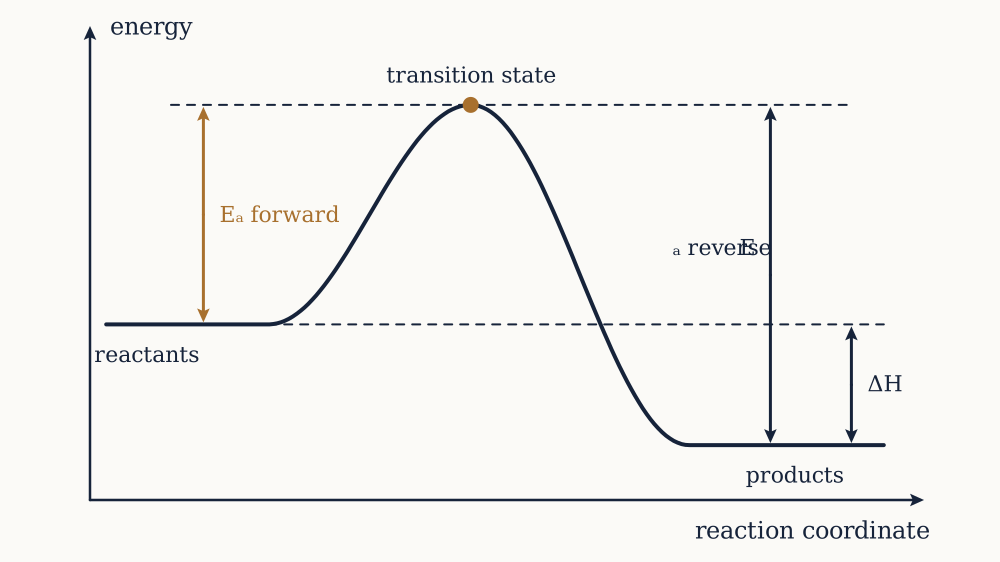
Something other than counting decides which way a mixture moves, and the first candidate is energy. Reactions that go tend to release heat: methane burns and warms the room, and nobody has to be persuaded that the reverse will not happen spontaneously. Making that intuition quantitative means being able to compute the heat of a reaction from tabulated data, for reactions nobody has run, which is the next lesson. It also means finding out, at the end of it, that the intuition is wrong.