Sign in

Libre University uses your GitHub account. Signing in is only needed to sit a final test, so the score is kept on your profile.

Atoms and Elements

How the atom was found, taken apart and finally explained: from combining weights and Rutherford scattering to orbitals, periodic trends and the chemical bond.

The atomic hypothesis

Take a drop of water and halve it, then halve the half, and keep going: does the process ever end? Either you can continue without limit, and matter is a continuum, or you reach a piece that cannot be cut, and matter is grainy. For two thousand years there was no way to decide, because both answers explain everything the unaided eye can see. This lesson is about how that question became a matter of measurement, and how chemists ended up not merely asserting that atoms exist but counting them.

An argument nobody could settle

The discrete answer is ancient. Leucippus and his pupil Democritus, in the fifth century BC, held that the world consists of atomos, literally the uncuttable, moving through a void. Lucretius set it out in verse around 55 BC, arguing from the way a wet pavement dries invisibly and a ring wears thin unseen. Aristotle preferred a continuum built from four qualities, and because his system organised the rest of natural philosophy so conveniently, his view prevailed for eighteen centuries.

The revival was respectable but no more decisive. Newton, in Query 31 of the Opticks (1704), wrote that God had probably formed matter in "solid, massy, hard, impenetrable, movable particles". None of this forbade anything: a continuum theory and an atomic theory predicted the same colour, the same weight, the same behaviour on heating. When two hypotheses agree on every observable, choosing between them is aesthetics.

What broke the deadlock was not a new idea but an old instrument used with new discipline. Lavoisier's insistence in the 1780s that mass is conserved through every reaction, so that the products of a combustion must be caught and weighed rather than allowed to escape, turned chemistry into a science of numbers. Once combining masses were recorded to three significant figures, a pattern appeared that no continuum can produce.

The laws of combining weights

The first regularity was the law of definite proportions: a compound always contains the same elements in the same proportions by mass, whatever its origin. Joseph Proust established this between 1794 and 1804, showing that copper carbonate made in the laboratory matched the mineral dug from the ground, against Claude Berthollet's view that composition varied continuously with the conditions of preparation.

The second regularity is the decisive one. The law of multiple proportions states that when two elements form more than one compound, the masses of one combining with a fixed mass of the other stand in a ratio of small whole numbers. Analysis gives the red oxide of copper as 88.8% copper and 11.2% oxygen by mass, the black oxide as 79.9% and 20.1%. Fix the copper at one gram in each: the red carries 11.2/88.8=0.126 g of oxygen, the black 20.1/79.9=0.252 g, and 0.252/0.126=2.00.

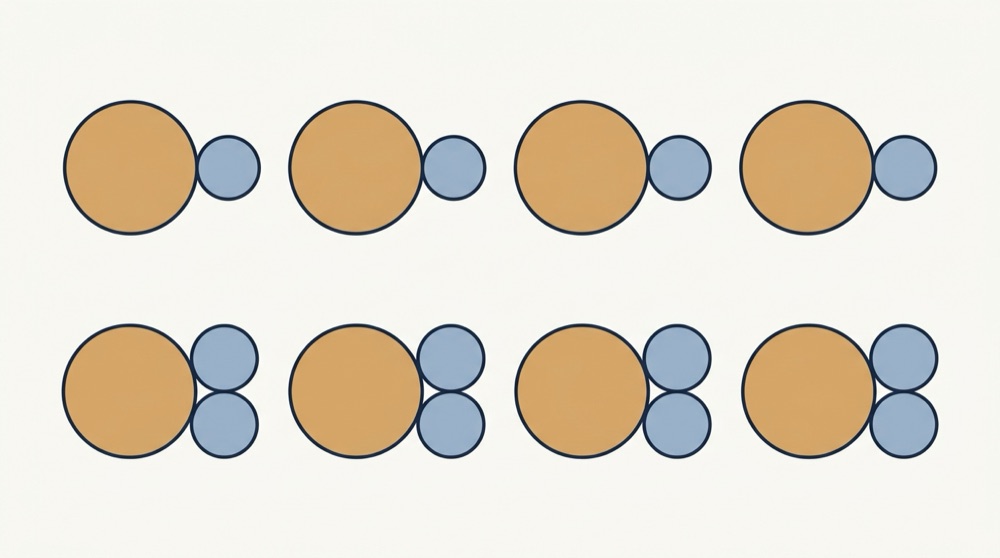
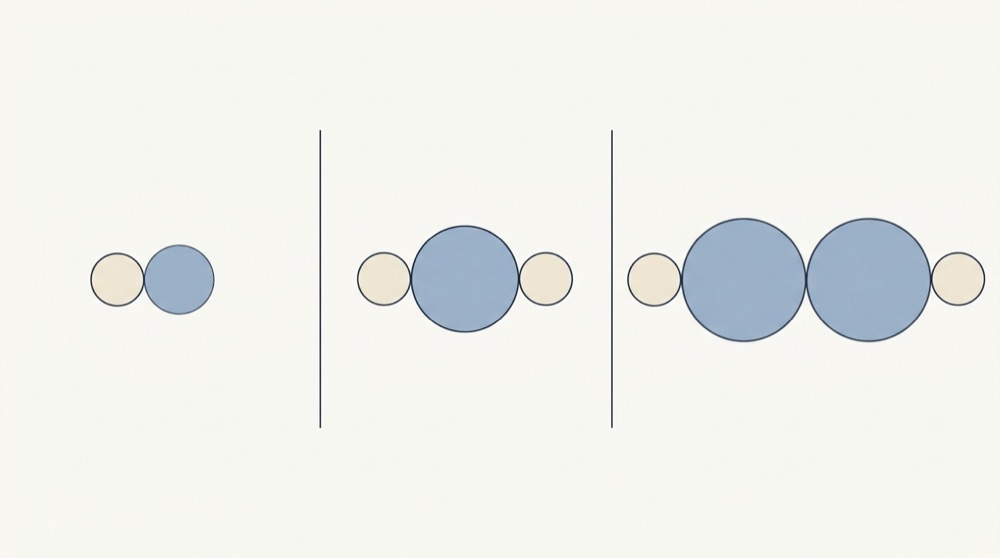
The law of multiple proportions drawn as packets: one row pairing each copper unit with a single oxygen unit for the red oxide, and a second row pairing each copper unit with two oxygen units for the black oxide, so the oxygen per copper stands at exactly one to two rather than at any intermediate amount.

Nothing in the procedure was arranged to give a whole number, and the figures could as easily have yielded 1.87 or 2.34. Nitrogen and oxygen are harder still to dismiss: across the five oxides, the oxygen combining with one gram of nitrogen is 0.571, 1.143, 1.714, 2.286 and 2.857 g, a ratio of 1:2:3:4:5. On a continuous view of matter the oxygen could be adjusted by any amount, and successive compounds would spread anywhere across the range. Small integers appear when, and essentially only when, you combine indivisible packets: one packet of oxygen per packet of copper in the first compound, two in the second. That is the fingerprint of discreteness, visible at the scale of grams because the packets are identical.

Dalton's postulates and their blind spot

John Dalton drew that conclusion between 1803 and 1808, in A New System of Chemical Philosophy. Each element consists of atoms, indivisible and indestructible. All atoms of an element are identical in mass and chemical properties, and differ from those of every other element. Chemical change separates, joins and rearranges atoms but never creates, destroys or transmutes them. Compounds unite atoms of different elements in fixed small whole-number ratios. Conservation of mass, definite proportions and multiple proportions then follow immediately: three empirical laws become consequences of one picture.

Dalton then hit an obstacle he could not remove. Analysis gives the ratio of combining masses, but that one number hides two unknowns: the formula of the compound and the relative masses of its atoms. Eight grams of oxygen per gram of hydrogen fits HO with an oxygen eight times as heavy, H_2O with a factor of sixteen, or H_2O_2 with a factor of thirty-two. One equation, two unknowns, and no measurement of the day could supply the second.
Dalton's blind spot: the same measured mass ratio of eight to one shown fitting three different formulae side by side, a one-to-one compound with a heavy oxygen atom, a two-to-one compound with an oxygen twice as heavy again, and a two-to-two compound heavier still, so the analysis alone cannot say which is water.

He closed the gap by assumption. His rule of greatest simplicity held that where only one compound of two elements was known, it should be taken as binary. So water was HO and ammonia NH, and oxygen came out at about 7, nitrogen at 5. Every one of those numbers is wrong by a simple factor, because the formulae beneath them are wrong, and the result was fifty years of incompatible atomic weight tables.

Volumes, and fifty years of confusion

The missing second equation was already on the table. In 1808 Gay-Lussac reported that gases react in simple ratios by volume at the same temperature and pressure: two volumes of hydrogen and one of oxygen give two volumes of water vapour, and one volume of nitrogen with three of hydrogen gives two of ammonia. Volumes of gas, unlike masses, count something directly, if only one knew what.

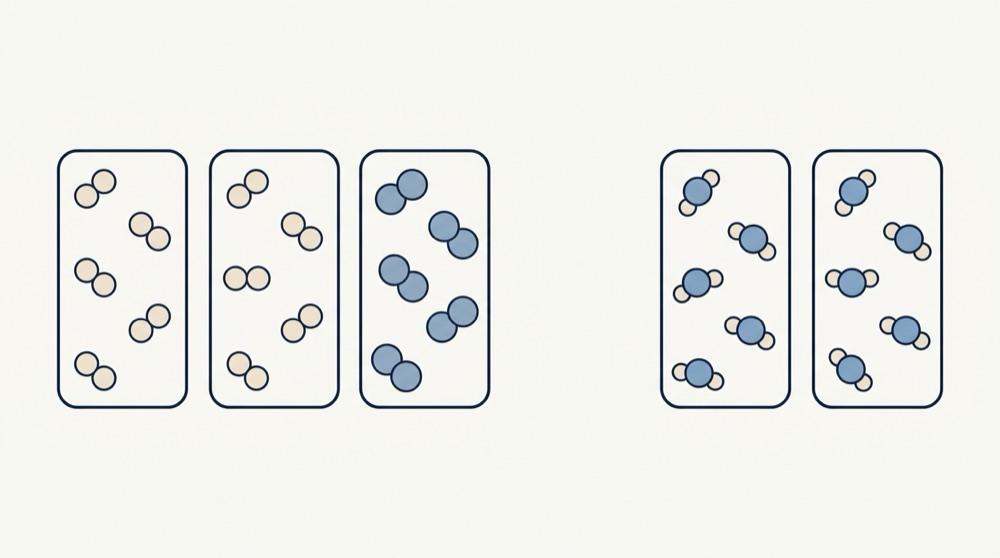
The obvious reading, that equal volumes hold equal numbers of atoms, produced an absurdity. One volume of oxygen yields two volumes of water vapour, so each oxygen particle must end up in two places, splitting the unsplittable. Dalton rejected the experiment instead. In 1811 Amedeo Avogadro offered the resolution: equal volumes of gases at the same temperature and pressure hold equal numbers of molecules, and the molecules of the elementary gases are pairs of atoms. Then O2+2H22H2O balances in atoms and in volumes, water is H_2O, and oxygen weighs 16.

Avogadro's resolution of the combining volumes: two equal jars of hydrogen and one jar of oxygen, each holding the same number of two-atom molecules, reacting to fill two jars of water vapour, so the volumes come out two to one to two while no atom is ever split.

Acceptance took nearly half a century. Chemists used "atom" and "molecule" interchangeably, so the crucial distinction was invisible in the language, and Berzelius held that compounds are bound by opposite charges, which made a molecule of two identical atoms seem self-contradictory. Avogadro published in an obscure journal, proposed no experiments of his own, and died unrecognised in 1856. The cost was chaos, with acetic acid written in the late 1850s in some nineteen competing formulae.

Cannizzaro ended it with a method rather than an argument. In his Sunto of 1858, handed to every delegate at the Karlsruhe Congress of September 1860, he fixed atomic masses unambiguously: take many volatile compounds of an element, get each molecular mass from its vapour density using Avogadro's hypothesis, find how much of the element each molecule holds, and take the highest common factor. Carbon comes out at 12 in compound after compound, never at 6, and the periodic table of 1869 became possible within the decade.

The mole and Avogadro's constant

All of this fixes relative masses, not absolute ones. Chemists still needed a bridge between the gram, which they could weigh, and the mass of one atom, which they could not. That bridge is the mole, the amount of substance containing as many entities as there are atoms in 12 g of carbon-12, and the bridging factor is the Avogadro constant NA, the number of entities per mole. Since 20 May 2019 the SI has defined the mole by fixing NA=6.02214076×10²³mol-1 exactly, but only because the measurement had first been pushed to a few parts in 108.

The essential point is that NA can be extracted from experiment rather than assumed, by routes with nothing in common. Faraday's electrolysis measurements of 1834 gave the charge that deposits one mole of a metal, F=96485 C, so NA=F/e once the elementary charge is known separately. Loschmidt in 1865 combined the mean free path of a gas molecule, obtainable from viscosity, with the volume that gas occupies when liquefied, two relations in the two unknowns of molecular size and number density. Planck, fitting the blackbody spectrum in 1901, got the Boltzmann constant and hence NA=R/kB=6.175×1023, a chemical number wrung out of thermal radiation.

The number resists intuition. A mole of sand grains, each a cubic millimetre, would bury the whole surface of the Earth, oceans included, more than a metre deep, and counting ten million atoms a second would take nineteen hundred million years. The 18 g of water in a small glass holds as many molecules as there are glassfuls of water in all the oceans, which is why Kelvin's challenge works: mark every molecule in your glass, pour it into the sea, let it mix, and any glass drawn afterwards will hold a thousand or so of your marked molecules.

Brownian motion settles the argument

By 1900 the atomic hypothesis was doing enormous work in chemistry and in the kinetic theory of gases, and a serious minority still refused it. Wilhelm Ostwald and Ernst Mach held that atoms were a bookkeeping device with no claim to reality, since nobody had measured one individually. The objection was not foolish: everything on offer was inference from bulk behaviour, and a critic could insist that the bulk behaviour was the real physics and the atoms a picture laid over it.

The answer had been in the literature since 1827, when Robert Brown found that pollen grains suspended in water jiggle ceaselessly, and showed the motion was not biological by finding the same restlessness in powdered rock. Einstein analysed it in 1905. His decisive move was to abandon the velocity of a grain, unmeasurable because the path reverses millions of times a second, and predict instead the mean square displacement of a random walk. Balancing osmotic pressure against Stokes drag on a sphere of radius a in a fluid of viscosity η gives D=RT/(6πηaNA), so

x2=2Dt=RTt3πηaNA.

Every quantity except NA is measurable at the bench. For a grain of radius 0.5 μm in water at 20 °C, where η=1.0×10⁻³ Pa s, this gives D=4.3×10⁻¹³m2s-1 and a root mean square displacement near 7 μm in a minute, comfortable to follow under a microscope. Jean Perrin and his students did exactly that from 1908, tracking grains of gamboge resin at 30 second intervals to get 6.9×10²³.

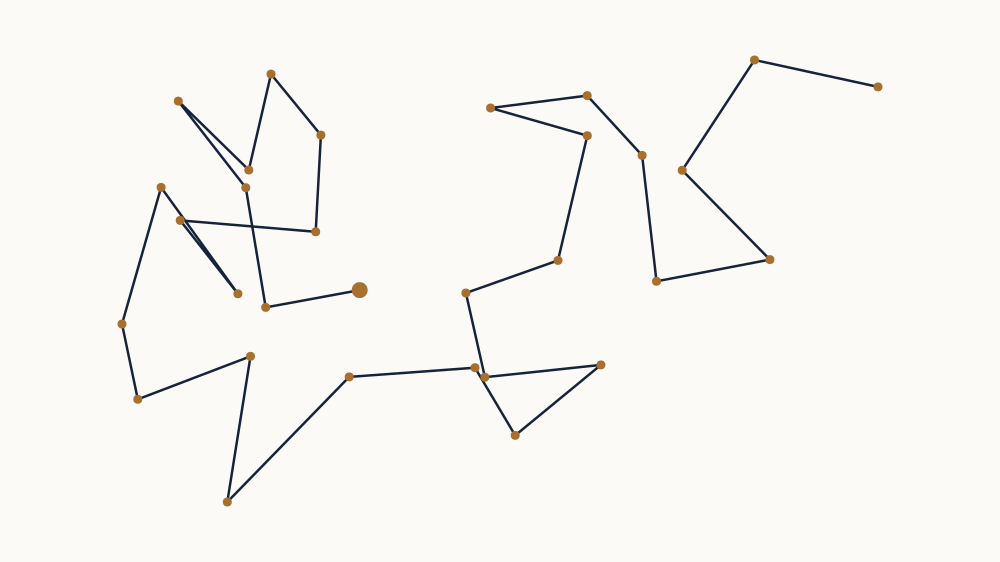
A Brownian random walk as Perrin recorded it: the position of one suspended grain marked at equal time intervals and joined by straight segments into a jagged path that wanders outward from its starting point, spreading with the square root of the time rather than travelling in any one direction.

A second experiment measured the sedimentation equilibrium of the same suspensions, an atmosphere in miniature whose concentration falls exponentially with height, thinning by a factor of e every RT/(mgNA) metres for a buoyancy-corrected grain mass m. Grains of radius 0.21 μm halved in number every 30 μm, which inverts to NA7×1023.

The agreement of independent routes was the whole point, and Perrin drove it home in Les Atomes (1913) by tabulating thirteen determinations: gas viscosity, blackbody radiation, the charge on the electron, the blue of the sky, the alpha particles counted by Rutherford and Geiger against the helium they accumulate. All landed between 6 and 7 ×10²³. Any one could be dismissed as a model-dependent artefact; thirteen converging from unrelated branches of physics could not. Ostwald conceded in 1909, and Perrin took the Nobel Prize in 1926.

The scale of atoms

With NA in hand the absolute numbers follow in a line of arithmetic. A carbon-12 atom has mass 0.012/(6.022×1023)=1.99×10-26 kg and a hydrogen atom 1.67×10⁻²⁷ kg, so it takes some 1026 of them to make a person. Sizes come as easily from bulk density: a cubic centimetre of copper weighs 8.96 g, which is 8.96/63.55=0.141 mol, or 8.5×10²² atoms, and the cube root of that is 4.4×10⁷ atoms along each edge, so neighbouring copper atoms sit 2.3×10⁻¹⁰ m apart.

Two tenths of a nanometre is typical of the whole periodic table. Atomic diameters run from roughly 0.06 nm for helium to 0.3 nm for caesium, a spread of only five across a family whose masses differ by a factor of 300. A cube of air one micrometre on a side, far too small to see, still holds some 27 million molecules.

There is a final irony worth noticing. All this evidence established the reality of an object whose defining property, in its name and in Dalton's postulates alike, was that it could not be divided. Yet the argument was barely won before that property collapsed. In 1897, twelve years before Ostwald's concession, J. J. Thomson had already pulled something smaller out of the atom, and within two decades it had a nucleus, a charge, an internal structure and a set of isotopes that broke Dalton's rule that all atoms of an element weigh the same. Having established that atoms exist, the next lesson takes one apart.
Probing the atom

Atoms were barely established as real before they turned out to have parts. Thomson found the electron in 1897, before Perrin's Brownian motion work had finished convincing the sceptics that atoms exist, and by 1911 the atom had a nucleus. This lesson follows the experiments that took the uncuttable particle apart.

Rays that would not behave

By the 1890s every well equipped laboratory owned an evacuated tube with an electrode at each end. Raise the voltage across a good vacuum and something streams from the cathode, casting sharp shadows and bending in a magnetic field. These cathode rays bent as a negative charge should, which suggested particles, but Heinrich Hertz had failed to deflect them electrically, which suggested waves in the ether.

Thomson broke the deadlock by realising that Hertz's null result came from residual gas: the rays ionised it, and the ions drifted to the plates and cancelled the field. In a harder vacuum the beam bent electrically. He then sent it through an electric field E and a magnetic field B at right angles, arranged so the deflections opposed, and tuned them until the spot returned to its undeflected position. At balance qE=qvB, so the speed follows without knowing the charge:

v=EB

Switching the electric field off leaves the magnetic field to bend the beam into an arc of radius r, where qvB=mv2/r, giving q/m=E/(rB2). Thomson found roughly 1011 C kg⁻¹ (now 1.759×10¹¹) against 9.58×10⁷ for the hydrogen ion, until then the largest charge-to-mass ratio known for anything. Nor did the value shift with the gas in the tube or the metal of the cathode. Every kind of matter emitted the same particle at nearly two thousand times the hydrogen ratio, so it belonged to atoms in general rather than to any one element.

Weighing the electron

A ratio is not a mass, and until e was measured on its own the electron stayed half known. Cavendish cloud methods leaked accuracy, since water droplets evaporate while you watch them. Robert Millikan and Harvey Fletcher solved that in 1909 with a mist of low volatility watch oil sprayed between two horizontal brass plates.

The method is a pair of force balances. With no field applied a drop falls at terminal velocity, its weight matched by the Stokes drag 6πηav, and since the mass is 43πa3ρ, timing the fall gives the radius and hence the weight. X-rays then ionise the air so the drop captures a few ions, and the field is raised until it hangs still, giving qE=mg.

The jumps were the real result. Charge was never continuous: every drop carried an integer multiple of one basic amount, and every change was a multiple of it. Millikan's 1.592×10⁻¹⁹ C sits half a percent below the modern value, an error traced to the viscosity of air he assumed. With Thomson's ratio it gives me=9.11×10⁻³¹ kg, about 1/1836 of a hydrogen atom.

The plum pudding

Atoms are neutral and contain very light negative particles, so they must also hold positive charge carrying nearly all the mass. Thomson's 1904 model, remembered as the plum pudding, spread that charge as a uniform sphere about 10-10 m across, with the electrons embedded in it in rotating rings.

It is easy to sneer at this and quite wrong to do so. Nobody had isolated a light positive particle, so there was no candidate for a compact core. The model was calculable, it made electron rings stable only in particular numbers, and Thomson used that to attempt an account of chemical periodicity. It also matched the small deflections seen when beta and alpha particles crossed thin foils.

A model that is neutral, tractable and consistent with every measurement to hand is a good model. This one was tested and failed, which is the honourable fate of good models, and the test that killed it was set up to check something else entirely.

One alpha in eight thousand

In 1909 Ernest Rutherford handed Hans Geiger and the undergraduate Ernest Marsden a check nobody expected to yield anything. A radium source in a lead block fired alpha particles, helium nuclei of about 7.7 MeV, at a gold foil some 4×10⁻⁷ m thick, around two thousand atomic layers. Observers with eyes dark-adapted for half an hour counted flashes on a movable zinc sulphide screen. Marsden looked for alphas coming back towards the source and found them: roughly one in 8000 turned through more than 90.

To see why that is impossible in the Thomson atom, ask how hard a diffuse sphere can push. The field of a uniform ball of charge peaks at its surface, at Ze/(4πε0R2) with R10-10 m, and an alpha crossing the atom in 10-19 s feels it only briefly. The sideways momentum it gains corresponds to a deflection of a hundredth of a degree, and the electrons, thousands of times lighter, barely move it. Deflections in successive atoms are independent, so they accumulate as a random walk growing with the square root of the layers, and the chance of thousands of tiny kicks conspiring into a reversal is vanishing.

Concentrate the same charge into a ball of radius 10-14 m and the alpha can approach ten thousand times closer, where the inverse square law gives it 108 times the field, so one encounter can turn it round. Rutherford worked this out in 1911 for a point charge and a pure Coulomb force, predicting that the number scattered into unit solid angle at θ varies as

dσdΩ=(Zze216πε0E)21sin4(θ/2)

Geiger and Marsden spent 1913 testing that prediction. The sin-4(θ/2) factor held from 5 to 150 across a count rate varying by 105, and the yield went as the foil thickness, as 1/E2, and as the square of the nuclear charge. That agreement turned a startling anecdote into a measurement.

The same physics bounds the size of the nucleus. Head-on, an alpha stops where all its kinetic energy has become potential energy, at a distance given by E=2Ze2/(4πε0d). Taking e2/4πε0=1.44 MeV fm, a 7.7 MeV alpha on gold stops at 2(79)(1.44)/7.730 fm, an upper limit since it never touched anything. For light elements the scattering later broke away from the Coulomb prediction, showing the alphas had reached something near 10-15 m.

The emptiness of matter

A nucleus of 10-15 m inside an atom of 10-10 m is a ratio of 105 in radius and 1015 in volume. Put a grain of rice on the centre spot of a football stadium and the nearest electrons are up in the tiers.

That grain carries more than 99.9% of the mass, giving nuclear matter a density near 2×10¹⁷ kg m⁻³. A cubic millimetre would weigh two hundred thousand tonnes, and a neutron star is essentially a nucleus the size of a city.

The obvious objection is that matter does not behave as though it were empty, since a table stops your hand. Solidity, though, is electromagnetic rather than geometric. What stops your hand is repulsion between the outer electrons of your skin and those of the table, which fills space even when particles do not. An alpha particle, small and fast and positive, notices only the rare close approach to a nucleus.

The proton and the missing mass

If nuclear charge is Ze, the natural guess is that it is built from hydrogen nuclei, the lightest positive particles known. Rutherford supplied evidence in 1919 by bombarding nitrogen with alphas and detecting hydrogen nuclei emerging, the first artificial transmutation, ¹⁴N + α → ¹⁷O + p. He named the particle the proton the following year.

That created a bookkeeping problem. Helium carries charge 2e but four times the mass of hydrogen, and nitrogen carries 7e with mass 14, so nuclei weigh about twice what their charge implies. The stopgap was to add A-Z electrons to A protons, but confining an electron to 10-14 m demands tens of MeV, far above anything seen in beta decay, and the measured spin of ¹⁴N came out wrong.

James Chadwick settled it in 1932. Bothe and Becker had found that beryllium struck by polonium alphas emits a penetrating uncharged radiation, and the Joliot-Curies showed it knocks protons out of paraffin wax, calling it gamma radiation. Chadwick objected that a photon would need some 50 MeV to eject protons of the observed energy, and measured recoils from hydrogen and nitrogen instead. Elastic collision kinematics gave a projectile mass close to the proton's: the neutron, uncharged, of mass 1.0087 u.

Isotopes and the weighted average

The neutron also explained something chemists had puzzled over. In 1913 Thomson deflected positive rays of neon and found two traces, at masses 20 and 22, from a chemically single gas. Frederick Soddy had already named such variants isotopes, meaning same place in the periodic table, and Francis Aston built a mass spectrograph that eventually catalogued over two hundred. Isotopes share Z, so they are chemically identical, and differ in neutron number, so they differ in mass.

A mass spectrometer refines Thomson's apparatus. Atoms are ionised and accelerated through a potential difference V, so that 12mv2=qV, then bent by a magnetic field into an arc of radius r=mv/(qB), which combine to give m/q=B2r2/2V. Where an ion lands identifies its mass, and the current it deposits measures how much of it there is.

This is why relative atomic masses are rarely whole numbers. A relative atomic mass is an abundance-weighted average over the isotopes in a natural sample. Chlorine is the standard case: ³⁵Cl has mass 34.969 u and abundance 75.76%, ³⁷Cl has mass 36.966 u and abundance 24.24%, and 0.7576×34.969+0.2424×36.966=35.45, the figure on the periodic table. No chlorine atom weighs 35.45 u: three in four weigh 35 and one in four weighs 37.

Why the nucleus holds

Packing positive charges into 10-15 m ought to be impossible. Two protons 2 fm apart repel with a force of about 58 N, trivial for a person and colossal for a particle of mass 1.7×10⁻²⁷ kg. Gravity between them is weaker than that repulsion by a factor of 1036, so nothing in the forces known in 1932 could hold a nucleus together.

The answer is a further force, the strong nuclear force, attractive between nucleons, indifferent to whether they are protons or neutrons, and about a hundred times stronger than electrostatic repulsion at close quarters. Its defining property is that it dies away almost entirely beyond 2 fm. Yukawa explained that range in 1935 by proposing an exchange particle whose mass sets the scale, predicting some 150 MeV; the pion, found in 1947, weighs 140 MeV.

The short range has consequences you will meet again. Each nucleon binds only to its neighbours, so binding energy grows in step with nucleon number and settles near 8 MeV each, while Coulomb repulsion is long ranged and every proton pushes every other. Heavy nuclei therefore need surplus neutrons to dilute the repulsion, and the neutron to proton ratio climbs from 1 in light elements to about 1.5 in lead. Past bismuth, Z=83, nothing is stable.

By 1932 the picture looked complete: a dense nucleus of protons and neutrons held by the strong force, with electrons somewhere outside. The trouble is that this atom cannot exist. An orbiting electron is accelerating, classical electromagnetism says an accelerating charge radiates, and the orbit should collapse in about 10-11 s. Classical mechanics also allows any orbital radius at all, so it cannot say why every hydrogen atom is the same size, nor why atoms emit sharp spectral lines. Rutherford's nucleus is correct and mechanically impossible at once, and that contradiction is where the next lesson begins.

The quantum atom

Rutherford's nuclear atom solved one problem and created a far worse one, because the picture it forces on us is one that classical physics says cannot exist for even a hundredth of a nanosecond.

The atom that should collapse

The nuclear atom leaves electrons outside a tiny positive core, and they cannot simply sit there: an electrostatic attraction with nothing opposing it would pull them straight in. The obvious repair is orbital motion, with the Coulomb attraction supplying the centripetal force exactly as gravity does for a planet. That is what Rutherford proposed, and what every textbook diagram still draws.

The trouble is that an electron is not a planet, because it carries charge, and Maxwell's electrodynamics is unambiguous on the point: an accelerating charge radiates. The Larmor formula gives the radiated power for a non-relativistic charge of acceleration a as

P=e2a26πε0c3

and a body in circular motion is accelerating continuously, since its velocity is changing direction even at constant speed. An orbiting electron must therefore leak energy without pause.

Energy lost means a smaller orbit, a smaller orbit means larger acceleration, and larger acceleration means faster loss still, so the collapse runs away with itself. Integrating the Larmor result for an electron starting at a typical atomic radius of about 53 pm gives a lifetime of roughly 1.6×10⁻¹¹ s, with a continuous smear of ever-rising frequency radiated on the way down. This is not a rough edge to be tidied up later. It is a falsification: classical physics, applied honestly to the atom that experiment had just revealed, says no atom survives ten picoseconds and matter cannot exist. Since matter conspicuously does exist, one of the assumptions feeding that calculation is wrong.

The light atoms emit

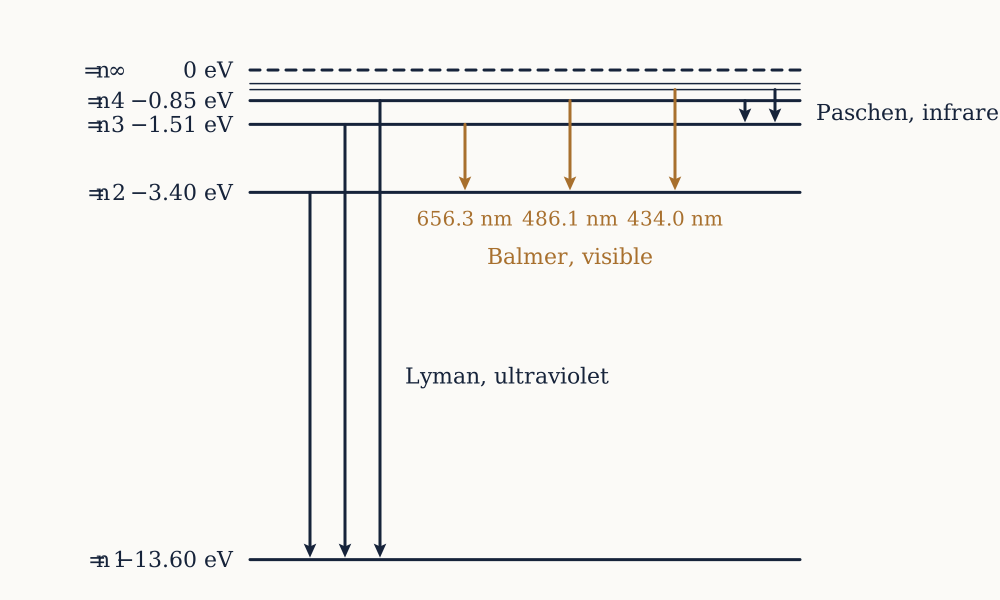
A second failure was already sitting in the laboratory, decades old and equally unexplained. Pass a discharge through a low-pressure gas and it glows; disperse that glow through a prism and you do not get the continuous rainbow a spiralling electron would produce. You get sharp, isolated lines at fixed wavelengths, and the pattern is a fingerprint of the element. Hydrogen gives a red line at 656.3 nm, a blue-green one at 486.1 nm, then violet lines crowding towards a limit.

In 1885 Johann Balmer, a Swiss schoolmaster with no theory in mind, found that those visible hydrogen wavelengths were fitted by a simple formula involving small integers. Johannes Rydberg generalised it to cover every hydrogen line, ultraviolet and infrared as well as visible:

1λ=RH(1n12-1n22)

where n1 and n2 are positive integers with n2>n1, and RH1.097×107 m⁻¹. Setting n1=2 recovers Balmer's visible series, n1=1 gives the ultraviolet Lyman series, n1=3 the infrared Paschen series.

The formula matches measured wavelengths to five or six significant figures. It was also, at the time, entirely unexplained. Nobody could say what RH was made of, why integers should appear at all, or why an atom would care about the difference of two reciprocal squares. Empirical numerology of this precision is a signpost: something deep is going on, and the theory that explains it will not be a small adjustment.

Bohr's quantum condition

In 1913 Niels Bohr took the two failures together and made a single radical assumption. Electrons, he proposed, may occupy only certain stationary states, orbits in which, by fiat, they do not radiate. Radiation happens only when an electron jumps between two of them, carrying away exactly the energy difference as one photon, hν=E2-E1. The rule picking out the allowed orbits is that angular momentum comes in whole multiples of :

L=mevr=n,n=1,2,3,

Everything else is ordinary mechanics. Setting the Coulomb attraction equal to the centripetal force required for a circular orbit gives

e24πε0r2=mev2r

Eliminating v using v=n/mer and rearranging for the radius yields

rn=n224πε0mee2

Put n=1 and every symbol on the right is a measured constant, so the answer is a pure prediction with nothing fitted: 52.9 pm. That is the Bohr radius a0, the size of a hydrogen atom, a quantity classical physics could not produce at all.

The energy follows just as directly. The kinetic energy is e2/8πε0r and the potential energy is -e2/4πε0r, so the total is exactly half the potential energy, negative and therefore bound. Substituting rn gives

En=-mee4(4πε0)222n2=-13.6eVn2

Take the difference between two levels, set it equal to hc/λ, and the Rydberg formula falls out of the algebra with RH=mee4/8ε02h3c. Evaluate that combination of constants and you get 1.097×10⁷ m⁻¹. Balmer's schoolroom fit had been derived from first principles, and the ionisation energy of hydrogen, 13.6 eV, came free with it.

What Bohr could not explain

The triumph was real and it was also narrow. Apply the same treatment to helium, with its two electrons, and it fails outright: the predicted spectrum is simply wrong, and no patching with elliptical orbits or relativistic corrections rescued it. A theory of the atom that works only for the one atom with a single electron is not yet a theory of the atom.

It was silent on other observables too. Spectral lines differ enormously in brightness, and the model offers no way to calculate the intensity of a transition, or to say why some occur readily and others hardly at all. Nor could it handle line splitting in magnetic fields beyond the crudest cases.

Deeper than either failure is the conceptual incoherence. Bohr uses classical mechanics to fix the orbits, then forbids classical electrodynamics from acting on them, with no principle deciding when each applies. The quantisation of angular momentum is asserted, not explained. And the electron is still a particle on a definite track at a definite radius, exactly the picture the following decade would destroy.

Matter waves

The missing principle arrived in 1924 in Louis de Broglie's doctoral thesis. Light had already been forced to be both wave and particle, with a photon of momentum p carrying wavelength λ=h/p. De Broglie proposed that the symmetry runs both ways, so that any particle of momentum p has a de Broglie wavelength

λ=hp

For a cricket ball the wavelength is around 10-34 m and unobservable. For an electron in an atom it is comparable to the atom itself, so wave behaviour ought to dominate. Davisson and Germer confirmed it in 1927 by diffracting electrons off a nickel crystal.

The payoff is immediate. If the electron is a wave running round a circular orbit, the only stable arrangement is one where the wave joins smoothly onto itself after a complete circuit, a standing wave containing a whole number of wavelengths. That condition is 2πr=nλ, and substituting λ=h/p gives pr=nh/2π, which is mevr=n. Bohr's arbitrary postulate is nothing more than the requirement that a wave fit round a loop.

The wavefunction and what it means

Erwin Schrödinger took the idea seriously enough to ask what equation such a wave obeys. His answer, in 1926, plays for quantum mechanics the role Newton's second law plays for classical mechanics. For a single electron in the field of a nucleus, the time-independent form is

-22me2ψ+Vψ=Eψ

where V=-e2/4πε0r is the Coulomb potential. This is an eigenvalue problem: for most values of E the only solution that stays finite and vanishes at infinity is ψ=0. Acceptable solutions exist only for a discrete set of energies, and for hydrogen those come out as -13.6eV/n2. Quantisation is no longer postulated. It is what happens when you demand well-behaved solutions to a wave equation in a confining potential, just as a string fixed at both ends can sound only a discrete set of harmonics.

What remains is to say what ψ, the wavefunction, actually is. Max Born supplied the answer: ψ itself is not observable, but |ψ|2 is a probability density, so |ψ|2dV is the probability of finding the electron in a small volume dV there. The electron is not smeared out as a substance; the theory simply does not assign it a trajectory, only a distribution of outcomes for a measurement of position. What replaces the orbit is the orbital, a one-electron wavefunction whose squared modulus says where that probability lies, and which has no edge, since |ψ|2 decays exponentially without ever reaching zero.

Werner Heisenberg's uncertainty principle, ΔxΔp/2, explains why nothing sharper is on offer. Confining an electron to a region the size of an atom forces a momentum spread large enough to make a definite orbit meaningless. Asking exactly where the electron is, and how fast it is going, is not a hard question awaiting better apparatus. It is a question the physics declines to answer.

The four quantum numbers

Solving the equation in spherical coordinates produces three integers automatically, one from each coordinate. The principal quantum number n, taking values 1,2,3,, fixes the energy in hydrogen and sets the overall size of the orbital. It is the same n that appeared in Balmer's formula and Bohr's derivation.

The azimuthal quantum number controls the orbital angular momentum, whose magnitude is (+1), and with it the shape of the orbital. It runs from 0 to n-1, and the values 0,1,2,3 are labelled s, p, d and f for spectroscopic reasons. So n=1 permits only 1s, while n=3 permits 3s, 3p and 3d.

The magnetic quantum number m fixes the component of angular momentum along a chosen axis, and therefore the orientation of the orbital in space. It takes the 2+1 integer values from - to +, which is why there are three p orbitals and five d orbitals. Orientation affects energy only when an external field breaks the symmetry, which is what Zeeman splitting reveals.

The fourth label does not come from the equation at all. The spin quantum number ms takes the values +12 and -12, and spin is an intrinsic angular momentum with no classical analogue and no relation to any spatial coordinate. It was forced on physics by the Stern-Gerlach experiment and by the doubling of spectral lines, and it completes the specification of an electron's state.

The shapes of orbitals

An s orbital has =0, no angular momentum and no preferred direction, so it is spherically symmetric: |ψ|2 depends on r alone. The p orbitals have one unit of angular momentum and a nodal plane through the nucleus, giving the familiar two-lobed dumbbell aligned along x, y or z, with opposite algebraic sign in the two lobes, a detail that becomes essential for bonding. Four of the five d orbitals have two nodal planes and the resulting four-lobed clover shape.

The nodes are where the physics shows through. A node is a surface on which ψ vanishes, and the electron is never found there. Every orbital has n-1 in total: angular nodes, the planes or cones that carve out the lobes, and n--1 radial nodes, spherical shells where the wavefunction changes sign. A 3s orbital therefore has two radial nodes and no angular ones, a sphere within a sphere within a sphere.

To ask how far the electron is from the nucleus you need the radial distribution function, P(r)=4πr2|ψ|2, which weights the probability density by the surface area of a shell at radius r. For hydrogen 1s, |ψ|2 is largest at the nucleus itself, yet there is almost no volume there. With the 4πr2 factor included, P(r)=(4r2/a03)e-2r/a0, and differentiating shows the maximum sits at r=a0, precisely the 52.9 pm Bohr had calculated. The most probable distance survives; the definite orbit does not.

Every result here is exact, and that is its limitation. The Schrödinger equation has a closed-form solution for hydrogen because it is a two-body problem, one electron and one nucleus. Add a second electron and it repels the first, so the potential depends on both positions at once and no exact solution exists for helium or anything beyond it. Whether the language of orbitals and quantum numbers survives the move to the other ninety-odd elements, and what must be added to make it work, is the subject of the next lesson.

Many-electron atoms

Hydrogen is the only atom whose Schrödinger equation can be solved exactly, and everything we know about the other ninety or so elements is built on approximations to that one clean result.

The problem with the second electron

The hydrogen solution worked because of a symmetry: one electron, one nucleus, a potential depending only on the separation r. The equation splits into radial and angular parts and the energy depends on n alone, so 2s and 2p come out exactly degenerate: costs nothing. Now write the Hamiltonian for N electrons around a nucleus of charge Z:

Hˆ=i=1N(-22mei2-Ze24πε0ri)+i<je24πε0rij

The first sum is harmless: every term refers to a single electron, so it separates into N hydrogen-like problems. The second, the electron-electron repulsion, ruins everything. The distance rij between two electrons cannot be split into a piece belonging to electron i and a piece belonging to electron j, so the variables will not separate and the equation has to be solved whole. This is not a failure of ingenuity: helium simply has no closed-form solution.

Chemistry uses the orbital approximation instead. Pretend each electron moves not in the jittering field of individual neighbours but in the smooth averaged field of the nucleus plus the smeared-out cloud of the others. The problem becomes N one-electron problems, solved self-consistently, and we keep the hydrogen labels and can still speak of an electron as being in an orbital. What we lose is that the energies no longer depend on n alone.

Spin and the exclusion principle

The previous lesson introduced a fourth quantum number with no classical counterpart. Spin is an intrinsic angular momentum carried by the electron itself, quantised so that ms=+12 or -12 and nothing else. It is not a rotating ball, a picture that fails on dimensional grounds, but it is measurable: a beam of silver atoms in an inhomogeneous magnetic field splits into exactly two.

The Pauli exclusion principle states that no two electrons in an atom may share all four quantum numbers n, , m and ms. Its deeper form is that the total wavefunction must change sign when any two electrons are exchanged. It is not a force, and no energy is transferred when it operates. It restricts which states can exist at all, and it is the reason matter takes up space.

The counting follows. For a given n, runs from 0 to n-1; each has 2+1 values of m; each spatial orbital takes two electrons of opposite spin. A subshell therefore holds 2(2+1) electrons, two for s and six for p, ten for d, fourteen for f, and over a whole shell,

=0n-12(2+1)=2n2

which gives 2, 8, 18 and 32. These capacities are not fitted to the periodic table: they follow from counting and symmetry, and the table has to live with them.

Shielding and the effective nuclear charge

In the orbital approximation an outer electron never feels the bare nuclear charge, because the inner electrons stand between it and the nucleus and cancel part of it. The bookkeeping device is the effective nuclear charge Zeff=Z-S, where the shielding constant S counts the units of charge cancelled. Gauss's law gives the intuition: charge lying inside radius r acts as though it sat at the centre, and charge outside contributes nothing.

Sodium's outer electron would see Zeff=1 if shielding were perfect. It does not, because orbitals overlap. Slater's rules estimate S crudely: for an s or p electron of shell n, each other electron in that shell contributes 0.35, each electron in shell n-1 contributes 0.85, and each deeper one a full 1.00. For sodium's valence electron in 1s22s22p63s1 that gives S=8×0.85+2×1.00=8.80, so Zeff=2.20. Put into E-13.6Zeff2/n2 eV that predicts 7.3 eV against a measured 5.14 eV: the right scale, the wrong detail.

The trends matter more than the values. Across the second period each added proton is only partly offset by the added electron, since same-shell shielding is worth a mere 0.35 of a unit:

ElementZSZeff
Li31.701.30
Be42.051.95
B52.402.60
C62.753.25
N73.103.90
O83.454.55
F93.805.20
Ne104.155.85

Neon's valence electrons feel an effective charge four and a half times lithium's, which is why atoms shrink and grow harder to ionise from left to right.

Penetration and the end of the degeneracy

Shielding also breaks the hydrogen degeneracy, through penetration: the extent to which an orbital places density inside the region occupied by the core. In hydrogen 2s and 2p are identical in energy. In lithium 2s lies about 1.85 eV below 2p, which is why the ground state is 1s22s1. Nothing about the nucleus distinguishes those two orbitals. The other two electrons do.

To see why, use the radial distribution function P(r)=r2|Rn(r)|2, the probability of finding the electron in a thin shell between r and r+dr. It matters more than the wavefunction because it weights density by the volume available at each radius. An orbital has n--1 radial nodes, so 2s has one and 2p none, and that node gives 2s a small subsidiary lobe at short range while 2p rises smoothly to a single maximum.

Lithium's 1s density peaks at a fraction of the Bohr radius. The inner lobe of 2s overlaps it; 2p is essentially absent there. A 2s electron therefore spends part of its time inside the core, unscreened, feeling nearly the full +3. That fraction is small, but the potential there is enormously deep, so the average comes out decisively lower.

Hence the rule that governs everything from here: within a shell the ordering is s<p<d<f. Higher brings fewer radial nodes and a larger centrifugal term (+1)2/2mer2 in the effective radial potential, a barrier pushing the electron out. High- orbitals cannot get in, are screened efficiently and lie high; low- orbitals sneak in, feel more of the nucleus and lie low.

Building up the ground state

The aufbau principle builds a ground state by adding electrons one at a time to the lowest orbital Pauli still allows, in the order given by the (n+) rule: increasing n+, with ties broken by the lower n. That yields 1s, 2s, 2p, 3s, 3p, 4s, 3d, 4p, 5s, 4d, 5p, 6s, 4f.

The famous case is 4s before 3d, since n+ is 4 for one and 5 for the other, and the physics behind the arithmetic is penetration. Three radial nodes give 4s inner lobes reaching deep into the argon core, where they are barely shielded. The 3d orbital is compact, its main density closer in, but it has no inner lobes and the =2 centrifugal barrier keeps it out of the core. Screened by eighteen electrons and penetrating none of them, 3d sits above 4s in potassium and calcium.

Hund's rule of maximum multiplicity settles the case where a subshell offers several orbitals of equal energy: the ground state is the one with the greatest number of unpaired parallel spins. Carbon puts its two 2p electrons in different orbitals with parallel spins rather than pairing them, nitrogen has three unpaired, and only at oxygen does pairing begin.

The reason usually given, that separated electrons repel less, is the less interesting half of it. The real mechanism is exchange energy, a purely quantum effect. Antisymmetry requires that two electrons with parallel spins have an antisymmetric spatial function, and such a function vanishes when their positions coincide, so parallel electrons carry a built-in Fermi hole and keep apart by symmetry rather than by force. The stabilisation scales with the number of parallel pairs, N(N-1)/2: three for nitrogen's 2p3, ten for manganese's 3d5.

Configurations, and the awkwardness of the d block

Writing a configuration is now mechanical. Phosphorus is 1s22s22p63s23p3, with three unpaired p electrons by Hund's rule. Noble-gas shorthand replaces a completed core with the preceding noble gas, so that becomes [Ne]3s23p3, sodium is [Ne]3s1 and bromine [Ar]3d104s24p5. Iron is [Ar]3d64s2: fill 4s, then start on 3d.

Here is the subtlety that catches everyone. Although 4s fills first, its electrons are the first to leave on ionisation. Fe²⁺ is [Ar]3d6, with 4s emptied and the 3d population untouched, and every first-row transition metal behaves the same way. How can an orbital be filled first and emptied first?

Because orbital energies are not fixed properties of a shell. They depend on the nuclear charge and on which orbitals are already occupied. As Z rises across the d block the poorly shielded 3d orbitals contract and fall, so by scandium 3d already lies below 4s in the neutral atom. The atom keeps two electrons in 4s anyway, because what is minimised is the total energy rather than the sum of orbital energies, and those contracted 3d orbitals are compact enough that filling them costs a heavy repulsion penalty. Ionise, and you take the outermost and least tightly bound electron, which is 4s.

Chromium and copper break the pattern outright, coming out as [Ar]3d54s1 and [Ar]3d104s1. The usual explanation, that half-filled and filled shells are especially stable, is a mnemonic dressing up the exchange argument, not a law. Here 3d and 4s lie within a fraction of an electronvolt of each other, so the outcome turns on small quantities: the cost of pairing in a compact orbital, the exchange stabilisation of parallel d spins, and d-d repulsion. How narrowly it tips shows in the elements that ignore it. Niobium is [Kr]4d45s1, palladium [Kr]4d10 with an empty 5s, and tungsten reverts to [Xe]4f145d46s2 despite sitting directly below chromium and molybdenum.

The evidence: successive ionisation energies

All of this is a model, and models need testing. The cleanest test is to strip an atom of its electrons one at a time. The nth successive ionisation energy detaches the nth electron from the (n-1)-fold charged ion, so the sequence reads out directly how the electrons were organised.

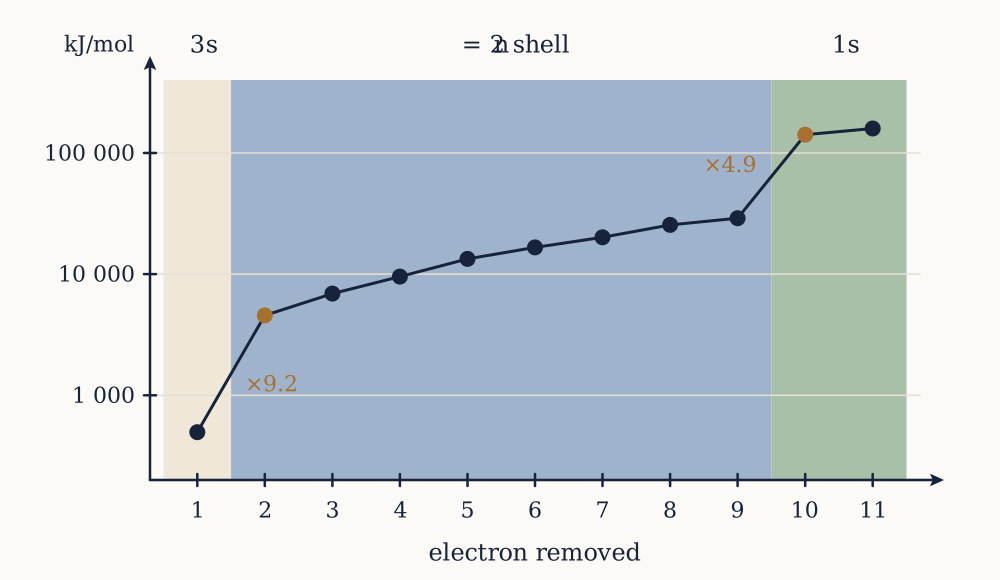
Take sodium. In kilojoules per mole its eleven values are 496, then 4562, 6910, 9543, 13354, 16613, 20117, 25496, 28932, and finally 141362 and 159076. The first electron leaves for a modest price; the second costs more than nine times as much. Seven further removals raise the price steadily but never abruptly, until the tenth demands almost five times the ninth. The groupings run one, eight, two: the 3s electron, the n=2 shell, the 1s pair, with sizes exactly the 2n2 capacities Pauli demands.

The size of the jumps is as telling as their position. Within a shell, each removal leaves the rest at roughly the same radius while raising Zeff by a little under a unit, so the cost climbs smoothly. Breaking into a new shell means reaching an electron at a far smaller radius held by a much larger effective charge, and the energy leaps by a factor of five to ten. Magnesium says the same in a different signature: 738 and 1451, then 7733.

We now have a procedure that takes an atomic number and returns a configuration, with a physical account of why that one and not another. The next lesson lays those configurations out in order of Z and finds that the periodic table, discovered decades before any of this theory existed, is the aufbau sequence written on a grid.

Periodicity

The previous lesson gave the rules for putting electrons into orbitals, and this one is what those rules look like with every element laid out side by side. The periodic table is not a filing system for chemical facts, it is the electron configurations of the elements in order of atomic number, folded so that atoms with matching outer configurations share a column. Every trend on it follows from two quantities: the effective nuclear charge Zeff felt by an outer electron, and the principal quantum number n of its shell. Zeff sets how hard the nucleus pulls, n how far out the electron sits, and what follows is an argument about which is winning.

A table that predicted elements nobody had seen

Dmitri Mendeleev was not the first to notice that chemical properties recur, but he was the first to trust the recurrence more than the data. Arranging the known elements by atomic weight in 1869, he found valency and reactivity recurring at intervals, and where the pattern demanded an element no laboratory possessed he left the square empty. A catalogue can only be wrong about what it contains; a theory can be wrong about what it omits.

He went further and specified them. His eka-silicon, the gap below silicon in group 14, was described in 1871 with a mass, a density, an oxide and the volatility of its chloride. Clemens Winkler isolated germanium from argyrodite in 1886.

PropertyEka-silicon, predicted 1871Germanium, measured 1886
Atomic weight7272.3
Density / g cm⁻³5.55.47
OxideEsO2, density 4.7GeO2, density 4.70
Chlorideboils below 100 degrees Celsius, density 1.9boils at 86 degrees Celsius, density 1.88

Gallium and scandium had already arrived in 1875 and 1879 with comparable agreement. Predictions of that precision about substances nobody had handled are not what a lucky filing scheme produces. The table was reporting something physical, and that something was electron structure.

Moseley and the ordering variable

Mendeleev's arrangement carried a flaw he could not explain. Strict ordering by atomic weight put tellurium (127.6) after iodine (126.9), and argon (39.9) after potassium (39.1), placing each in a group whose chemistry it plainly did not share. He inverted both pairs on chemical grounds, contradicting his own rule and suspecting the weights were simply wrong.

The resolution came in 1913 from Henry Moseley, who bombarded metal targets with electrons and measured the X-rays emitted as an electron fell into a vacancy in the innermost shell. The frequencies did not scale with atomic weight; they obeyed ν(Z-σ), with Z an integer stepping up by one along the table and σ near 1 for the K series, just as a one-electron Bohr calculation predicts.

That integer is the nuclear charge, and Moseley showed it, not mass, orders the elements. Tellurium at Z=52 genuinely precedes iodine at Z=53; the weights invert only because tellurium's stable isotopes are neutron-rich. The same argument settled argon and potassium, and cobalt and nickel, and since Z counts without skipping it fixed how many gaps were left to fill.

The shape of the table is orbital filling

Read the table left to right and you are reading the aufbau order out loud. In the two columns on the left the outermost electron enters an s orbital, in the six on the right a p, in the ten in the middle a d, in the detached strip an f. These are the blocks, and their widths are the degeneracies 2(2+1), doubled by spin: two, six, ten, fourteen.

The period lengths follow. Period 1 offers only 1s and holds two elements; periods 2 and 3 offer ns and np, so eight each. From period 4 the (n-1)d set has fallen below np and slots in after ns, giving 2+10+6=18, and period 5 repeats it. Period 6 adds 4f: 2+14+10+6=32. The sequence 2,8,8,18,18,32 is a census of orbital capacity in filling order.

The f block is pulled out beneath the main body for the width of the page: printed in full the table would be thirty-two columns across, driving the transition metals far from the elements they resemble. That is typography rather than chemistry, and it hides the fact that the lanthanides sit inside period 6, not below it.

Size: atomic and ionic radii

Cross period 2 and each step adds a proton and an electron, the electron joining the same n=2 shell. Electrons in one shell screen each other poorly, so Zeff climbs by roughly 0.65 per step while n is unchanged, and the shell is reeled in: lithium 152 pm, beryllium 112, boron 85, carbon 77, nitrogen 75, oxygen 73, fluorine 71. Descend group 1 and Zeff barely moves, since each new inner shell screens almost completely, while n grows: 152, 186, 227, 248, 265 pm to caesium.

Ions restate the argument more violently. Cations shrink because stripping sodium's lone 3s electron removes a whole shell, leaving Na+ at 102 pm against the atom's 186. Anions expand because adding an electron to chlorine leaves n alone but shares seventeen protons among eighteen electrons, cutting Zeff and swelling the ion to 181 pm from a covalent radius of 99.

An isoelectronic series isolates the effect. N3-, O2-, F-, Na+, Mg2+ and Al3+ all hold ten electrons in the same configuration, so n and the shielding are fixed and only Z varies. The radii fall monotonically: 146, 140, 133, 102, 72, 53 pm.

One irregularity earns its own name. The 4f electrons added across the lanthanides are diffuse and shield badly, so Zeff creeps up over fourteen consecutive elements and the atoms contract. This lanthanide contraction of some 15 pm lands on everything after it in period 6. Hafnium ends up the same size as the zirconium above it (159 pm against 160, and 71 against 72 as 4+ ions), so the two are chemically almost inseparable.

Ionisation energy and its two dips

The first ionisation energy is the work needed to remove the least tightly held electron, and by Coulomb's law it scales as Zeff over the orbital radius. It therefore rises across a period and falls down a group, mirroring size. Period 2 runs 520, 899, 801, 1086, 1402, 1314, 1681, 2081 kJ mol⁻¹ to neon, while group 1 falls 520, 496, 419, 403, 376 to caesium.

Two of those numbers go the wrong way, and both are diagnostic. Boron (801) is easier to ionise than beryllium (899) because beryllium's outermost electron is a 2s and boron's a 2p. The 2p orbital penetrates the 1s core less, so it is screened more effectively and lies higher in energy despite boron's greater nuclear charge. The same group 2 to group 13 dip recurs between magnesium and aluminium, direct evidence that s and p subshells are split.

Oxygen (1314) is likewise easier to ionise than nitrogen (1402). Nitrogen's 2p3 puts one electron in each 2p orbital with parallel spins, as Hund's rule requires. Oxygen's fourth 2p electron finds no empty orbital and must pair, and two electrons in one region repel strongly. That penalty is handed back when the electron leaves, and the same group 15 to group 16 dip appears between phosphorus and sulfur.

Electron affinity, the awkward cousin

Electron affinity is the energy released when a gaseous atom accepts an electron. Broadly it grows across a period with Zeff and shrinks down a group as n grows, so the halogens are the champions while the noble gases and group 2 metals give negative values, meaning an unbound anion. The trend is much rougher than the ionisation trend, because the incoming electron joins a crowded shell and the repulsion can rival the nuclear attraction.

Nitrogen is the clearest case. Its affinity is about -7 kJ mol⁻¹, effectively zero, because the arriving electron must pair up in a half-filled 2p3 set and the repulsion nearly cancels the attraction. Carbon, which still has a genuinely empty 2p orbital, releases 122 kJ mol⁻¹.

Fluorine breaks the naive expectation outright. Sitting above chlorine with the higher Zeff and smaller radius, it ought to be the better acceptor, yet it releases 328 kJ mol⁻¹ against chlorine's 349. Fluorine's 2p shell is so compact that seven electrons are already packed into a tiny volume and an eighth arrives into severe repulsion, while chlorine's roomier 3p shell buys the same pull at a lower crowding cost.

Electronegativity

Electronegativity is not an experimental quantity in the way ionisation energy is. Linus Pauling defined it thermochemically in 1932, noting that a bond between unlike atoms is almost always stronger than the mean of the two homonuclear bonds and attributing the excess Δ to ionic character:

|χA-χB|=0.102Δ,Δ=D(AB)-D(AA)D(BB)

with Δ in kJ mol⁻¹. Only differences are defined, so the scale needs an anchor, and fluorine takes the maximum at 3.98, with caesium at 0.79 and francium near 0.7.

Robert Mulliken offered a cleaner justification. An atom that both holds its own electrons tightly and welcomes new ones will draw electron density towards itself in a bond, so χM(I+A)/2. Suitably scaled, Mulliken values track Pauling values closely, and both rise across a period and fall down a group for the reasons you now expect.

The caveat matters. Electronegativity belongs to an atom in a molecule rather than to an isolated atom, and it shifts with oxidation state, hybridisation and neighbouring groups: carbon is more electronegative in an sp hybrid than in an sp3 one, because more s character means more penetration towards the nucleus. The tabulated numbers are a useful average, not a constant.

Metals, diagonals and the anomalous first row

Metallic character is what low ionisation energy looks like in bulk. An element whose valence electrons are weakly held surrenders them to a delocalised sea, giving lustre, malleability and conduction, so metals crowd the bottom left where Zeff is low and n high, non-metals the top right, and the metalloids run diagonally between them. The oxides trace the same gradient, from basic sodium oxide through amphoteric alumina to acidic sulfur trioxide.

Because Zeff rises rightwards and n downwards, a step right combined with a step down partly cancels the two and leaves charge density roughly unchanged. This is the diagonal relationship. Lithium resembles magnesium more than sodium: both form normal oxides rather than peroxides, both combine directly with N2, and both have carbonates that decompose on heating. Beryllium resembles aluminium: amphoteric oxides, covalent bridged chlorides, passivation by an oxide film.

That diagonal is a symptom of a broader first-row anomaly. Second-period elements have no accessible d orbitals, capping their covalency at four: nitrogen forms NF3 but never NF5, while phosphorus gives PF5 readily and sulfur SF6. They are also small and of high charge density, so their 2p orbitals overlap sideways well and they form strong multiple bonds, which is why nitrogen is a triple-bonded gas while phosphorus catenates into P4 and silica builds a single-bonded lattice. Small size also crowds lone pairs and weakens single bonds: F-F is only 158 kJ mol⁻¹ against Cl-Cl at 242, much of the reason fluorine is so aggressive.

Every property here has reduced to one competition, between how hard the nucleus pulls and how far out the electron sits. What it fixes is where electron density goes when two atoms meet: whether one surrenders an electron outright, or whether the two share it evenly or unequally. That is the question lesson 6 takes up, because knowing which way the electrons move is knowing how the atoms bond.

Chemical bonding

Bring two hydrogen atoms together and 436 kJ per mol comes out, and that number, rather than any story about atoms wanting full shells, is what a chemical bond actually is.

The energy of two approaching atoms

Set the energy of two isolated atoms at infinite separation to zero and watch it change as they approach. At long range it falls: each electron feels the other nucleus too, and density gathers between the nuclei where it is attracted to both at once. Closer in the curve turns and climbs steeply, driven less by nuclear repulsion than by the Pauli principle, since overlapping filled orbitals force electrons into higher ones.

Between the fall and the wall lies a minimum, and that minimum is the bond. Its position gives the bond length, 74 pm in H2, and its depth the bond dissociation energy. Curvature matters too, since a steeper well means a stiffer bond: strong bonds are short, stiff and deep, three views of one curve.

Notice what has not been mentioned. The octet rule summarises a real fact, that an ns2np6 configuration is unusually low in energy, but it is a heuristic and it fails constantly: boron is content with six electrons, nitric oxide has an odd number, sulfur hexafluoride sits at twelve. Atoms do not want anything. A bond forms when the bonded arrangement lies lower in energy, and there are two limiting ways to manage that, transferring an electron or sharing a pair, with metals as a third case.

Ionic bonding and the arithmetic of the lattice

Sodium and chlorine are the textbook pair, and the story is that sodium hands over an electron. Check it: ionising gaseous sodium costs +496 kJ per mol and attaching that electron to chlorine returns only -349, so the transfer alone is endothermic by nearly 150.

What pays for everything is the lattice. Sodium chloride contains no molecules: each Na+ sits octahedrally among six Cl- and each Cl- among six Na+, indefinitely, so the formula is a ratio and not a particle. Summing Coulomb terms over that array gives the Madelung constant, 1.748 here, and the lattice energy follows from the Born-Lande expression

U=-NAMz+z-e24πε0r0(1-1n)

with r0 the equilibrium separation and n a Born exponent for short-range repulsion. It cannot be measured directly, so we get it from a closed cycle where Hess's law leaves one unknown, the Born-Haber cycle.

StepΔH / kJ mol⁻¹
Na(s)Na(g), sublimation+107
Na(g)Na+(g)+e-, ionisation+496
12Cl2(g)Cl(g), dissociation+122
Cl(g)+e-Cl-(g), electron affinity-349
Na+(g)+Cl-(g)NaCl(s), lattice-787
Sum: enthalpy of formation-411

Read the column: every step that makes the ions is uphill, 725 kJ per mol of it, and the single downhill step is the lattice, which covers the bill with 411 to spare. Melting dismantles the array, so sodium chloride melts at 801 °C and magnesium oxide, with doubled charges, at 2852. Slip one plane by half a spacing and cations face cations, so the crystal cleaves instead of deforming. Solid, the ions are fixed and it insulates; molten or dissolved, they migrate and it conducts.

Shared pairs, formal charge and resonance

Where both atoms hold their electrons tightly, sharing is the way down. Lewis's notation from 1916 still works: a covalent bond is a pair shared between two nuclei, the rest left as lone pairs. Where rival structures compete, formal charge ranks them. Give each atom its lone pair electrons plus half of each bonding pair, subtract from its free-atom valence count, and prefer charges nearest zero with negative charge on the more electronegative atom.

Sometimes no single drawing will do. Carbonate has 24 valence electrons, and every Lewis structure gives one double and two single bonds, implying two long bonds and one short. Experiment finds three identical bonds of 129 pm, between a single at 143 and a double at 123. The bond order is 4/3 to each oxygen, and a notation that insists on localising pairs cannot say so, so we draw all three structures and call the truth their resonance hybrid. Nothing oscillates, and delocalisation of this kind is worth some 150 kJ per mol in benzene.

The octet exceptions deserve better than a footnote. Boron trifluoride is stable with six electrons, and its hunger for two more makes it a strong Lewis acid. Nitric oxide has eleven valence electrons, so one is necessarily unpaired. Sulfur hexafluoride looks like twelve on sulfur, once explained by sp3d2 hybrids; calculation killed that, since sulfur's 3d orbitals lie far too high to contribute. The truth is polar multi-centre bonding, one sulfur orbital binding two fluorines across a three-centre four-electron arrangement with the density on fluorine. The octet was not expanded but evaded.

Shapes: electron domains repel

A Lewis structure gives connectivity, not shape. VSEPR supplies the rest with one rule: every region of valence density around a central atom, each bond counting once whatever its order and each lone pair counting once, repels every other. Two domains give 180°, three a trigonal plane at 120°, four a tetrahedron at 109.5°, five a trigonal bipyramid, six an octahedron.

Lone pairs distort things, because a bonding pair is pulled taut between two nuclei while a lone pair is held by one and spreads out, taking more angular room near the central atom and pushing harder. Methane, four bonding domains and nothing else, sits at 109.5°; ammonia, with one lone pair, is squeezed to 107°; water, with two, closes to 104.5°.

The same logic handles subtler cases: electronegative substituents pull density away, so those domains take less room and NF3 closes to 102°, while in five-domain geometries lone pairs claim equatorial sites, making SF4 a seesaw and XeF2 linear. Notice the limits, though. VSEPR gives no bond energies, no spectra, no account of why a double bond is rigid. For those we need orbitals.

Overlap and hybridisation

Valence bond theory keeps Lewis's picture and puts quantum mechanics underneath: a bond forms where a singly occupied orbital on one atom overlaps a singly occupied orbital on another and the spins pair. Heitler and London did this for H2 in 1927, the first quantum treatment of a chemical bond.

Carbon breaks the simple version at once. Its ground configuration 1s22s22p2 has two unpaired electrons, so it should form two bonds at 90° and methane should be CH2. The repair is hybridisation: promote one 2s electron into the empty 2p, then mix the 2s with all three 2p orbitals to give four equivalent sp3 hybrids pointing at the corners of a tetrahedron. Four bonds worth 410 kJ per mol each repay the promotion many times over. It is a change of basis, not a physical process.

Mix 2s with two 2p orbitals and three sp2 hybrids lie at 120° in a plane, leaving one p orbital perpendicular. This is ethene. The carbons overlap hybrids head-on along the axis to give a σ bond, cylindrically symmetric about it, while the leftover p orbitals overlap sideways to give a π bond with a nodal plane through the nuclei. The double bond is shorter, 134 pm against 154, and rigid: twisting one end would tear the sideways overlap apart, a barrier near 270 kJ per mol, which is why alkenes have cis and trans isomers.

Mix 2s with one 2p and the two sp hybrids point at 180°. Ethyne is therefore linear, one σ and two π, 120 pm and 835 kJ per mol, which is not three times the 348 of a single bond: sideways overlap is less effective than head-on, and that is why π bonds are where reactions happen.

Molecular orbitals and why oxygen sticks to a magnet

Molecular orbital theory drops the pair between named atoms and lets electrons belong to the whole molecule. Combine two 1s functions in phase and constructive interference builds density between the nuclei, giving a bonding orbital below the atomic level; combine them out of phase and a node appears between the nuclei, giving an antibonding orbital above it, raised by rather more than the bonding one is lowered.

Fill them as you would an atom and take the bond order as (bonding-antibonding)/2. In H2 both electrons enter σ1s and the order is one. In He2 the next two must enter σ1s*, the order is zero, and since antibonding costs more than bonding pays, the molecule does not exist. Helium is monatomic, said without once mentioning a full shell.

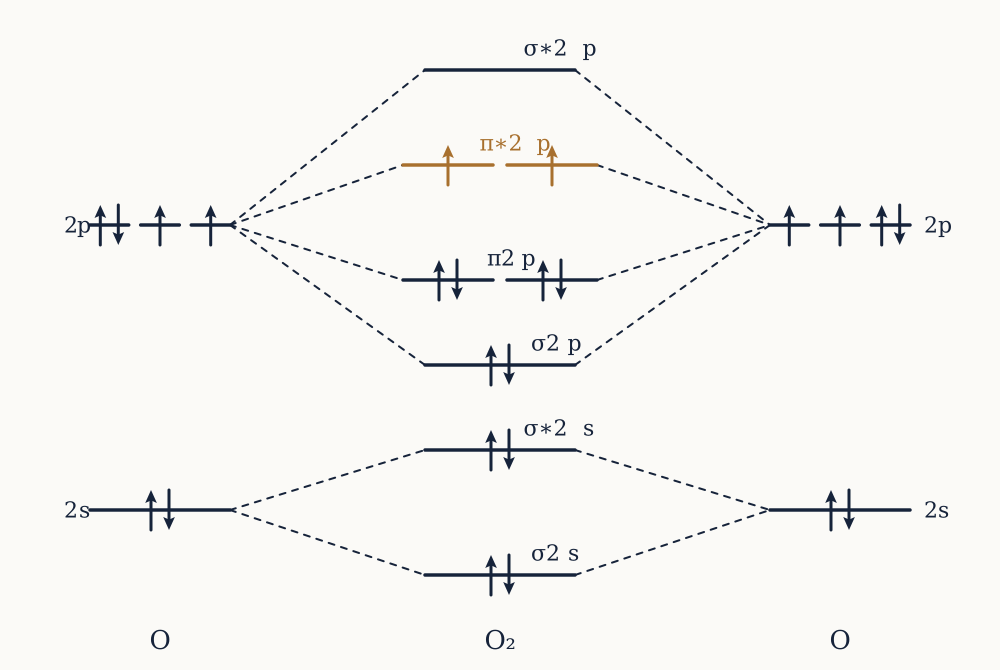
Now oxygen, the case that won the argument. Its Lewis structure pairs every electron and predicts a diamagnetic molecule, yet liquid oxygen clings between the poles of a magnet. Twelve valence electrons fill σ2s, σ2s*, σ2p and the degenerate π2p pair, leaving two for the degenerate π2p* orbitals, which Hund's rule fills singly with parallel spins. The bond order (8-4)/2=2 matches the measured 498 kJ per mol, and the ground state has two unpaired electrons. Paramagnetism falls out of the diagram before anyone looks.

The same picture gives fractional orders, 2.5 for O2+ and 1.5 for superoxide, and order three for N2, hence its 945 kJ per mol. Valence bond theory supplies chemists' intuition and their arrows, molecular orbital theory the spectra and the magnetism.

The continuum, and the metallic corner

There is no boundary between ionic and covalent, only a scale, with electronegativity difference as the crude ruler. Above roughly Δχ=1.8 the description is essentially ionic and below 0.4 essentially nonpolar, while the wide middle is polar covalent, shared but unequally, leaving partial charges at the ends. That shows up as a dipole moment μ=δd. Hydrogen chloride would show 6.1 D if transfer were complete, so its observed 1.08 D makes the bond about 18 per cent ionic.

The middle is reached from the other end too. A small, highly charged cation distorts its neighbour's electron cloud and drags density back between the nuclei, which is Fajans' polarisation argument. Aluminium chloride ought to be a refractory solid, yet it sublimes below 200 °C as Al2Cl6 molecules.

Metals arise where there are many atoms and too few valence electrons to go round. Sodium has one 3s electron and eight nearest neighbours, so pairwise sharing is impossible. Each atom gives its orbital to the crystal instead, and N atomic orbitals give N molecular orbitals spread over the sample, spaced so finely at N1023 that they form a continuous band. Sodium's is half filled, so empty states lie infinitesimally above the occupied ones: apply a field and electrons accelerate, carrying charge and heat alike, while the continuum of transitions absorbs and re-emits across the visible, which is lustre.

Malleability comes from the same delocalisation. The bonding is non-directional glue, so one plane of cations slides over another and finds the electron sea unchanged, deforming rather than fracturing, unlike the ionic lattice that shatters or diamond, where slip breaks directional σ bonds. Where a gap separates a filled band from an empty one, that freedom disappears and you have an insulator or a semiconductor instead.

Between the molecules, and back to Dalton

Bonding explains molecules but not why molecular substances condense. Methane is internally satisfied and externally neutral, yet it liquefies. The reason is dispersion: the electron distribution in any atom fluctuates, an instantaneous dipole induces a matching one in a neighbour, and the interaction is always attractive. It scales with polarisability, so noble gas boiling points climb from 4 K for helium to 165 K for xenon.

A permanent dipole adds dipole-dipole attraction. And where hydrogen is bonded to nitrogen, oxygen or fluorine, the pair is pulled so far off it that the proton is left almost bare, with no inner shell to screen it, and it grips a lone pair on the next molecule. This hydrogen bond is worth around 20 kJ per mol, ten times a typical dispersion interaction but a twentieth of the covalent O-H bond beside it.

Water is the consequence. Extrapolated from hydrogen sulfide and its heavier relatives it should boil near -80 °C; it boils at 100, because each molecule donates two hydrogen bonds and accepts two through its lone pairs, tying the liquid into a network whose disruption absorbs energy and gives water its high heat capacity. On freezing the network completes into a fully tetrahedral and therefore open arrangement, so ice at 917 kg per cubic metre floats on water at 1000, leaving a lake liquid beneath its lid.

Look back at where this course began. Dalton saw elements combining in whole-number ratios and inferred atoms, because whole numbers demand countable things. We can now say why the numbers are what they are: sodium and chlorine one to one because single charges balance in a lattice, hydrogen and oxygen two to one because oxygen has two half-filled 2p orbitals to overlap. Everything between sits underneath that. Thomson's electron and Rutherford's nucleus supplied the charges that attract. Bohr's spectra and Schrödinger's equation replaced orbits with orbitals and gave them shapes. Pauli's exclusion built the shells, raised the repulsive wall on the energy curve, and put one electron in each of two π* orbitals in oxygen. Mendeleev's columns turned out to be a count of valence electrons. A chemical bond, the thing that makes water wet and diamond hard, is those results and nothing else: two nuclei, a set of orbitals, and an arrangement that comes out lower in energy than the alternative.

Atoms and Elements, from libre.university