The First Law counts energy and finds it always balances, which turns out to say almost nothing about what actually happens in the world.
The gap the First Law leaves
Put a hot cup of coffee on a desk in a cool room and it cools. Energy leaves the coffee and enters the room, and the books balance to the last joule. Now imagine the reverse: the room gives up a little of its enormous store of internal energy, the coffee heats back to scalding, and the room drops by a few thousandths of a degree. The energy books balance there just as exactly, and the First Law has no objection to it whatsoever.
Nobody has ever seen it happen. The same asymmetry is everywhere. A dropped ball bounces lower each time, warming the floor; a floor has never cooled and thrown a ball into the air. Both directions conserve energy perfectly, and only one of them occurs.
So the previous lesson's law is a bookkeeping constraint, not a law of behaviour. If something happens the ledger must balance, but it is silent on which of the balanced ledgers nature will write. Something else picks the direction, and it is not in the energy equation.
The Second Law is that missing statement, and it is unusual in being stated as an impossibility: not a formula predicting a result, but a declaration that certain processes never occur, however the apparatus is built. From that negative statement a specific positive number will follow.
The engine as the historical problem
The law arrived from steam engines. By the 1820s engines were doing real work in mines and mills, and their builders had found by trial that a hotter boiler gave more work from the same coal. Nobody knew why, or whether there was a ceiling.
In 1824 a young French military engineer, Sadi Carnot, published Reflexions sur la puissance motrice du feu, roughly a hundred pages that founded the subject. His question was practical. Given a quantity of heat passing from a hot body to a cold one, is there a limit to the work you can extract, and does that limit depend on what fluid the engine uses? If steam were fundamentally better than air, engine design was a search for the right substance. If not, it was a search for the right process.
What makes the achievement remarkable is that Carnot got the answer right while holding a theory of heat that was wrong. He believed the caloric theory: heat was an indestructible fluid, and an engine produced work by letting caloric fall from a high temperature to a low one, as a water wheel does with water. On that picture the caloric arriving at the condenser equals the caloric that left the boiler, which is false, and the First Law was still twenty years away. The wrong model nonetheless carried a right instinct: the flow from hot to cold is the essential thing, and the temperatures are what matter.
Carnot's book sold poorly and he died of cholera in 1832 at thirty-six. Emile Clapeyron rescued it a decade later, and in the 1850s Rudolf Clausius and William Thomson (later Lord Kelvin) rebuilt the argument on the conservation of energy, giving the law its modern form.
Two statements, and why they are one
Kelvin and Planck stated it as a limit on engines. No cycle can take heat from a single reservoir and convert it entirely into work, with no other effect. Every qualifier matters. A cycle means the device returns to its starting state, so nothing is used up, and "no other effect" rules out permanent changes elsewhere: a gas expanding isothermally does turn heat entirely into work, but it ends larger than it started, so it is not a cycle.
Clausius stated it as a limit on refrigeration. No cycle can transfer heat from a colder body to a hotter one with no other effect. Refrigerators plainly move heat up a temperature gradient, but they consume electrical work to do it, and that is the other effect. What Clausius forbids is doing it for free.
These look like statements about two different machines. They are one statement, and the proof is the cleanest reasoning in the subject: assume one is violated, bolt a legal machine onto the violator, and show that the composite violates the other.
Suppose Clausius is false, so a device exists that moves heat from the cold reservoir to the hot one using no work. Run an ordinary engine between the same reservoirs, sized so it rejects exactly to the cold one while drawing from the hot one and producing . Treat the two as one box. The cold reservoir gives to and receives from , so it ends unchanged and may be disconnected. The box now touches one reservoir only, draws from it, and delivers all of that as work, which is exactly what Kelvin and Planck forbid.
Now the other direction. Suppose Kelvin-Planck is false, so a device exists that takes from the hot reservoir and delivers work with nothing rejected. Feed that work into an ordinary refrigerator, which lifts out of the cold reservoir and dumps into the hot one. Work crosses only between the two internal machines, so none enters or leaves the box. The hot reservoir loses to and gains , a net gain of ; the cold reservoir loses . The composite has moved from cold to hot with no other effect, violating Clausius. Each statement implies the other, so they are one law wearing two faces.
Example. An inventor proposes an ocean-powered ship: a cyclic device on the hull draws heat from the seawater, converts it entirely into propulsive work, and rejects nothing anywhere. Which statement does it violate?
The sea is a single reservoir, the device runs in a cycle, and every joule drawn comes out as work with no other effect. That is exactly what Kelvin and Planck forbid: a cycle taking heat from one reservoir and converting it entirely into work. The energy books would balance, so the First Law is untouched; it is the Second Law that sinks the ship.
Now you. A camping gadget claims to keep a cool-box cold by "passive thermal siphoning": a sealed cyclic unit with no battery or fuel that continuously transfers heat from the box's interior at 5 degrees Celsius to the warmer air outside at 30 degrees. Which statement does it violate?
Answer
It moves heat from a colder body to a hotter one in a cycle with no work input and no other effect, which is precisely what Clausius forbids. A real cool-box unit could do this, but only by consuming work, and that consumption would be the "other effect" that makes it legal.
Reversible and irreversible
To turn the impossibility into a number, one more idea is needed. A process is reversible if it can be run backwards so that both the system and everything around it return exactly to their initial states, leaving no trace anywhere. It is an idealisation, never achieved, but it is the yardstick against which real processes are measured.
Four mechanisms spoil it, and between them they cover essentially all real behaviour. Friction, including fluid viscosity and electrical resistance, converts organised work into internal energy, and running the motion backwards heats things further rather than undoing the heating. Unrestrained expansion: a gas bursting into a vacuum does no work on the way out, and pushing it back costs work that must then be removed as heat. Heat flow across a finite temperature difference, which by Clausius no free process returns. And mixing, which no one has seen reverse itself.
Reversibility therefore demands the opposite of anything practical: no friction, and every exchange made across a vanishing difference, so heat enters only from a reservoir infinitesimally hotter. Such a process is quasi-static, passing through a continuous succession of equilibrium states, and it takes infinite time. That is the price of the limit.
Internally reversible is the weaker and more useful notion: nothing irreversible happens inside the system, but the boundary heat may still cross a large temperature drop to reach the surroundings. A cycle can be internally reversible and still generate irreversibility outside itself.
Carnot's theorem
Now the payoff. No engine between two given reservoirs can be more efficient than a reversible engine between the same two, and all reversible engines between the same two have the same efficiency. Efficiency here means , work out over heat drawn from the hot reservoir, which by the First Law is .
Proof by contradiction. Let be reversible and be any engine, and suppose . Because is reversible it can be run backwards as a heat pump, so let drive it. Scale the two so both exchange the same with the hot reservoir: draws and in reverse returns , leaving that reservoir unchanged and disconnectable.
Since both handle the same and , the work produced by exceeds the work needed by . The composite delivers net work , and since the hot reservoir nets zero, energy conservation says that work came entirely from the cold one. That is precisely the Kelvin-Planck violation, so . If is itself reversible, run the argument again with the roles swapped to get , and the two are equal.
The corollary is the one Carnot was after. That efficiency cannot depend on the working substance, the engine's size, or any detail of its construction, because if it did, two reversible engines using different fluids would differ and the theorem would fail. The only things it may depend on are the two reservoir temperatures. So a universal function of two temperatures exists, measurable with an engine and independent of any thermometer's material, and Kelvin used exactly this to define absolute temperature thermodynamically: the ratio of two temperatures is the ratio of the heats exchanged by a reversible engine running between them.
The Carnot cycle
To find that function, take the simplest reversible cycle between two reservoirs and use an ideal gas, which the theorem says costs no generality. Carnot's cycle has four quasi-static stages.
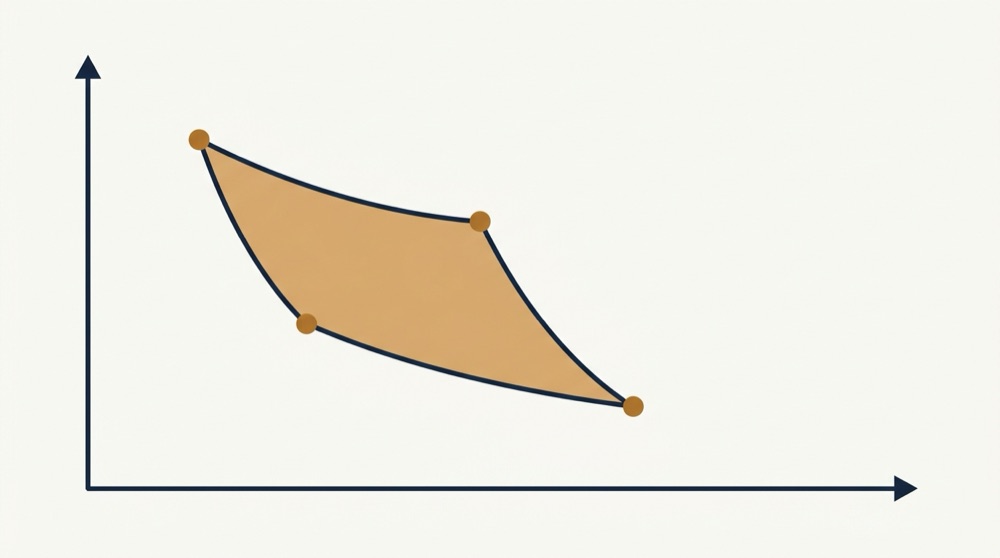
First, isothermal expansion at from to in contact with the hot reservoir: the temperature is constant, so an ideal gas holds its internal energy and all the heat absorbed leaves as work, . Second, adiabatic expansion from to with the gas insulated, so the work done comes out of internal energy and the temperature falls to . Third, isothermal compression at from to , rejecting . Fourth, adiabatic compression from back to , raising the temperature to and closing the loop.
The efficiency is , which is
and the logarithms are about to disappear. Along a reversible adiabat an ideal gas obeys , so the second stage gives and the fourth gives . Divide one by the other and the temperatures cancel, leaving and therefore . The two logarithms are equal and cancel:
with both temperatures absolute. Everything about the gas has vanished: , , the volumes, the pressures. By Carnot's theorem the result holds for every reversible engine whatever its substance, and caps every real one. Efficiency reaches one only if , and no cleverness raises the ceiling, which the two temperatures fix alone.
Example. A geothermal plant receives steam at 180 degrees Celsius and rejects heat to cooling water at 25 degrees. What is the Carnot ceiling on its efficiency?
The formula demands absolute temperatures, so convert first: K and K. Then , a ceiling of 34.2 percent. Plugging in the Celsius values gives , a wildly wrong 86.1 percent; the classic error, and the reason the conversion comes first every time.
Now you. A steam turbine takes heat at 550 degrees Celsius and rejects it at 20 degrees. What is its Carnot ceiling?
Answer
K and K, so , a ceiling of 64.4 percent.
Running the cycle backwards
Every stage of the Carnot cycle is reversible, so the whole thing runs the other way: absorb at , consume work, reject at . That is a refrigerator, and it is also a heat pump. The hardware is the same and only the purpose differs, so each gets its own figure of merit, a coefficient of performance: what you want divided by what you pay.
For a refrigerator you want the heat removed from the cold space, so , which for the reversible cycle is . For a heat pump you want the heat delivered to the warm space, so . Since , the two differ by exactly one.
A heat pump's coefficient of performance is therefore always greater than one, often by a lot. A pump keeping a house at degrees Celsius ( K) from outside air at degrees ( K) has a reversible ceiling of . That violates nothing, because the number is not an efficiency: the pump uses one joule of work to move roughly fifteen joules that already exist in the cold outdoor air, and delivers sixteen. Real units reach three or four rather than fifteen, but even three beats an electric resistance heater, stuck at one by construction.
Example. A freezer holds its interior at degrees Celsius in a kitchen at 22 degrees. What is the reversible refrigerator's coefficient of performance, and how much work does it need to remove 1000 J from the freezer?
Absolute temperatures first: K and K, so K. Then . Since , the work is J.
Now you. A cold-storage room sits at 5 degrees Celsius with the surroundings at 25 degrees. Find the reversible COP and the work needed to remove 1000 J.
Answer
K, K, difference K. , and J. The smaller temperature lift makes the job far cheaper.
A real power station against the ceiling
Take a modern supercritical coal-fired unit. Main steam leaves the boiler at about degrees Celsius, and the plant rejects heat to a river or cooling tower at around degrees. Published net thermal efficiencies for the best such units sit near percent on a lower-heating-value basis. Convert first, since the formula demands absolute temperatures: K and K. Then
so percent, against an actual . Twenty points have gone missing, and they are not a mystery.
Most of the gap is not loss at all but a mismatch of shape. A Rankine steam cycle does not add its heat at K. It adds heat from feedwater temperature upward, and only the superheat at the end is near degrees. What governs the cycle is the mean temperature of heat addition, around degrees Celsius (roughly K) for a supercritical unit with reheat and regenerative feedwater heating. The condenser also sits above the cooling water, needing perhaps a K approach, so call it K. That pair gives , and the ceiling drops thirteen points before any component has been built badly.
The rest is ordinary engineering loss. Turbine expansion is irreversible enough that isentropic efficiencies run near percent, taking to about ; the boiler loses hot flue gas up the stack and unburned carbon into the ash, roughly a further , giving ; and the plant runs its own pumps, fans and mills, another , giving .
That estimate, percent, sits just under the published , which is as close as a chain of round factors deserves to land. The structure matters more than the last two points: the Carnot figure assumes both reservoirs are single temperatures and every process reversible, and no power station has come near it. The best combined-cycle gas plants reach about percent, and they do it by raising to roughly degrees in the gas turbine, not by cleverness at the cold end.
Every result in this lesson rests on comparing whole cycles. What is missing is a property of a state, evaluable at a point, that measures irreversibility directly instead of inferring it from an engine's performance. Clausius found it by asking what happens to the sum of around a cycle, and that is the next lesson.