The previous lesson ended with a pitch as a number, and no reader has ever opened a score and found numbers in it. What a score contains is dots on lines, and this lesson is the decoder.
Height on the page means pitch
Western notation makes one very good decision at the start: it maps pitch onto vertical position, so higher on the page is higher in frequency. That single choice is why a melodic shape is visible at a glance and why a rising line looks like a rising line.
The grid it maps onto is the staff, five horizontal lines with four spaces between them. A notehead sits either centred on a line or centred in a space, and those nine positions, plus the ones extended above and below, are the only places a note can go. Moving up one position, from a line to the space above it, is one step through the letter names: A to B, B to C, and so on round the alphabet, which runs A B C D E F G and then starts again.
That last point matters more than it looks. The staff counts letters, not semitones. Adjacent positions on the staff are sometimes a tone apart and sometimes a semitone apart, because the seven letters are unevenly spread across the twelve semitones of the octave. From B to C and from E to F is one semitone; every other pair of adjacent letters is two. The staff is a diagram of the seven-letter system, and the missing five pitches have to be bolted on with accidentals later in this lesson. Why the letters are spaced that way is not arguable from the staff alone: it is a fact about the major scale, which the lesson on scales takes up.
Clefs fix which pitch
Five lines with no further information say nothing absolute. They give you the shape of a tune but not its pitch, because nothing declares what the bottom line is. That declaration is the clef, printed at the head of every staff.
The treble clef is a stylised letter G, and the point of its inner spiral is the whole content of the symbol: the line it curls around is G4, the G above middle C. Everything else follows by counting positions. From that G, the line below is E4 and the line above is B4, so the five lines of a treble staff, bottom to top, are E4, G4, B4, D5, F5, and the four spaces between them are F4, A4, C5, E5.
The bass clef is a stylised letter F, and its two dots straddle the line that is F3, the F below middle C. Counting from there gives lines G2, B2, D3, F3, A3 and spaces A2, C3, E3, G3.
Both exist because one staff is not enough. Music in common use spans roughly seven octaves, and a single staff covering it would need dozens of lines that no eye could count. Five is close to the limit for reading a position without counting. Two clefs, placed a good distance apart, cover the whole practical range with staves that stay readable, and each singer or instrument uses the one that keeps its notes on or near the lines. There are also two moveable C clefs, which mark middle C at whichever line they are centred on: the alto clef, with middle C on the middle line, is what viola players read, and the tenor clef, with middle C on the fourth line, appears in the upper register of cello, bassoon and trombone parts. They exist for the same reason, which is to avoid ledger lines.
The grand staff and middle C
Keyboard music uses both clefs at once, braced together as a grand staff, with the right hand usually reading the treble and the left the bass. The gap between them is not arbitrary. The top line of the bass staff is A3 and the bottom line of the treble staff is E4, and continuing the pattern upward through the gap gives a space at B3, a line at C4 and a space at D4. That middle line is the one the printer leaves out, and the note it would carry is C4, middle C.
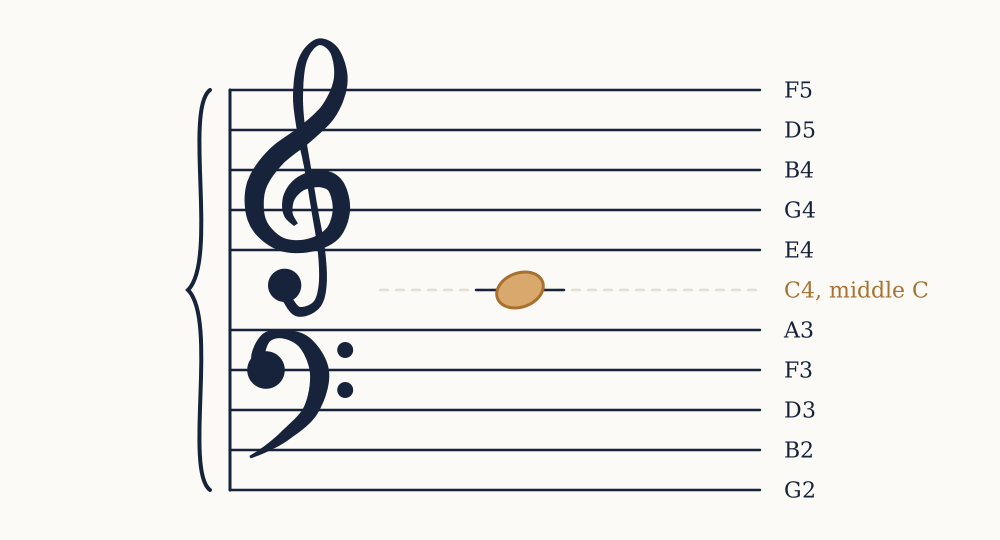
That is why middle C is drawn on a short line of its own, one ledger line below the treble staff or one above the bass staff, and why both drawings mean the same key on the piano. Think of the grand staff as an eleven-line system with the middle line rubbed out and restored one note at a time, and the whole layout stops needing to be memorised.
Example. A note sits in the second space from the bottom of the treble staff. Name it, and give its frequency.
The treble spaces upward are F4, A4, C5, E5, so the second is A4. From the previous lesson, A4 is the tuning reference at 440 Hz exactly.
Now you. A note sits on the top line of the bass staff. Name it and give its frequency.
Answer
The bass lines upward are G2, B2, D3, F3, A3, so the top line is A3. It is twelve semitones below A4, so Hz.
Naming which octave
"A" names seven different pitches on a piano, so a written note needs an octave label as well as a letter. The standard is scientific pitch notation, which appends a number: A4 is the tuning A, A3 the octave below, A5 the octave above.
The one trap is where the number changes. It does not change at A, despite the alphabet starting there; it changes at C. The sequence running upward is B3, C4, D4 ... B4, C5, so middle C begins octave 4 and the A four notes above it is A4. A note written B3 is one semitone below C4 and shares no digit with it.
The same numbering underlies the note numbers used by MIDI, where middle C is 60 and A4 is 69, one number per semitone. That gives a direct route from a printed dot to a frequency: read the letter and octave off the staff, convert to a note number , and apply
which is the formula from the previous lesson with its reference shifted. Be aware that software disagrees about the names, though never about the numbers: some manufacturers label note 60 as C3 rather than C4, so a synthesiser's display and a theory textbook can be an octave apart in words while agreeing exactly in pitch.
Ledger lines and octave signs
Notes beyond the staff get ledger lines, short line segments continuing the pattern above or below. They are counted, and counting is slow, which is why more than three or four in a row is considered bad engraving.
Example. How many ledger lines does C6 need above a treble staff?
The top line is F5. Continuing upward, the space above it is G5, then the first ledger line is A5, the space above that is B5, and the second ledger line is C6. So two ledger lines, and the notehead sits on the upper one.
Now you. How many ledger lines does C2 need below a bass staff, and what note sits on the first of them?
Answer
The bottom line is G2. Below it, the space is F2, the first ledger line is E2, the space below that is D2, and the second ledger line is C2. Two ledger lines, with E2 on the first.
The alternative is an octave sign. 8va written above a passage means play it an octave higher than written, 8vb below a passage means an octave lower, and 15ma means two octaves higher, the 15 counting inclusively in the way intervals are counted in a later lesson. A dashed line shows how far the instruction runs, and loco cancels it. Piccolo, glockenspiel and double bass parts would be unreadable without them.
Accidentals, and how long they last
Seven letters cannot name twelve pitches, so five of the twelve are written as a letter plus a sign. There are five signs. The sharp raises a note one semitone, the flat lowers it one semitone, the natural cancels either, the double sharp raises by two semitones, and the double flat lowers by two. In printed music they are the symbols ♯, ♭, ♮ and their doubles; in running text, including everywhere in this course and in every quiz answer, they are written as they are typed, so F sharp is F# and B flat is Bb.
An accidental is printed to the left of the notehead, but it applies forward, and its life is precisely defined: it lasts until the end of the bar, and it applies only to that letter in that octave. Write F# on the first beat of a bar, and every F on that same line or space for the rest of the bar is sharp without being marked again. The barline cancels it. An F an octave higher in the same bar is strictly unaffected, though modern editors nearly always add a cautionary accidental in brackets rather than trust the reader, and you should read the bracket as politeness, not as new information. A note tied across a barline keeps its accidental for as long as the tie lasts, since it is one sounding note rather than two.
Example. A bar in the key of C major contains, in order, F, F#, F, G, and then a barline followed by F. Which of those F notes sound as F#?
The first F is plain, because nothing has altered it. The F# is sharp by its own sign. The third F is also sharp, since the accidental holds until the barline. The F after the barline is plain again.
Now you. A bar contains Bb on beat 1, then B natural marked on beat 2, then B on beat 4, and the following bar opens with B. Which of them sound as B natural?
Answer
Beats 2 and 4 of the first bar. The natural sign cancels the flat for the rest of that bar, so the B on beat 4 is natural too. The B in the next bar reverts to whatever the key signature says, which in a key with a Bb in its signature means B flat again, a point the lesson on keys will make properly.
Two names for one sound
Because a sharp raises and a flat lowers, more than one spelling can land on the same pitch. C# and Db are the same key on a piano and the same frequency in equal temperament, as are F# and Gb, and less obviously E# and F, or Cb and B. Such pairs are enharmonic equivalents.
It is tempting to conclude that the spelling is decoration. It is not, for two reasons. The practical one is that the staff position differs: C# sits on the C line with a sharp, Db sits on the D line with a flat, and the choice changes what the player's hand does and how the passage reads. The musical one is that spelling records function, and function is what the second half of this course is about. In the key of D major the note between C and D is C#, the leading note that pulls up to the tonic, and writing it Db would say the opposite thing about where the music is going.
There is one place the equivalence is not even exactly true. In equal temperament C# and Db are identical by construction, since the tuning was flattened until they were. In just intonation or in the unequal temperaments used before it, they are different frequencies, and violinists playing without a keyboard still bend them apart, playing a leading note high and a flattened note low.
What the staff does not say
A page of noteheads on lines now decodes to a list of exact frequencies. What it does not decode to is music, because nothing so far says when any of them happens or for how long. That is not a small omission: rhythm is the half of notation this lesson has entirely ignored, and the next one takes it up, starting from a single note and cutting it in half.