A piece in E major contains four notes that are always sharp, and printing the sign on every one of them would bury the page in accidentals. The key signature is the fix, and its layout is not a convention anyone chose freely.
What a key signature declares
A key signature is a group of sharps or flats printed immediately after the clef, at the start of every staff line. It says that those notes are sharp or flat throughout the piece, until it is cancelled or replaced.
Its scope is wider than an accidental's in one important way. An accidental applies to one letter in one octave for the rest of one bar; a key signature applies to that letter in every octave, in every bar, until the end. A signature with an F sharp in it sharpens F2, F4 and F6 alike, even though the sign is printed on one line only. An accidental inside the piece temporarily overrides the signature for its own bar and octave, and the barline hands control back.
A key is a scale plus the tonic that scale is built on, and the signature exists to declare which. That declaration is genuinely ambiguous, as the last section of this lesson shows, but for now: no sharps or flats means C major, one sharp means G major, two means D major, and there is a rule behind that sequence.
The order of the sharps is forced
Build the major scales in order and watch what happens. C major needs nothing. Go up a perfect fifth to G major, and the scale G A B C D E F# G needs exactly one accidental, F sharp, because degree 7 of a major scale must be a semitone below the tonic. Go up another fifth to D major: D E F# G A B C# D, which keeps the F sharp and adds C sharp, again as its leading note. Another fifth to A major adds G sharp. Another to E major adds D sharp.
Two things are happening at once and both are worth stating. First, moving up a fifth adds exactly one sharp and never removes one, because the new scale shares six of its seven notes with the old and differs only in raising the old degree 4. Second, the new sharp is always the leading note of the new key, which is a fifth above the previous new sharp, since the keys themselves are a fifth apart.
So the order in which sharps appear is itself a chain of fifths:
F sharp, C sharp, G sharp, D sharp, A sharp, E sharp, B sharp. They are always printed in that order and a signature never skips one, so four sharps is always F# C# G# D# and never any other four.
Going the other way, down a fifth from C to F, gives F G A Bb C D E F, which needs B flat, since degree 4 of the new key must be a semitone above degree 3. Down another fifth to B flat major adds E flat. The order of flats is a chain of falling fifths, which is the sharp order read backwards:
That the two lists are exact reverses of one another is not a coincidence to be memorised. It follows from the fact that going up a fifth and going down a fifth are inverse operations, and the printed signatures inherit the symmetry.
Reading a key off a signature
Two rules, each a direct consequence of the derivation above.
For sharps: the last sharp in the signature is the leading note, so the tonic is one semitone above it. Four sharps ends on D sharp, and a semitone above D sharp is E, so it is E major.
For flats: the last flat is degree 4 of the key, and counting back four degrees is fiddly, so use the shortcut instead. In any signature of two or more flats, the second-to-last flat is the tonic. Five flats is Bb Eb Ab Db Gb, the second-to-last is D flat, and the key is D flat major. One flat is the single exception, since there is no second-to-last, and it is F major.
Here is the whole system in one place, with each major key beside the minor key that shares its signature.
| Sharps | Major | Minor | Flats | Major | Minor |
|---|---|---|---|---|---|
| 0 | C | A | 0 | C | A |
| 1 | G | E | 1 | F | D |
| 2 | D | B | 2 | Bb | G |
| 3 | A | F# | 3 | Eb | C |
| 4 | E | C# | 4 | Ab | F |
| 5 | B | G# | 5 | Db | Bb |
| 6 | F# | D# | 6 | Gb | Eb |
| 7 | C# | A# | 7 | Cb | Ab |
Example. A piece has a signature of four sharps and ends on a C sharp minor chord. What key is it in, and what are the four sharps?
The four sharps are F#, C#, G# and D#, in that order. That signature is E major or C sharp minor, and the final chord settles it: C sharp minor.
Now you. A piece has five flats. Name the flats in order, and both keys the signature could mean.
Answer
Bb, Eb, Ab, Db, Gb. The second-to-last flat is D flat, so the major key is D flat, and its relative minor is B flat minor.
The circle of fifths, and why it closes
Chain the keys by fifths and something convenient happens. C, G, D, A, E, B, and then F sharp, C sharp: eight keys, with sharps accumulating one at a time. Chain downward instead and you get C, F, B flat, E flat, A flat, D flat, G flat, C flat, with flats accumulating. Twelve steps of a fifth from C arrive back at C, which lets the whole system be drawn as a clock face with C at twelve, the sharp keys clockwise and the flat keys anticlockwise. That drawing is the circle of fifths, and it is the single most useful diagram in the subject: neighbours on it share six of seven notes, and distance around it is a good proxy for how far apart two keys sound.
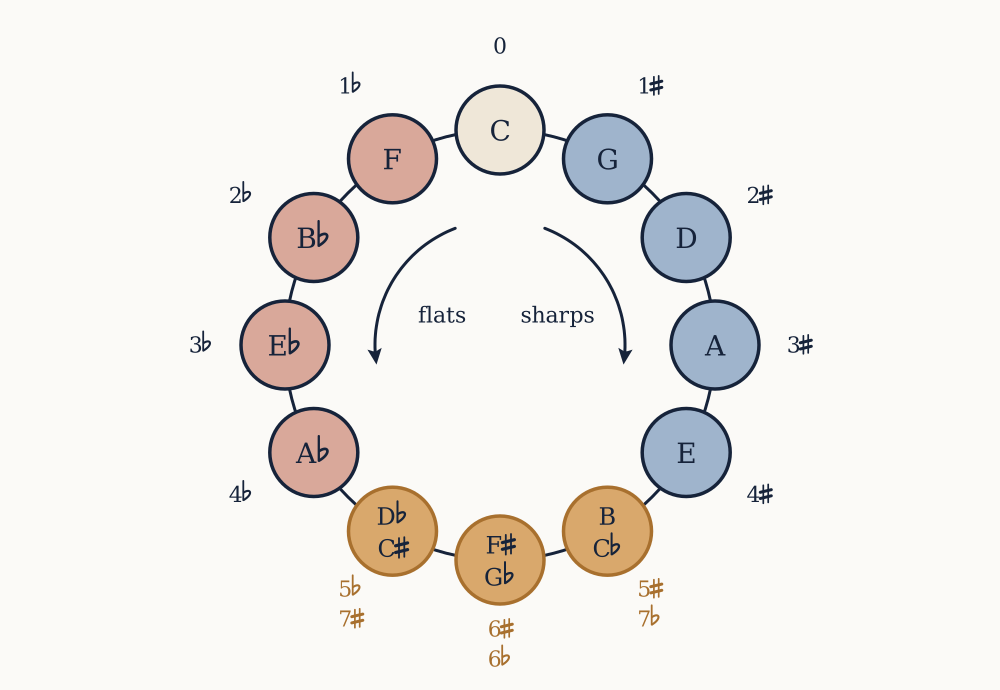
It closes only because of a compromise made in the first lesson. Twelve pure fifths give a ratio of while seven octaves give , so a chain of pure fifths overshoots by the Pythagorean comma of 23.5 cents and never returns to its starting pitch. Equal temperament shaves each fifth by 1.96 cents, twelve of which is exactly the comma, and the circle snaps shut. In the unequal temperaments of the seventeenth century the far side of the circle was genuinely unusable, and the modern freedom to modulate anywhere was bought with those two cents per fifth.
Enharmonic keys, and choosing between them
Because the circle closes, the sharp end and the flat end meet, and three keys have two spellings. B major with five sharps is the same set of pitches as C flat major with seven flats. F sharp major with six sharps equals G flat major with six flats. C sharp major with seven sharps equals D flat major with five flats.
The choice is normally made on accidental count, which is why D flat major is common in print and C sharp major is not. It is not automatic, though. A movement that has just been in B major may write C sharp minor rather than D flat minor because the players are already reading sharps, and a horn or clarinet part transposed from a flat key stays in flats to keep its own fingerings sane. The pitches are identical in equal temperament; the page is not, and the page is what a player reads at speed.
Example. Write the key signature of A major, and say which enharmonic key, if any, could replace it.
A major has three sharps: F#, C# and G#. Its enharmonic equivalent would be B double flat major, which is not a key anybody writes, so there is no alternative. Only the keys near the six-accidental crossing point have practical enharmonic twins.
Now you. Write the key signature of A flat major, and name its enharmonic equivalent if it has a usable one.
Answer
A flat major has four flats: Bb, Eb, Ab and Db. Its enharmonic equivalent is G sharp major, whose scale is G# A# B# C# D# E# F double sharp, so its signature would need a double sharp and is never printed. A flat is far from the crossing point, exactly as A major was.
Relative and parallel
Two minor keys sit near every major one and they are easy to confuse.
The relative minor shares the signature. It is built on degree 6 of the major scale, which is a minor third below the tonic, so the relative minor of C major is A minor, of E flat major is C minor, of B major is G sharp minor. Both keys use the same seven pitches; they differ only in which is home, and that difference is audible enough to carry a whole movement.
The parallel minor shares the tonic instead. C major and C minor start on the same note, and their signatures differ by exactly three accidentals: C major has none, C minor has three flats. The three is not a coincidence, since natural minor flattens degrees 3, 6 and 7 of the major scale, and each of those flattenings is one step around the circle. E major has four sharps and E minor has one, again a difference of three.
Composers use the two relationships differently. A move to the relative minor is smooth, because nothing in the signature changes and the shared notes carry across. A switch to the parallel minor is a colour change, sudden and obvious, and is often used at the same pitch level for exactly that reason.
Example. Name the relative minor of E flat major and the parallel minor of E major, with the signature of each.
The relative minor of E flat major is C minor, sharing three flats. The parallel minor of E major is E minor, which has one sharp against E major's four.
Now you. Name the relative minor of B major and the parallel minor of B major, with the signature of each.
Answer
The relative minor is G sharp minor, sharing B major's five sharps. The parallel minor is B minor, with two sharps, three fewer than B major.
The signature does not settle the key
The last section is the caveat, and it is a real one. A signature is compatible with two keys by construction and with more than two in practice, so it is evidence rather than proof.
Three things settle it instead. The first is the ending: tonal pieces almost always finish on the tonic chord, so the last bass note is the strongest single clue, and the first bar is usually the second strongest. The second is the accidentals inside the piece. Minor-key writing raises degree 7 to get a leading note, and that raised note is not in the signature, so a piece with no sharps in its signature that keeps printing G sharp is in A minor rather than C major. Look for the raised seventh and the key names itself. The third is the harmony, which is what the rest of this course is for.
Two further complications are worth knowing about now. Music often changes key part way through, and if the new key is short-lived the signature does not change at all; the modulation shows up only as accidentals, and recognising that pattern is a skill the last lessons of this course build. And modal music sits badly in this system: a piece in D Dorian is often printed with no signature at all, or with one flat, and neither choice means what the table above says it means.
The signature has now given a fixed set of seven notes and a home among them. The next step is to stop treating them one at a time: stack them in thirds, and the result is chords.