Warming a mixture by ten kelvin, a change of about three per cent in absolute temperature, commonly doubles the rate of a reaction, and no amount of pushing on concentrations produces a response that steep.
The previous lesson defined the rate constant and treated it as a fixed number for a given reaction. It is fixed only at a fixed temperature. This lesson is about how it varies, what that variation measures, and what it reveals about how a reaction happens at all.
The steepest dependence in chemistry
Doubling a concentration doubles a first order rate: an effect proportional to the change. Warming a reaction from K to K, which raises the average molecular kinetic energy by about three per cent, can double it too. Something is amplifying a small change enormously, and an exponential is the only function that behaves like that.
The mechanism of the amplification is that a reaction does not use the average molecule. It uses the rare ones in the high energy tail of the distribution, and the population of that tail is exponentially sensitive to temperature. The fraction of molecules with energy above kJ mol⁻¹ at K, using the Boltzmann factor , is . At K it is . Nothing about the bulk has changed appreciably, and the population that can react has nearly quadrupled.
The Arrhenius equation
Svante Arrhenius put this together in 1889, generalising an empirical fit of Jacobus van 't Hoff's. He proposed that the rate constant has the form
with two parameters. is the activation energy, an energy barrier that reacting molecules must carry into the collision, and is the pre-exponential factor, which has the same units as and represents how often the encounter happens at all. The exponential is a Boltzmann factor: it is the fraction of encounters energetic enough to matter.
The immediate consequence is that taking logarithms gives a straight line,
so plotting against gives a slope of and an intercept of . This is the Arrhenius plot, and it is how essentially every activation energy in the literature was obtained. Note its resemblance to the van 't Hoff plot of the fifth lesson, which is a real family likeness and not a coincidence: both are the logarithm of a Boltzmann factor against reciprocal temperature. They are not the same quantity, though. The van 't Hoff slope gives , a difference between two states; the Arrhenius slope gives , the height of a barrier between them.
The familiar rule that ten degrees doubles a rate is a numerical accident, not a law. At K a barrier of kJ mol⁻¹ gives a factor of for a ten kelvin rise, which is where the rule comes from; a barrier of kJ mol⁻¹ gives , and a very low barrier gives almost nothing. The rule holds because activation energies around kJ mol⁻¹ are common in the reactions people happen to run near room temperature.
Measuring the barrier
Two rate constants at two temperatures are enough, by writing the equation twice and subtracting:
Example. Dinitrogen pentoxide decomposes with s⁻¹ at °C and s⁻¹ at °C. Find and .
The ratio of the constants is , so . The reciprocal temperatures are and K⁻¹, differing by . Hence J mol⁻¹, or kJ mol⁻¹. For , substitute back at either temperature: s⁻¹.
That value of is worth a moment. For a unimolecular decomposition, s⁻¹ is roughly a molecular vibration frequency, which is exactly what it should be: the molecule tries to fall apart once per vibration and succeeds with the Boltzmann probability.
Now you. A reaction has s⁻¹ at K and s⁻¹ at K. Find .
Answer
, and K⁻¹. So J mol⁻¹, about kJ mol⁻¹. This is the barrier the ten degree rule secretly assumes.
Collision theory: the exponential is right and the prefactor is not
For a gas phase bimolecular reaction, can be computed rather than fitted, which is a genuine test of the picture. Kinetic theory gives the rate at which two species collide: the collision cross section times the mean relative speed times the number densities. Per mole,
where is the reduced molar mass. Every quantity is measurable independently, from viscosity data for and from the formula for .
Example. Estimate for at K, with nm², and compare with the measured dm³ mol⁻¹ s⁻¹.
The reduced molar mass is g mol⁻¹, so m s⁻¹. Then m³ mol⁻¹ s⁻¹, which is dm³ mol⁻¹ s⁻¹. The measured value is smaller by a factor of .
Now you. The reaction has a measured about times its calculated collision value. What does a steric factor greater than one imply about the encounter?
Answer
The reaction happens more often than the two species collide, so the reactants must be interacting before they touch. This is the harpoon mechanism: an electron jumps from potassium to bromine at long range and the resulting ions are pulled together, giving an effective cross section much larger than the physical one.
That ratio of observed to calculated prefactor is the steric factor , and its size is the honest verdict on collision theory. The theory gets the temperature dependence right and the absolute rate wrong by up to six orders of magnitude, because it models molecules as featureless spheres for which any collision counts. Real molecules have to meet in a particular orientation, and the more complicated they are, the smaller the fraction of encounters that qualifies. is a fudge factor with a physical interpretation, which is better than a fudge factor without one, but it cannot be predicted from within the theory.
The transition state
The better picture follows the reacting pair along a reaction coordinate, the path from reactants to products through the configuration of highest energy. That maximum is the transition state, an arrangement in which old bonds are partly broken and new ones partly formed. It is not an intermediate: it sits at a maximum, not a minimum, and has no lifetime beyond a single vibration.
Drawing the energy against the reaction coordinate makes the relations plain. The barrier from the reactant side is the forward activation energy, the barrier from the product side the reverse one, and the difference between the two ends is the enthalpy change of the reaction. Hence, for an elementary step,
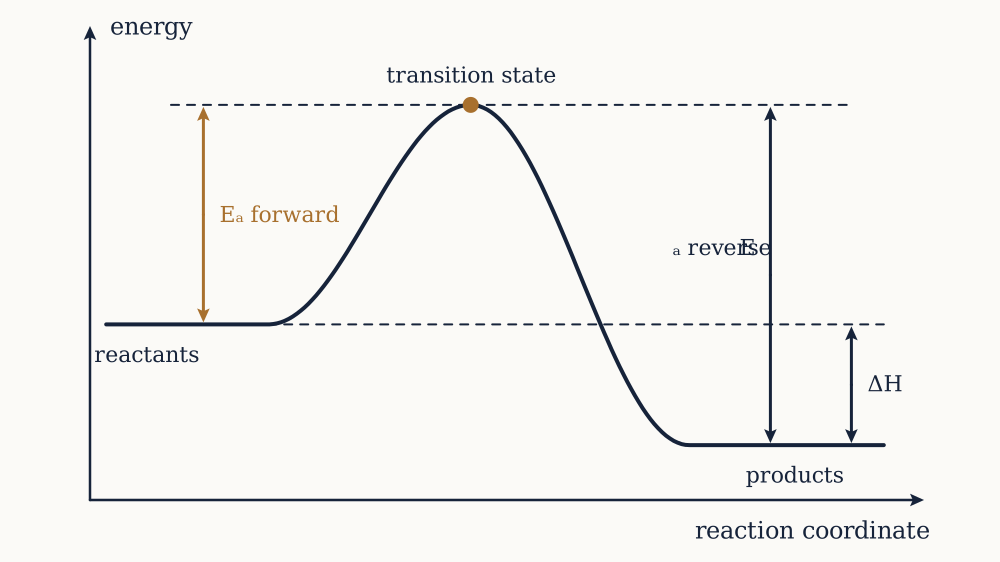
An exothermic step has the lower barrier in the forward direction, which is the grain of truth in the old idea that exothermic reactions are fast. It is only a grain: the barrier can be large in both directions, as it is for hydrogen and oxygen, where is kJ mol⁻¹ and the mixture is stable indefinitely.
Henry Eyring and Michael Polanyi's transition state theory of 1935 treats the activated complex as being in equilibrium with the reactants and derives the rate constant from the free energy of activation, . Splitting that into and gives the prefactor a meaning: is controlled by the entropy of activation, which is strongly negative when two floppy molecules have to freeze into one rigid arrangement. That is the steric factor, arrived at from a theory instead of from a ratio.
Catalysis is a different route, not a push
A catalyst provides an alternative path with a lower activation energy, participating in the mechanism and being regenerated by it. Two consequences follow immediately from the equations above, and both are worth stating carefully.
First, the effect on the rate is exponential in the barrier reduction, so modest reductions produce enormous accelerations. Second, a catalyst cannot change the equilibrium position at all. It lowers the forward and reverse barriers by exactly the same amount, because both routes pass over the same new transition state, so and change by the same factor and their ratio, which is , does not move. A catalyst gets you to the same place sooner. Any claim that one improves a yield beyond equilibrium is a claim that energy is being created.
Example. Hydrogen peroxide decomposes with kJ mol⁻¹ uncatalysed, kJ mol⁻¹ with iodide ion, and about kJ mol⁻¹ with the enzyme catalase. By what factor does each catalyst multiply the rate at K, if is unchanged?
For iodide the barrier falls by kJ mol⁻¹, giving . For catalase it falls by kJ mol⁻¹, giving . A reaction that would take a thousand years takes a hundredth of a second, which is why a drop of blood on a peroxide-soaked cut foams.
Now you. A catalyst lowers the activation energy of a reaction by kJ mol⁻¹. By what factor is the rate multiplied at K, assuming is unchanged?
Answer
, a factor of about fifty thousand.
The assumption that is unchanged is a simplification, and often a bad one: a heterogeneous catalyst that binds a reactant to a surface changes the entropy of activation substantially. The barrier is the dominant term, but a full account has to include both.
What the barrier does not tell you
An activation energy is a property of a step, not of an equation. Measuring kJ mol⁻¹ for the decomposition of dinitrogen pentoxide is a statement about whatever the slowest step of that decomposition is, and the balanced equation, with its two molecules of reactant, does not say what that step is.
This is the same gap the previous lesson found in the orders. Both the rate law and the activation energy are experimental summaries of something happening underneath, and both become interpretable only once the sequence of elementary steps is proposed. That sequence is a mechanism, and constructing one, deriving the rate law it predicts, and comparing it with the measurement, is the next lesson.