Adding a hundredth of a mole of strong acid to a litre of water takes it from pH 7 to pH 2, and adding the same amount to a litre of acetate buffer moves it by less than a tenth of a unit.
The previous lesson computed the pH of a weak acid on its own and of its conjugate base on its own. This lesson puts both in the same flask, which is the situation in blood, in seawater, in every enzyme assay and at every point of a titration except two.
What a buffer is
A buffer is a solution containing appreciable amounts of a weak acid and its conjugate base. It resists pH change because it has a reservoir of each: added hydroxide is consumed by the acid, added protons are consumed by the base, and neither reservoir is depleted quickly by a small addition.
The working equation comes straight from the definition of . Rearranged for the hydronium concentration,
and taking negative logarithms of both sides gives the Henderson-Hasselbalch equation, published by Lawrence Henderson in 1908 and put into logarithmic form by Karl Hasselbalch in 1917:
Two features do the work. The pH depends on the ratio of the two species, not on their absolute concentrations, so diluting a buffer tenfold changes its pH hardly at all. And a logarithm of a ratio near one is small and flat, so a substantial change in the ratio moves the pH very little: going from to costs only units.
The equation is an approximation, and it is worth knowing where it fails. It assumes that the amounts of and actually present are the amounts mixed in, that is, that the acid's own ionisation and the base's own hydrolysis are negligible compared with them. That holds when both are present at concentrations well above mol dm⁻³ and the ratio is within about a factor of ten of one. It fails near the ends of a titration, where one component nearly vanishes, and it takes no account of activity coefficients, which in a real buffer of ionic strength shift the answer by around units.
How much it resists
Example. A litre of buffer contains mol of acetic acid () and mol of sodium acetate. Find its pH, then the pH after adding mol of hydrogen chloride, ignoring the volume change. Compare with adding the same to a litre of pure water.
Initially the ratio is and the logarithm is zero, so . The added protons convert acetate to acetic acid mole for mole, giving mol of acid and mol of base. Then
a shift of units. The same addition to pure water gives and , a shift of five units. The buffer has absorbed the same chemistry with a fiftyfold smaller effect on the logarithm, which is roughly a factor of in hydronium concentration.
Now you. Take the same buffer and add mol of sodium hydroxide instead. Find the new pH.
Answer
The hydroxide converts acetic acid to acetate, giving mol of acid and of base, so . Symmetric with the acid case, because the ratio has been inverted.
Capacity, and how to choose a buffer
Resistance is finite. The buffer capacity is how many moles of strong acid or base per litre are needed to move the pH by one unit, and it depends on two things.
It is proportional to the total concentration of the pair, which is the size of the reservoirs. And it is greatest when the two are equal, which is when the ratio can be disturbed proportionally least, giving : for the mol dm⁻³ total above, about mol per pH unit. Beyond a ratio of about in either direction the capacity has fallen so far that the mixture is no longer usefully a buffer.
So choosing a buffer is choosing an acid whose is close to the pH wanted, ideally within one unit, and then setting the ratio to fine-tune.
Example. Prepare a buffer at pH , the pH of blood, from dihydrogenphosphate and hydrogenphosphate, whose pair has . What ratio of the two is needed?
Rearranging the Henderson-Hasselbalch equation, , so the ratio is . Dissolving mol of the hydrogenphosphate salt for every mol of the dihydrogenphosphate gives the target, and any total concentration will do, with larger totals giving more capacity.
Now you. What ratio of acetate to acetic acid () gives a buffer at pH ?
Answer
, so the ratio is . Close enough to one that the capacity is near its maximum, which is why acetate buffers are used across roughly pH to and not beyond.
Phosphate () is the standard choice near neutrality and is why phosphate-buffered saline is ubiquitous in biology. Carbonate () buffers blood at , helped by the fact that the carbon dioxide reservoir is open to the lungs, so one component is regulated by breathing rate rather than being fixed. Blood held outside to for long is fatal, and that stability is a buffer doing its job.
The four regions of a titration curve
A titration adds a strong base of known concentration to an acid of unknown concentration and follows the pH. For a weak acid the curve has four regions, each needing a different calculation, and the whole of this course so far is used across them.
Example. Titrate mL of mol dm⁻³ acetic acid with mol dm⁻³ sodium hydroxide. Find the pH at , , , and mL.
The flask starts with mmol of acid.
At mL there is a weak acid alone, so and .
At mL, mmol of base has converted mmol of acid to acetate, leaving mmol of acid. This is a buffer, and since both species sit in the same volume the ratio of amounts serves: .
At mL exactly half the acid has been converted, the ratio is one, and . This is the half equivalence point, and it is the standard way of measuring a : read the pH off the curve halfway to the end point.
At mL all the acid has become acetate. The flask holds mmol of acetate in mL, so mol dm⁻³ of a weak base with . Then , giving and .
At mL there is mmol of excess hydroxide in mL, which is mol dm⁻³, so and . Past equivalence the weak acid is irrelevant and only the excess strong base counts.
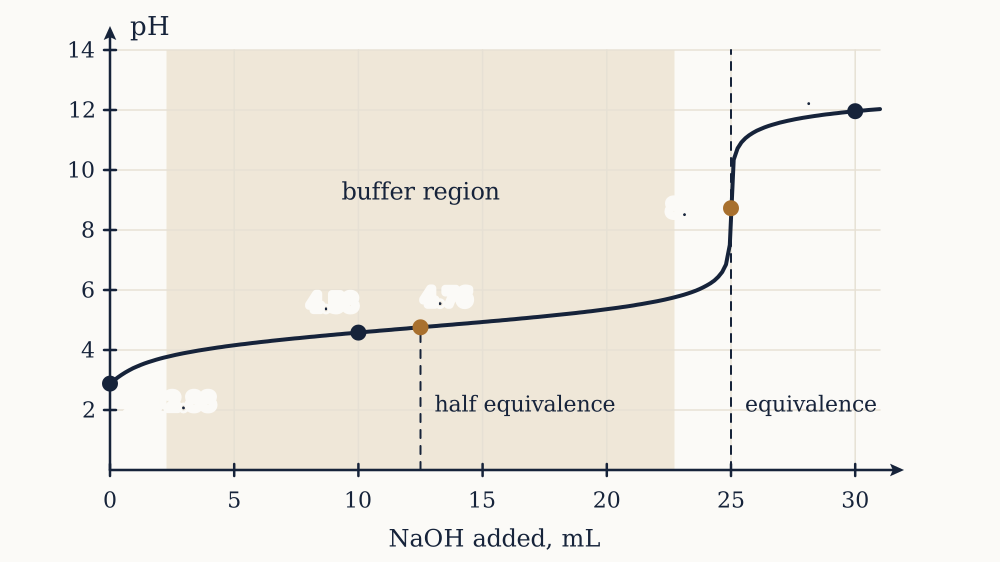
Now you. For the same titration, find the pH after mL of base.
Answer
mmol of base leaves mmol of acid and makes mmol of acetate, so . Still in the buffer region, but at a ratio of the capacity is falling and the curve is starting to steepen.
The Henderson-Hasselbalch treatment holds closer to equivalence than it looks. At mL only mmol of acid is left, yet its is right, because acetate reacting with water makes about mmol of acid, far too little to matter. It fails only within a few thousandths of a millilitre of equivalence, where those two amounts become comparable, and at equivalence itself there is no acid left to put in the ratio, so that point needs the treatment in the next section.
Why the equivalence point is not pH 7
The most common error in titration work is expecting neutrality at equivalence. Equivalence means the stoichiometric amounts have been matched, not that the solution is neutral, and what remains in the flask decides the pH.
Titrate a strong acid with a strong base and the product is sodium chloride, which does nothing, so equivalence is at pH . Titrate a weak acid with a strong base and the product is the conjugate base, which is alkaline: in the example above. Titrate a weak base with a strong acid and the product is acidic, typically around pH . Only the first case gives seven.
The shape of the curve differs as much as the end point. A strong acid with a strong base jumps from pH at mL to at mL: over six units across two drops. The weak acid curve above jumps from about to about over the same interval, a smaller and shallower step, because the buffer region leading into it has flattened everything. Titrating a very weak acid, below of about , gives no usable step at all.
Choosing an indicator
An indicator is itself a weak acid whose two forms differ in colour, so the same equilibrium applies: it appears in its acid colour when the pH is well below its own and in its base colour well above, changing over a range of roughly .
The rule for choosing one follows from the previous section. The indicator's range must lie inside the vertical jump of that particular curve. Phenolphthalein changes between and , which sits neatly inside the jump for a weak acid titrated with a strong base and is therefore correct for the acetic acid case. Methyl orange changes between and , which is inside the jump for a strong acid with a weak base but far outside the acetic acid jump: use it there and the colour changes around mL, halfway through the buffer region, giving an answer wrong by half.
A pH meter avoids the choice altogether and is what any modern laboratory uses, but the indicator argument is worth keeping, because it is the same reasoning applied to a reagent instead of a sample.
Polyprotic curves
An acid with several protons gives a curve with several steps, provided the constants are far enough apart. Phosphoric acid, with values of , and , shows two clear jumps, at one and at two equivalents of base; the third is lost because is too close to the solvent's own range for a step to develop.
Between two equivalence points the solution is a buffer, and at the first equivalence point of a diprotic acid the species present is the amphiprotic intermediate, which both donates and accepts. Its pH turns out to be close to the mean of the two constants that flank it, , independent of concentration. For carbonic acid that gives , which is why a solution of sodium hydrogencarbonate sits near pH whatever its strength.
The same constant, applied to a solid
Every calculation in the last two lessons has been an equilibrium constant used on a proton transfer, with the shape of the arithmetic set by the constant and the shape of the answer by which species dominate.
Nothing in that machinery is specific to protons. Write the same expression for a salt sitting in contact with its own saturated solution and it gives the solubility, in grams per litre, of a substance that a table lists only as "slightly soluble". It also predicts something the tables do not: which insoluble salts dissolve in acid and which ignore it entirely, a question the last two lessons have already supplied the answer to. That is the next lesson.