The previous lesson used without ever saying what it meant, because a right triangle has no angle larger than and the definitions given there therefore say nothing about one. That debt has to be paid before any of it can be trusted.
Paying it means abandoning the triangle as the home of the definitions and putting the angle at the centre of a circle instead. The reward is much larger than the repair: sine and cosine acquire a value for every real number, and they become the first functions in this course that repeat.
Putting the angle at the centre
Draw a circle of radius centred on the origin. Measure an angle anticlockwise from the positive horizontal axis, and let be the point where that ray meets the circle. Define
and as before.
For an acute angle this agrees with the old definition rather than replacing it. Drop a perpendicular from to the horizontal axis and you have a right triangle with hypotenuse , adjacent side and opposite side , so the old ratios give exactly and . Nothing already working has broken, which is the same test applied at every extension in this course.
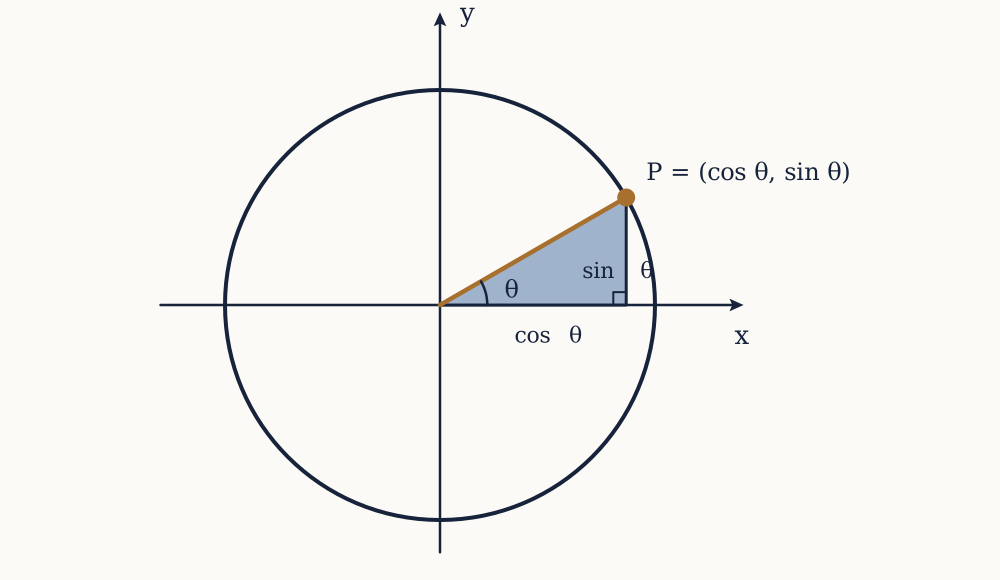
What the new definition adds is that nothing stops . Keep turning past and the point keeps moving round the circle, so every angle up to has coordinates, and beyond that the point simply laps: and give the same point, hence the same values. Negative angles turn clockwise. Sine and cosine are now defined for every real number, and they are periodic with period , meaning for all .
Since is on the unit circle, its coordinates satisfy , which is the identity again, now valid for every angle rather than acute ones only. The equation of the circle and the identity are the same statement.
Signs, and values all the way round
The coordinates carry signs, so the functions do too. In the first quadrant both are positive. In the second, from to , the point is left of the axis and above it, so cosine is negative and sine positive. In the third both are negative, and in the fourth cosine is positive and sine negative. The tangent, being the ratio, is positive where the two agree in sign, so it is positive in the first and third quadrants.
Values follow from the acute ones by reflection. The point at is the mirror image of the point at across the vertical axis, so it has the same height and the opposite horizontal position: and . That is the general rule, and it is why the previous lesson's ambiguous case had two angles with the same sine.
The quadrantal angles complete the picture. At the point is , at it is , at it is , and at it is . So , and does not exist, because it would require dividing by that zero. The tangent has these breaks every , and its own period is rather than , since diametrically opposite points have coordinates of opposite sign whose ratio is unchanged.
Example. Find , and exactly.
The angle is past , so the point is the reflection of the point through the origin, in the third quadrant where both coordinates are negative. Hence and , and the tangent is their ratio, , positive as the third quadrant requires.
Now you. Find , and exactly.
Answer
is short of a full turn, so the point is the point reflected below the axis: , , and .
Radians, and why degrees are the odd choice
Degrees are inherited from Babylonian astronomy and is arbitrary, chosen because it is close to the number of days in a year and divides conveniently. A unit with a mathematical reason behind it measures the angle by the arc it cuts.
Define one radian as the angle subtending an arc equal in length to the radius. A full circle has circumference , so a full turn is radians, and
Converting is multiplication by one way and the other. So is radians, and is radians.
The payoff is that formulas lose their conversion factors. An arc of angle radians on a circle of radius has length , and the sector it bounds has area , both of which acquire ugly factors of if degrees are used. The deeper reason, which belongs to calculus, is that the derivative of is only when is in radians; in degrees an extra factor of appears and never goes away. From here on, angles are in radians unless a degree sign says otherwise.
Example. A circular sector has radius m and angle radians. Find its arc length and area.
The arc is m. The area is m². As a check, radians is a little under a fifth of a full turn, and a fifth of the full circle's area m² would be m², which is close and slightly larger as expected.
Now you. A sector has radius m and angle radians. Find its arc length and area.
Answer
m and m².
The graphs, and the vocabulary of waves
Plot against in radians and the height of the circling point traces a smooth wave: zero at , up to at , back to zero at , down to at , and home at , then repeating forever. Cosine is the same curve shifted left by , since the horizontal coordinate leads the vertical by a quarter turn. That single observation is the identity .
The tangent looks nothing like either. It runs from minus infinity to plus infinity between consecutive breaks at odd multiples of , passing through zero at every multiple of , and repeats with period .
The transformations of the fifth lesson now acquire names. In
is the amplitude, half the distance from trough to peak; is the midline the wave oscillates about; compresses the horizontal axis, so the period is ; and is the phase shift, moving the whole wave right by . Any quantity that oscillates smoothly between two extremes can be fitted by choosing these four numbers, which is what makes the sine function a modelling tool rather than a geometrical curiosity.
Fitting a wave to real data
Daylight length is periodic with a period of a year. In London the longest day, around June, has about hours minutes of daylight, and the shortest, around December, about hours minutes.
Those two numbers fix two of the four parameters. The midline is the average, hours, and the amplitude is half the difference, hours. The period is days, so . The phase is set by the equinox around March, day of the year, where the length is at its midline and rising. So with the day of the year,
Test it away from the points used to build it. On January, , the model gives hours, that is hours minutes, against an actual figure near hours minutes. That is close, and the residual error is real rather than rounding: the true curve is not exactly sinusoidal, because the Earth's orbit is an ellipse and its speed varies through the year. A model this simple getting within a few minutes across a whole season is a fair result, and claiming better would be dishonest.
Identities the circle hands over
Several relations that look like formulas to memorise are visible facts about the circle. Reflecting the point across the horizontal axis sends to , keeping the horizontal coordinate and flipping the vertical, so and : cosine is even, sine is odd. Reflecting across the vertical axis sends to and gives , the supplementary-angle fact that caused the ambiguous case in the previous lesson.
Two identities do not fall out by inspection and have to be proved, most cleanly by rotating a pair of points and computing a distance:
They are worth checking numerically rather than taking on trust. With and , the first gives , and a calculator agrees to six places. Notice the minus sign in the cosine formula, which is the commonest error in the subject, and notice that is emphatically not , which would give here.
Setting gives the double-angle forms and , and combining the second with the Pythagorean identity gives , which is the form used to integrate a squared sine in calculus.
Solving equations that have infinitely many answers
An equation such as has no single solution, because the sine takes every value in its range once per lap and there are infinitely many laps. The routine is to find the solutions in one turn and then add the period.
Example. Solve for .
Divide to get . One angle with that sine is . The other point at the same height is its mirror image in the vertical axis, at . Both are in range, so those are the two solutions, and the full solution set over all real is these two plus any multiple of .
Now you. Solve for .
Answer
, so the reference angle is and cosine is negative in the second and third quadrants. The solutions are and .
Two habits prevent most errors here. Check which quadrants the sign allows before computing anything, since a calculator's inverse function returns only one of the two. And check the interval you were asked for, because an answer outside it is wrong however correct the arithmetic.
What comes next
The sine function has a property none of the earlier functions had: its values follow a rule that carries from one step to the next, so that knowing and gives for a fixed step without starting over. A quantity generated step by step from the previous one, rather than computed directly from its position, is a different kind of object.
Such step-by-step patterns, their closed forms, and what happens when infinitely many of their terms are added together are the subject of the next lesson.