Ampère's law says the circulation of the magnetic field round a closed path equals times the current passing through it, and for a charging capacitor that instruction does not have a unique answer.
This lesson finds the contradiction, repairs it, and assembles the four equations that result. Everything it needs is already in hand: Gauss's law from the third lesson, the absence of monopoles and Ampère's law from the eighth, and Faraday's law from the ninth. The only new physics is one term, and it is the term that makes the twelfth lesson possible.
The surface that does not agree
Ampère's law is stated for a closed path, and the current it refers to is the current through a surface bounded by that path. Which surface is not specified, and for good reason: for a steady current it makes no difference. A wire that pierces one surface bounded by the loop pierces every other, because a steady current has nowhere to stop.
Now charge a capacitor. Current flows along the wire, arrives at one plate, and stops there, with an equal current leaving the other plate. Draw a circular path round the wire, a few centimetres from the capacitor, and apply Ampère's law.
Take the flat disc bounded by that circle. The wire pierces it, so the enclosed current is , and the law gives .
Now take instead a surface shaped like a shopping bag, bounded by the same circle but bulging out and passing between the capacitor plates. No charge crosses the gap: that is what a capacitor is. So the enclosed current is zero, and the law gives .
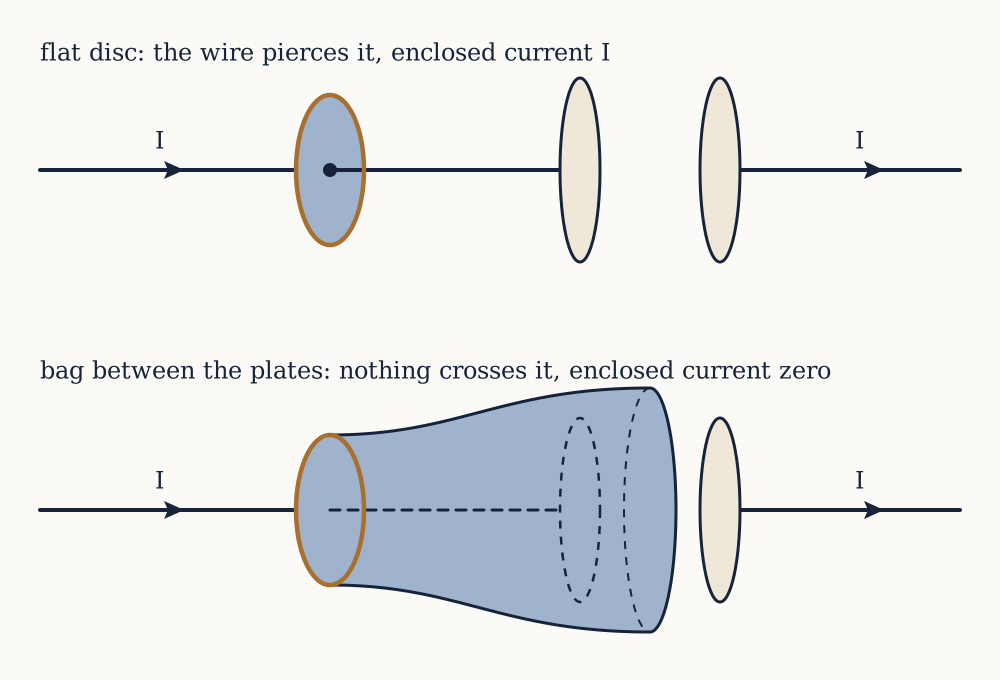
The left hand side is identical in the two cases, since it is an integral round the same physical path in the same physical field. The right hand sides differ. Ampère's law, as it stands, is not merely incomplete but self-contradictory whenever the current is not steady.
The deeper way to say it is that Ampère's law implicitly asserts that current never accumulates anywhere, which is a statement about steady states masquerading as a law. Charge conservation permits accumulation and demands that when charge does build up in a region, the current in exceeds the current out by exactly the rate of build-up. A capacitor plate is precisely such a region.
The term that repairs it
Something must be passing through the shopping bag surface with the same effect as a current. Look at what is between the plates: charge is arriving on them, so the field between them is growing.
For a parallel plate capacitor of area carrying charge , Gauss's law gives , so the electric flux between the plates is . Differentiate:
Exactly . Not approximately, not proportionally: the rate of change of electric flux through the gap, multiplied by , equals the conduction current in the wire, to the last digit, at every instant.
That is the fix. Define the displacement current
and write Ampère's law with it included:
Now the two surfaces agree. The flat disc has conduction current and no changing flux; the bulging one has no conduction current and displacement current ; the total is either way. The contradiction was not a paradox to be explained away, it was a missing term, and the requirement that the answer not depend on an arbitrary choice of surface determines that term uniquely.
Example. The plates of a capacitor have area 0.020 m², and the field between them is rising at V m⁻¹ s⁻¹. What current is flowing in the wire?
The displacement current between the plates must equal the conduction current in the wire, and since the area is fixed. So A. The enormous rate of change of the field is what a modest current looks like when it is expressed this way, because is very small.
Now you. The plates of a capacitor have area 0.035 m² and the field between them is rising at V m⁻¹ s⁻¹. What current is flowing in the wire?
Answer
A.
James Clerk Maxwell added it in a paper of 1861 and 1862 titled On Physical Lines of Force, and the route he took there is worth knowing, because it is not the route above. He was working with an elaborate mechanical model of the ether, in which magnetic field lines were vortices in a fluid and electric currents were small idle wheels rolling between them, and the displacement current entered as the elastic deformation of the vortex material. Nobody believes the model. The term is correct, and it is a case where a physically wrong picture produced a physically right equation, which happens more often than tidy accounts of science admit.
The name is a fossil of the same model and is doubly unfortunate: nothing is displaced, and it is not a current. Nothing at all moves between the plates of a vacuum capacitor. It is a changing electric field, given a name that says a changing electric field produces a magnetic field exactly as a current does.
Is it real?
A reasonable objection is that the displacement current is a bookkeeping device inserted to make the equations behave, and that it makes no prediction of its own.
It does. The added term says there is a genuine magnetic field in the gap of a charging capacitor, where no charge is moving at all, circling the axis exactly as though the wire continued through. Applying the amended law to a circular path of radius inside a gap between plates of radius gives, for ,
rising linearly from zero on the axis to at the rim, where it joins continuously onto the field of the wire outside. This has been measured, and it is there.
Example. A capacitor with circular plates of radius 4.0 cm is charged by a steady current of 0.50 A. How fast is the field between the plates changing, and what is the magnetic field 2.0 cm from the axis?
The plate area is m². The displacement current must equal 0.50 A, and , so V m⁻¹ s⁻¹. The magnetic field at 2.0 cm is T, half the value at the rim, which is T.
Now you. A capacitor with circular plates of radius 6.0 cm is charged at 1.2 A. Find the rate of change of the field between the plates, and the magnetic field 3.0 cm from the axis.
Answer
The area is m², so V m⁻¹ s⁻¹. The magnetic field is T.
The four equations
With the repair made, the whole of classical electromagnetism is four statements. Each is an integral over a closed surface or a closed path, each has been derived earlier in this course, and together they determine the fields completely once the charges and currents are given.
Gauss's law for electricity. The electric flux out of any closed surface counts the charge inside it.
Gauss's law for magnetism. The magnetic flux out of any closed surface is zero, because there is no magnetic charge.
Faraday's law. The circulation of the electric field round a closed path is minus the rate of change of the magnetic flux through it.
The Ampère-Maxwell law. The circulation of the magnetic field round a closed path is times the current through it, plus times the rate of change of the electric flux.
To these must be added the force law that connects the fields to matter, , usually called the Lorentz force, without which the equations describe fields that nothing can detect.
Two footnotes on the presentation. First, Maxwell did not write them like this. His 1865 paper A Dynamical Theory of the Electromagnetic Field gave twenty equations in twenty variables, including the potentials and written out component by component, and it is heavy going. The compact set above is Oliver Heaviside's, who reduced them to four in 1884 and 1885 using the vector notation he was inventing at the time, with Hertz arriving at much the same form independently. What everyone now calls Maxwell's equations is Heaviside's rewriting of Maxwell's physics, and the names attached to the four individual laws were largely settled by textbooks afterwards.
Second, these are the vacuum equations. Inside a material, the polarisation of the fifth lesson and the magnetisation of the eighth add their own bound charges and bound currents, and the usual dodge is to hide them by replacing with and with the material's permeability. That works when the material responds linearly and instantly, which covers most of engineering and none of ferromagnetism, nonlinear optics or anything at high frequency. The vacuum form has no such caveats, which is one reason the rest of this course stays in vacuum.
The structure is worth reading as a table of what makes what. Charges make electric flux. Nothing makes magnetic flux. Changing magnetic flux makes electric circulation. Currents and changing electric flux make magnetic circulation. The pattern is nearly symmetric between the two fields, and the one asymmetry, the zero in the second equation, is exactly the absence of magnetic monopoles: put a magnetic charge density on the right of the second equation and a magnetic current on the right of the third, and the four become perfectly symmetric. Nature declined the offer.
Example. A long solenoid of radius 5.0 cm has its field increasing at 0.20 T/s. What induced electric field appears at 3.0 cm from the axis, and at 8.0 cm?
Use Faraday's law on a circle of radius centred on the axis, on which the induced field is tangential and uniform by symmetry, so the circulation is . Inside, at m, the flux through the circle is , so and V/m. Outside, at m, the flux is only because there is no field beyond the solenoid, so V/m. Note that an electric field exists outside the solenoid where the magnetic field is zero, which is a genuinely non-local-looking result and entirely correct.
Now you. A long solenoid of radius 4.0 cm has its field increasing at 0.50 T/s. Find the induced electric field at 2.0 cm and at 10.0 cm from the axis.
Answer
Inside: V/m. Outside: V/m.
What the set forbids
A good way to test whether the equations have been understood is to ask what each one rules out.
The first forbids a field diverging from nothing. Any region from which net flux emerges contains charge, in exact proportion, which is why a hollow conductor shields and why a charge cannot be quietly created in a box.
The second forbids an isolated north pole. Field lines have no ends, so any magnetic field line followed far enough returns to where it began.
The third forbids a static description of a changing world. It also, as the ninth lesson showed, forbids the electric potential from existing wherever a magnetic flux is changing.
The fourth, with its new term, forbids the current from vanishing. Combining it with the first gives charge conservation as a theorem rather than an assumption: the equations cannot be satisfied by a process that destroys charge. Ampère's law without the displacement current was, in this precise sense, incompatible with one of the best-tested facts in physics, and Maxwell's term is what reconciles them.
The equations with nothing in them
The last question is the one that makes this course's title too small for its subject.
Take the four equations and set the charge and the current to zero. Empty space, no sources, nothing anywhere. Two of the four become trivial: no flux of either kind out of any closed surface. The other two do not:
Read them together. A changing magnetic field produces a circulating electric field. A changing electric field produces a circulating magnetic field. Neither needs a charge, a current or a wire. Each is the other's source, and the pair could in principle sustain each other indefinitely, propagating through vacuum with nothing material involved at any point.
Before the displacement current, that possibility did not exist: the second equation would have read zero, and a changing magnetic field would have produced an electric field that then did nothing. One term turned a one-way relationship into a loop.
Whether the loop actually closes, and at what speed the result travels, is a matter of solving the two equations rather than admiring them. That is the last lesson, and the constant sitting in the second one has already given the answer away.