Real bodies do not move along a line, and the cost of escaping the line turns out to be almost nothing, because motion in a plane is two straight line problems that happen to share a clock.
The previous lesson built the whole of one dimensional kinematics out of one function and its two derivatives. Everything here is that machinery run twice, once per axis, so a reader arriving cold needs only that velocity is , that acceleration is , and that constant acceleration gives .
Two numbers instead of one
Fix an origin and two perpendicular axes. The position of a particle is now the pair , and it is convenient to write the pair as a single object, the position vector . A vector is a quantity with a magnitude and a direction, and in practice it is a list of components, one per axis. Its magnitude is by Pythagoras, and its direction can be reported as the angle measured from the positive axis, taking care with the quadrant, since cannot tell from .
Two vectors add by adding components: . Geometrically this is the tip to tail rule, and the two descriptions are the same statement. Multiplying by a number scales every component, so points the same way and is twice as long, and points the opposite way. There is no operation that divides one vector by another, and looking for one is a sign that the wrong quantity is being sought.
The choice of axes is free, and choosing them well is most of the skill. Motion on a slope is usually easier with one axis along the slope; a projectile is easiest with one axis vertical. What must not change under that choice is any physical answer, and that invariance is worth testing on a problem occasionally, because it catches errors nothing else does.
Differentiating a vector
Velocity in a plane is defined exactly as on a line, as the limit of displacement over elapsed time:
Because the axes are fixed, differentiating a vector means differentiating each component separately, and the same goes for acceleration, . That single sentence is the whole content of two dimensional kinematics: the components do not talk to each other. Whatever is happening along has no influence on what is happening along , because the derivative of never contains .
Two consequences are worth stating separately because they are where intuition fails. First, velocity is a vector, so it can change without the speed changing, simply by turning. Second, acceleration need not point along the velocity: it is the rate of change of the velocity vector, not of its length. Split into a part along and a part perpendicular to it, and the parallel part changes speed while the perpendicular part changes direction only. A car that accelerates in a straight line uses only the first; a car cornering at constant speed uses only the second.
Speed is , and it is worth noticing that this is not the derivative of . A satellite in a perfectly circular orbit has a constant and a speed of nearly eight kilometres per second.
Projectiles: the same lesson twice
Take a body moving near the ground with air resistance neglected. Every experiment since Galileo says the acceleration is m s⁻² straight down and nothing else, so in components and . The two axes are now separate one dimensional problems with a shared time:
The horizontal motion has no acceleration and so is uniform. The vertical motion is free fall, identical to a dropped stone. This is the substance of Galileo's claim in the Two New Sciences of 1638, and the memorable form of it is that a bullet fired horizontally and a bullet dropped from the same height at the same instant hit the ground together, because their equations are identical and their equations are irrelevant to the landing.
For a launch from the ground at speed and angle , the components are and . Setting gives the time of flight , and multiplying by the horizontal speed gives the range
using . Three things fall out at once. The range is maximised at , since that is where . Angles either side of that are equally far from it give the same range, so and land in the same place, one on a flat trajectory and one on a lofted one. And goes as , so a ten per cent faster throw goes twenty one per cent further.
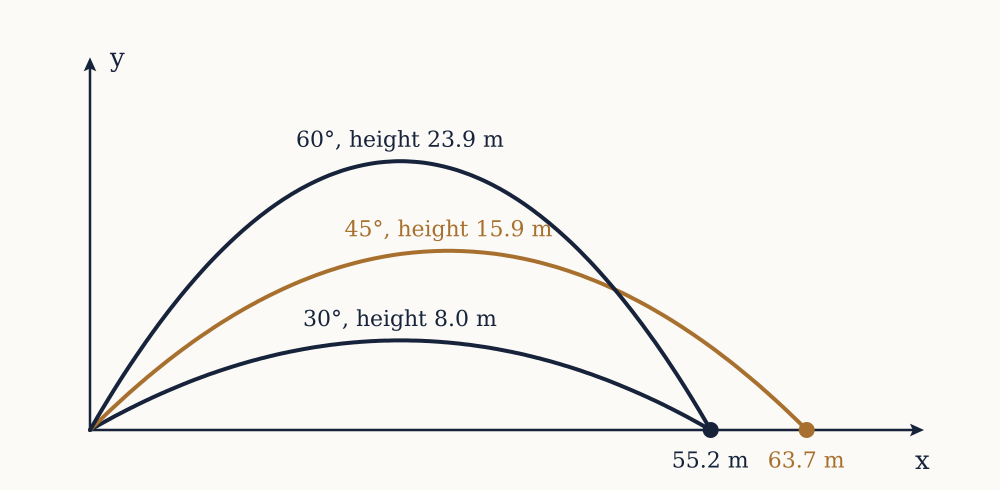
Example. A ball is launched from ground level at 25 m s⁻¹ at 40° above the horizontal. Find its time of flight, range and greatest height.
The components are m s⁻¹ and m s⁻¹. The vertical problem is a stone thrown up at 16.07 m s⁻¹, so it rises for s and the flight lasts s. The range is m, which the formula confirms: m. The greatest height is m.
Now you. A ball is launched from ground level at 18 m s⁻¹ at 30°. Find its time of flight, range and greatest height.
Answer
m s⁻¹ and m s⁻¹. Then s, m, and m.
Where the parabola stops being true
Two assumptions are buried in that derivation, and both fail in ordinary cases.
The first is that the launch and landing heights are equal, which is what let close the problem. A shot putter releases the shot from about 2.1 m above the ground, and the extra fall changes the arithmetic. Launching at 14 m s⁻¹ and 40° from that height, the vertical equation gives s rather than the 1.834 s of a ground level launch, and the range becomes m. More interestingly, the best angle is no longer 45°: scanning the angles for this speed and height puts the maximum at 42.3°, giving 21.98 m. Whenever a projectile lands below its launch point, the optimum tilts flatter, because time in the air is partly free.
The second assumption is the fatal one. Air resistance is not small for most things that fly. A baseball leaving the bat at 45 m s⁻¹ at 35° would, in a vacuum, travel m. Real home runs of that launch condition go about 120 to 135 m, so the vacuum formula overestimates by roughly half. The trajectory is not a parabola either: it is steeper on the way down than on the way up, because the ball loses horizontal speed throughout the flight and never gets it back. Drag depends on speed, so the horizontal and vertical equations stop being independent, and the whole method of this section collapses. Solving that case needs the differential equation of a later lesson, and even then usually a computer.
The parabola is therefore a good model for a thrown stone, a poor one for a badminton shuttlecock, and a catastrophic one for artillery, which is why range tables were compiled by firing rather than by algebra.
Relative velocity
If a boat moves at with respect to the water and the water moves at with respect to the ground, the boat's velocity over the ground is the sum:
The subscripts chain, and reversing a pair negates it, . That is the entire theory of relative motion at everyday speeds, and it is exactly what fails at speeds near light, where velocities do not simply add. Nothing in this course goes near that regime.
Example. A river 80 m wide flows at 1.2 m s⁻¹. A boat that can do 2.5 m s⁻¹ through the water points straight across. How long does the crossing take, where does it land, and how fast is it moving over the ground?
Point the axis across the river and downstream. The boat's velocity through the water is and the water's over the ground is , so over the ground the boat does . The crossing is governed by the component alone: s, unaffected by the current, which is the same independence that governed the projectile. In that time it drifts m downstream, and its ground speed is m s⁻¹ at from straight across.
Now you. The same boat on the same river wants to land directly opposite its start. At what angle upstream must it point, and how long does the crossing now take?
Answer
The downstream component must cancel, so and upstream. What is left across the river is m s⁻¹, so the crossing takes s, about four and a half seconds longer than the drifting crossing.
Going round in a circle
Now the case that breaks intuition. A particle moves round a circle of radius at constant speed . Its speed never changes, yet it is accelerating, and the size of that acceleration can be got without any calculus beyond similar triangles.
Over a short interval the particle turns through an angle , because it covers an arc of length . Its velocity vector has the same length before and after but has turned through that same angle , since velocity is always tangent to the circle. Draw the two velocity vectors from a common point: they form an isosceles triangle with two sides of length and an apex angle , so the third side, which is , is , and for small angles that is . Therefore
The direction takes one more step. As shrinks, becomes perpendicular to , and of the two perpendicular directions it points to the inside of the turn. So the acceleration has magnitude and points at the centre. It is called the centripetal acceleration, from centrum petere, to seek the centre. Since the time for one lap is , the acceleration can also be written , which is the form to use when a period is known and a speed is not.
Nothing here says what causes the acceleration. Centripetal acceleration is not a force and not a cause; it is a description of what the velocity vector is doing. The next lessons ask what has to push.
Example. The Moon orbits the Earth at a mean radius of m with a period of 27.32 days. What is its centripetal acceleration?
The period is s, so the orbital speed is m s⁻¹. Then m s⁻². That is smaller than at the Earth's surface by a factor of 3600, and the Moon's orbit is larger than the Earth's radius by a factor of 60.3, whose square is 3640. The agreement of those two numbers is the single most important coincidence in the history of physics, and a later lesson spends itself on what it means.
Now you. A centrifuge rotor spins at 12000 revolutions per minute. What is the centripetal acceleration at a radius of 0.10 m, and how many times is it?
Answer
The angular rate is radians per second, and with the acceleration is m s⁻². Dividing by 9.81 gives about 16100 , which is why a centrifuge tube must be rated for the speed it is spun at.
What has been gained, and what has not
Kinematics is now complete. Position, velocity and acceleration are defined in any number of dimensions, the constant acceleration case is solved, projectiles and circular motion are worked out, and relative motion is a sum. Given the acceleration of a body at every instant, its whole future can be written down.
That last sentence still contains the word "given". Nothing so far predicts an acceleration; every result above took one as input. The equations are equally content with a stone that falls at 9.81 m s⁻² and one that drifts sideways at 400 m s⁻² for no reason, and no amount of graph reading will separate them.
Filling that gap is the business of the next lesson, and it took the better part of two thousand years, because the natural guess is wrong. Everyday experience with sledges and carts suggests that force sets velocity, since a cart stops when you stop pushing. The right answer, that force sets acceleration and that the stopping is itself a force, requires believing in something nobody has ever seen: a body moving forever with nothing pushing it.