Newton's second law is a machine with an empty input slot: it says what a net force does but never what forces are present, and filling that slot is a separate, empirical business.
The previous lesson established and that it holds one component at a time. This lesson names the forces that actually appear in mechanical problems, and sets out the procedure that turns a physical situation into algebra.
The free body method
Almost every mistake in elementary mechanics is a bookkeeping mistake, and the free body diagram exists to prevent it. The procedure has four steps and no shortcuts.
Choose one body and draw it alone, detached from everything it touches. Draw every force acting on it, each as an arrow from the body, and name the agent of each: the Earth pulls it down, the table pushes it up, the rope pulls it along the rope. If no agent can be named, the force is imaginary, and this test alone kills most of the spurious forces beginners draw, including the mysterious forward force on a coasting ball. Choose axes, preferring one along the acceleration if the direction is known. Then write and and solve.
Forces on other bodies never appear in this diagram. If two bodies are connected, draw two diagrams and let the connection appear once in each, with opposite signs, which is the third law doing its work.
Weight, normal contact and tension
Near the ground, gravity pulls every body straight down with a force , with m s⁻² in Britain and varying from about 9.78 at the equator to 9.83 at the poles. Nothing in this lesson depends on why: the inverse square law that explains it comes much later.
The normal force is the push a surface exerts perpendicular to itself. It is not except by accident, and treating it as though it were is the most common single error in the subject. A surface pushes exactly as hard as it must to stop the body sinking into it, and that requirement changes when the surface is tilted, when the body accelerates, or when something else presses on it. On a slope of angle with no other vertical force, resolving perpendicular to the surface gives ; in a lift accelerating up at it is ; and the moment a surface would have to pull rather than push, contact is lost and , which is how a problem tells you a body has left the ground.
Tension is the pull transmitted along a rope or rod. An idealised string is massless and inextensible, and both idealisations do real work. Massless means the tension is the same at both ends, since a massless segment with unequal pulls would have infinite acceleration. Inextensible means the two bodies it connects have accelerations of equal magnitude, which is the extra equation that closes most connected body problems. A real rope has mass, so the tension in a hanging rope is larger at the top than the bottom, by exactly the weight of the rope below the point in question.
Friction, which is not a law
Slide one dry surface over another and it resists. The standard description, due to Amontons in 1699 and refined by Coulomb in 1785, is two rules.
While the surfaces are not sliding, static friction takes whatever value it must to prevent sliding, up to a limit:
Once sliding, kinetic friction acts backward along the motion with a roughly constant magnitude:
The first is an inequality, not an equation, and writing for a body that is not on the verge of slipping is wrong in a way that produces plausible nonsense. A 10 kg crate that nobody is pushing has zero friction on it, not .
Both rules are fits to data, not laws, and their strangest feature is what is missing: the contact area. A brick slides no more easily on its side than on its end. The accepted explanation is that surfaces touch only at microscopic asperities whose true contact area is a tiny fraction of the apparent area and grows in proportion to the load, so the two effects cancel. That explanation also predicts where the rules fail, and they do fail: for very light loads, for very clean surfaces in vacuum, which can weld, and for polymers, where contact area does matter and is not proportional to . Rubber on dry road has near 1.0, steel on steel about 0.6, ice on ice about 0.1, and PTFE on PTFE about 0.04. Kinetic values run slightly below static ones, which is why a stuck drawer jerks free.
The braking distance of the previous lessons can now be predicted rather than assumed. With a locked wheel, the deceleration is , so stopping from 28 m s⁻¹ on dry road with needs m. On ice with the same stop needs 266 m, more than five times as far, and no amount of care by the driver alters that number.
The inclined plane
Put a block of mass on a slope at angle and choose axes along and perpendicular to the surface, which is the choice that makes the acceleration lie on one axis. Gravity, of magnitude straight down, resolves into down the slope and into it. Perpendicular to the slope there is no acceleration, so . Along the slope, with friction opposing the sliding,
and the mass cancels: . Heavy and light blocks of the same material slide alike, which is the same insensitivity to mass that makes all bodies fall at .
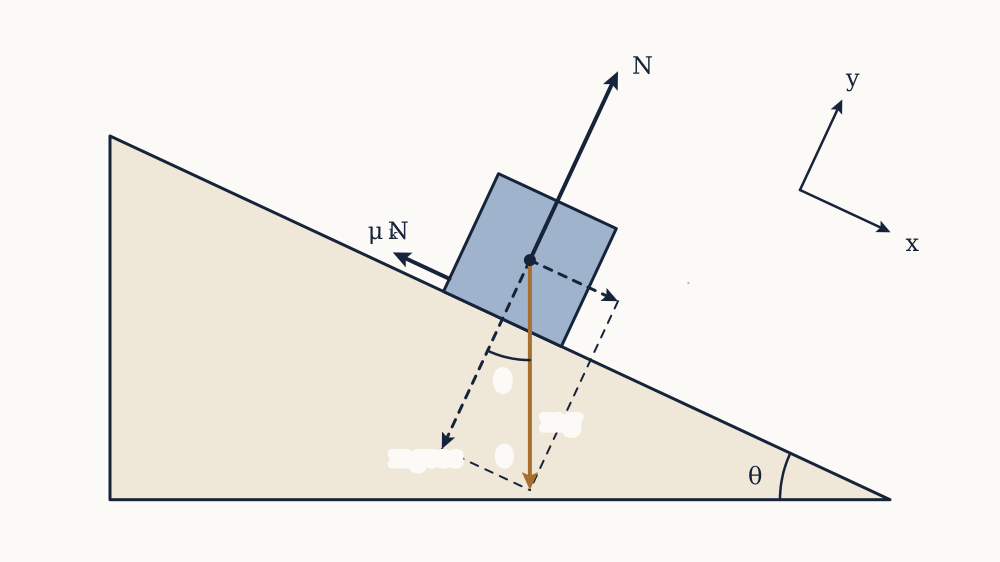
Setting at the point of slipping gives the angle of repose, , and this is how coefficients are measured in the simplest laboratory: tilt the plane until the block moves and take the tangent. For that angle is 16.7°, and for 0.60 it is 31.0°, which is roughly the steepest slope a pile of dry sand will hold.
Example. A block slides down a 25° slope with . What is its acceleration?
m s⁻². The friction has removed nearly two thirds of the driving component. Had been 0.47 the bracket would have vanished and the block would have slid at constant speed.
Now you. A block slides down a 35° slope with . What is its acceleration?
Answer
m s⁻².
Connected bodies
When two bodies are joined, each gets its own free body diagram and its own equation, and the string supplies the link. The Atwood machine, two masses over a frictionless massless pulley, is the classic case, and George Atwood built it in 1784 precisely to slow gravity down to a speed his clocks could measure.
Take , with descending. For , taking up as positive, . For , taking down as positive, , using the same because the string is inextensible. Add the two equations and vanishes:
Two checks say the algebra is right. With the acceleration is zero and , as it must be. With the acceleration is and the tension is zero, which is free fall. The device dilutes gravity by the ratio of the mass difference to the total, so nearly equal masses fall arbitrarily slowly while accelerating uniformly, and that is what made measurable in 1784.
Example. An Atwood machine carries 3.0 kg and 5.0 kg. Find the acceleration and the tension.
m s⁻², and N. Notice that the tension lies between the two weights, 29.4 N and 49.1 N, as it must: the string pulls the light mass up faster than gravity alone and holds the heavy one back.
Now you. An Atwood machine carries 2.0 kg and 6.0 kg. Find the acceleration and the tension.
Answer
m s⁻², and N.
Drag, and the first real differential equation
Everything above has constant forces, so the second law never had to be integrated. Air resistance breaks that, because the force depends on the speed, which depends on the force.
At low speeds, for small slow objects in viscous flow, drag is proportional to speed, , which is Stokes' law. At everyday speeds for everyday objects the flow is turbulent and drag goes as the square of the speed:
with the air density, 1.2 kg m⁻³ at sea level, the frontal area and a dimensionless drag coefficient, about 1.0 for a person, 0.3 for a car, 0.47 for a sphere. The crossover between the two regimes is governed by the Reynolds number, which is not needed here beyond knowing that the linear law is for dust and mist and the quadratic one for cars, balls and people.
Take the linear case, since it can be solved in closed form. A body falling from rest obeys
Separate the variables and integrate:
which gives , and rearranging,
Two features matter. The speed approaches a terminal speed but never reaches it, because the exponential never vanishes; at the body has 63 per cent of it and at three times that, 95 per cent. And the terminal speed is where the drag exactly balances the weight, which can be read off the original equation by setting without solving anything. That shortcut works for any drag law, including the quadratic one that has no such tidy solution.
For quadratic drag the balance gives
Example. A skydiver of mass 80 kg falls head down with a frontal area of 0.70 m² and . What is the terminal speed?
m s⁻¹, about 156 km/h. The dependence on the square root of everything is why the answer is so insensitive: doubling the mass raises the terminal speed by only 41 per cent.
Now you. The same skydiver spreads out, raising the area to 1.0 m² and to 1.2. What is the new terminal speed?
Answer
m s⁻¹, about 119 km/h. Spreading out costs a quarter of the speed, which is the entire technique of controlling a fall before the parachute opens.
The formula is honest about its own limits. It assumes constant air density, which is why Felix Baumgartner, jumping from 39 km in 2012 where the air is about one per cent as dense, passed 377 m s⁻¹ and went supersonic before the thickening air slowed him to an ordinary terminal speed lower down.
Where this method runs out
The free body method solves any problem in which the forces are known at every instant. That covers a great deal, but it has a structural weakness that the next lessons attack from two directions.
The first is that a body moving on a curved path has an acceleration that is not simply along one axis, and the natural question becomes what force is required to produce a given turn rather than what acceleration follows from a given force. Circular motion is where that inversion is worked out, and it is next.
The second weakness is deeper. Solving requires knowing as a function of time, and the interesting forces are known as functions of position instead: a spring depends on its extension, gravity on the separation. The whole apparatus of energy exists because there is a way to integrate over position rather than time, and it answers questions about speed and place without ever finding out when.