Take a drop of water and halve it, then halve the half, and keep going: does the process ever end? Either you can continue without limit, and matter is a continuum, or you reach a piece that cannot be cut, and matter is grainy. For two thousand years there was no way to decide, because both answers explain everything the unaided eye can see. This lesson is about how that question became a matter of measurement, and how chemists ended up not merely asserting that atoms exist but counting them.
An argument nobody could settle
The discrete answer is ancient. Leucippus and his pupil Democritus, in the fifth century BC, held that the world consists of atomos, literally the uncuttable, moving through a void. Lucretius set it out in verse around 55 BC, arguing from the way a wet pavement dries invisibly and a ring wears thin unseen. Aristotle preferred a continuum built from four qualities, and because his system organised the rest of natural philosophy so conveniently, his view prevailed for eighteen centuries.
The revival was respectable but no more decisive. Newton, in Query 31 of the Opticks (1704), wrote that God had probably formed matter in "solid, massy, hard, impenetrable, movable particles". None of this forbade anything: a continuum theory and an atomic theory predicted the same colour, the same weight, the same behaviour on heating. When two hypotheses agree on every observable, choosing between them is aesthetics.
What broke the deadlock was not a new idea but an old instrument used with new discipline. Lavoisier's insistence in the 1780s that mass is conserved through every reaction, so that the products of a combustion must be caught and weighed rather than allowed to escape, turned chemistry into a science of numbers. Once combining masses were recorded to three significant figures, a pattern appeared that no continuum can produce.
The laws of combining weights
The first regularity was the law of definite proportions: a compound always contains the same elements in the same proportions by mass, whatever its origin. Joseph Proust established this between 1794 and 1804, showing that copper carbonate made in the laboratory matched the mineral dug from the ground, against Claude Berthollet's view that composition varied continuously with the conditions of preparation.
The second regularity is the decisive one. The law of multiple proportions states that when two elements form more than one compound, the masses of one combining with a fixed mass of the other stand in a ratio of small whole numbers. Analysis gives the red oxide of copper as 88.8% copper and 11.2% oxygen by mass, the black oxide as 79.9% and 20.1%. Fix the copper at one gram in each: the red carries g of oxygen, the black g, and .
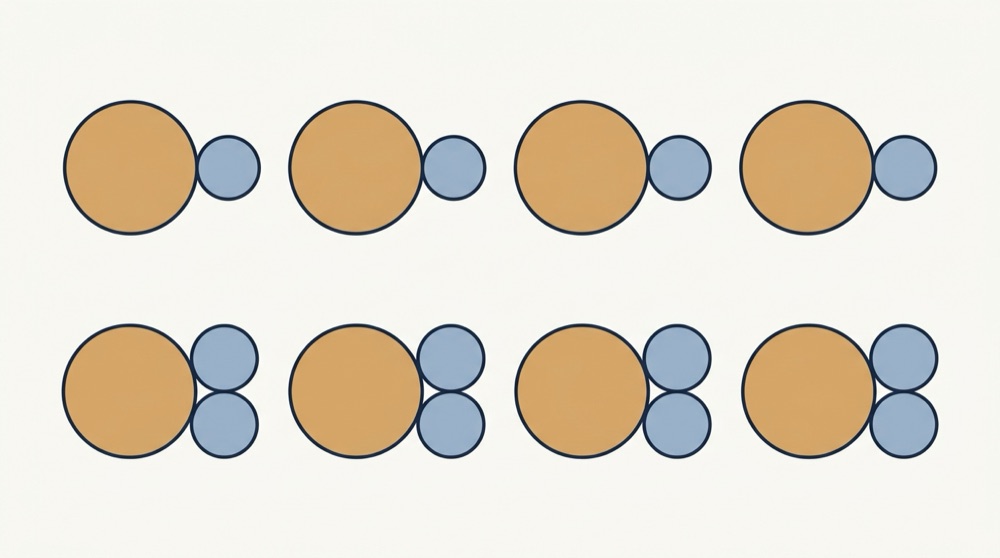
Nothing in the procedure was arranged to give a whole number, and the figures could as easily have yielded 1.87 or 2.34. Nitrogen and oxygen are harder still to dismiss: across the five oxides, the oxygen combining with one gram of nitrogen is 0.571, 1.143, 1.714, 2.286 and 2.857 g, a ratio of 1:2:3:4:5. On a continuous view of matter the oxygen could be adjusted by any amount, and successive compounds would spread anywhere across the range. Small integers appear when, and essentially only when, you combine indivisible packets: one packet of oxygen per packet of copper in the first compound, two in the second. That is the fingerprint of discreteness, visible at the scale of grams because the packets are identical.
Dalton's postulates and their blind spot
John Dalton drew that conclusion between 1803 and 1808, in A New System of Chemical Philosophy. Each element consists of atoms, indivisible and indestructible. All atoms of an element are identical in mass and chemical properties, and differ from those of every other element. Chemical change separates, joins and rearranges atoms but never creates, destroys or transmutes them. Compounds unite atoms of different elements in fixed small whole-number ratios. Conservation of mass, definite proportions and multiple proportions then follow immediately: three empirical laws become consequences of one picture.
Dalton then hit an obstacle he could not remove. Analysis gives the ratio of combining masses, but that one number hides two unknowns: the formula of the compound and the relative masses of its atoms. Eight grams of oxygen per gram of hydrogen fits HO with an oxygen eight times as heavy, HO with a factor of sixteen, or HO with a factor of thirty-two. One equation, two unknowns, and no measurement of the day could supply the second.
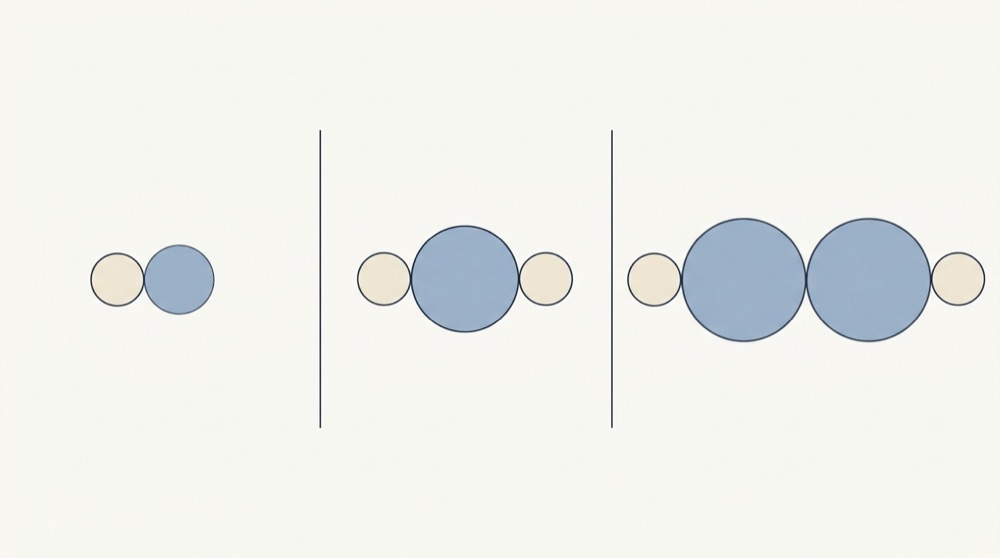
He closed the gap by assumption. His rule of greatest simplicity held that where only one compound of two elements was known, it should be taken as binary. So water was HO and ammonia NH, and oxygen came out at about 7, nitrogen at 5. Every one of those numbers is wrong by a simple factor, because the formulae beneath them are wrong, and the result was fifty years of incompatible atomic weight tables.
Volumes, and fifty years of confusion
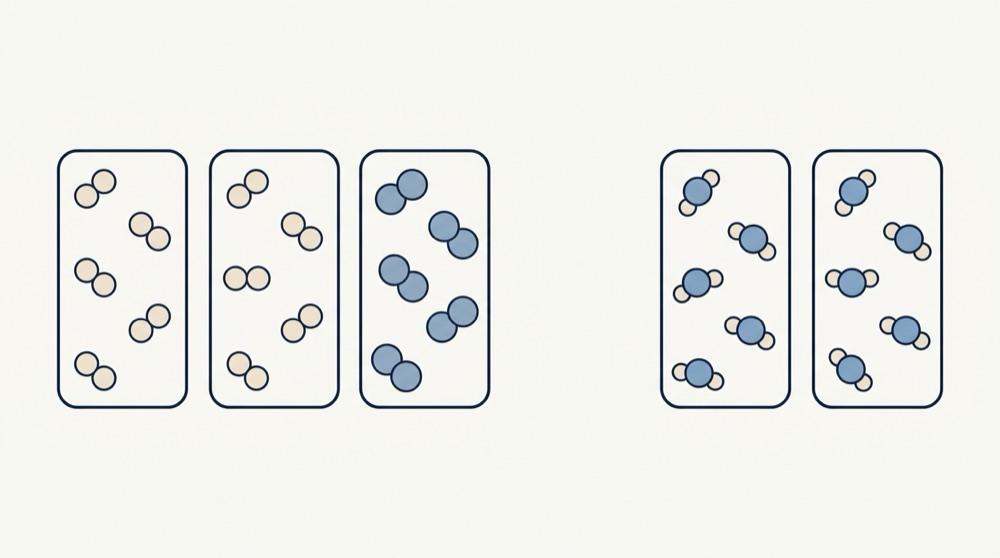
The missing second equation was already on the table. In 1808 Gay-Lussac reported that gases react in simple ratios by volume at the same temperature and pressure: two volumes of hydrogen and one of oxygen give two volumes of water vapour, and one volume of nitrogen with three of hydrogen gives two of ammonia. Volumes of gas, unlike masses, count something directly, if only one knew what.
The obvious reading, that equal volumes hold equal numbers of atoms, produced an absurdity. One volume of oxygen yields two volumes of water vapour, so each oxygen particle must end up in two places, splitting the unsplittable. Dalton rejected the experiment instead. In 1811 Amedeo Avogadro offered the resolution: equal volumes of gases at the same temperature and pressure hold equal numbers of molecules, and the molecules of the elementary gases are pairs of atoms. Then balances in atoms and in volumes, water is HO, and oxygen weighs 16.
Acceptance took nearly half a century. Chemists used "atom" and "molecule" interchangeably, so the crucial distinction was invisible in the language, and Berzelius held that compounds are bound by opposite charges, which made a molecule of two identical atoms seem self-contradictory. Avogadro published in an obscure journal, proposed no experiments of his own, and died unrecognised in 1856. The cost was chaos, with acetic acid written in the late 1850s in some nineteen competing formulae.
Cannizzaro ended it with a method rather than an argument. In his Sunto of 1858, handed to every delegate at the Karlsruhe Congress of September 1860, he fixed atomic masses unambiguously: take many volatile compounds of an element, get each molecular mass from its vapour density using Avogadro's hypothesis, find how much of the element each molecule holds, and take the highest common factor. Carbon comes out at 12 in compound after compound, never at 6, and the periodic table of 1869 became possible within the decade.
The mole and Avogadro's constant
All of this fixes relative masses, not absolute ones. Chemists still needed a bridge between the gram, which they could weigh, and the mass of one atom, which they could not. That bridge is the mole, the amount of substance containing as many entities as there are atoms in 12 g of carbon-12, and the bridging factor is the Avogadro constant , the number of entities per mole. Since 20 May 2019 the SI has defined the mole by fixing exactly, but only because the measurement had first been pushed to a few parts in .
The essential point is that can be extracted from experiment rather than assumed, by routes with nothing in common. Faraday's electrolysis measurements of 1834 gave the charge that deposits one mole of a metal, C, so once the elementary charge is known separately. Loschmidt in 1865 combined the mean free path of a gas molecule, obtainable from viscosity, with the volume that gas occupies when liquefied, two relations in the two unknowns of molecular size and number density. Planck, fitting the blackbody spectrum in 1901, got the Boltzmann constant and hence , a chemical number wrung out of thermal radiation.
The number resists intuition. A mole of sand grains, each a cubic millimetre, would bury the whole surface of the Earth, oceans included, more than a metre deep, and counting ten million atoms a second would take nineteen hundred million years. The 18 g of water in a small glass holds as many molecules as there are glassfuls of water in all the oceans, which is why Kelvin's challenge works: mark every molecule in your glass, pour it into the sea, let it mix, and any glass drawn afterwards will hold a thousand or so of your marked molecules.
Brownian motion settles the argument
By 1900 the atomic hypothesis was doing enormous work in chemistry and in the kinetic theory of gases, and a serious minority still refused it. Wilhelm Ostwald and Ernst Mach held that atoms were a bookkeeping device with no claim to reality, since nobody had measured one individually. The objection was not foolish: everything on offer was inference from bulk behaviour, and a critic could insist that the bulk behaviour was the real physics and the atoms a picture laid over it.
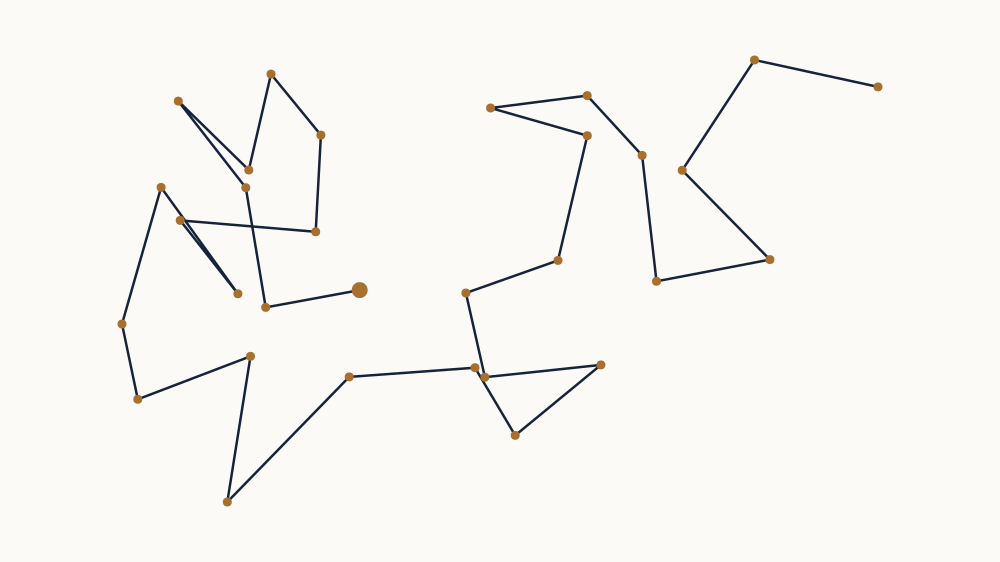
The answer had been in the literature since 1827, when Robert Brown found that pollen grains suspended in water jiggle ceaselessly, and showed the motion was not biological by finding the same restlessness in powdered rock. Einstein analysed it in 1905. His decisive move was to abandon the velocity of a grain, unmeasurable because the path reverses millions of times a second, and predict instead the mean square displacement of a random walk. Balancing osmotic pressure against Stokes drag on a sphere of radius in a fluid of viscosity gives , so
Every quantity except is measurable at the bench. For a grain of radius 0.5 m in water at 20 °C, where Pa s, this gives and a root mean square displacement near 7 m in a minute, comfortable to follow under a microscope. Jean Perrin and his students did exactly that from 1908, tracking grains of gamboge resin at 30 second intervals to get .
A second experiment measured the sedimentation equilibrium of the same suspensions, an atmosphere in miniature whose concentration falls exponentially with height, thinning by a factor of every metres for a buoyancy-corrected grain mass . Grains of radius 0.21 m halved in number every 30 m, which inverts to .
The agreement of independent routes was the whole point, and Perrin drove it home in Les Atomes (1913) by tabulating thirteen determinations: gas viscosity, blackbody radiation, the charge on the electron, the blue of the sky, the alpha particles counted by Rutherford and Geiger against the helium they accumulate. All landed between 6 and 7 . Any one could be dismissed as a model-dependent artefact; thirteen converging from unrelated branches of physics could not. Ostwald conceded in 1909, and Perrin took the Nobel Prize in 1926.
The scale of atoms
With in hand the absolute numbers follow in a line of arithmetic. A carbon-12 atom has mass kg and a hydrogen atom kg, so it takes some of them to make a person. Sizes come as easily from bulk density: a cubic centimetre of copper weighs 8.96 g, which is mol, or atoms, and the cube root of that is atoms along each edge, so neighbouring copper atoms sit m apart.
Two tenths of a nanometre is typical of the whole periodic table. Atomic diameters run from roughly 0.06 nm for helium to 0.3 nm for caesium, a spread of only five across a family whose masses differ by a factor of 300. A cube of air one micrometre on a side, far too small to see, still holds some 27 million molecules.
There is a final irony worth noticing. All this evidence established the reality of an object whose defining property, in its name and in Dalton's postulates alike, was that it could not be divided. Yet the argument was barely won before that property collapsed. In 1897, twelve years before Ostwald's concession, J. J. Thomson had already pulled something smaller out of the atom, and within two decades it had a nucleus, a charge, an internal structure and a set of isotopes that broke Dalton's rule that all atoms of an element weigh the same. Having established that atoms exist, the next lesson takes one apart.