Bring two hydrogen atoms together and kJ per mol comes out, and that number, rather than any story about atoms wanting full shells, is what a chemical bond actually is.
The energy of two approaching atoms
Set the energy of two isolated atoms at infinite separation to zero and watch it change as they approach. At long range it falls: each electron feels the other nucleus too, and density gathers between the nuclei where it is attracted to both at once. Closer in the curve turns and climbs steeply, driven less by nuclear repulsion than by the Pauli principle, since overlapping filled orbitals force electrons into higher ones.
Between the fall and the wall lies a minimum, and that minimum is the bond. Its position gives the bond length, pm in , and its depth the bond dissociation energy. Curvature matters too, since a steeper well means a stiffer bond: strong bonds are short, stiff and deep, three views of one curve.
Notice what has not been mentioned. The octet rule summarises a real fact, that an configuration is unusually low in energy, but it is a heuristic and it fails constantly: boron is content with six electrons, nitric oxide has an odd number, sulfur hexafluoride sits at twelve. Atoms do not want anything. A bond forms when the bonded arrangement lies lower in energy, and there are two limiting ways to manage that, transferring an electron or sharing a pair, with metals as a third case.
Ionic bonding and the arithmetic of the lattice
Sodium and chlorine are the textbook pair, and the story is that sodium hands over an electron. Check it: ionising gaseous sodium costs kJ per mol and attaching that electron to chlorine returns only , so the transfer alone is endothermic by nearly .
What pays for everything is the lattice. Sodium chloride contains no molecules: each sits octahedrally among six and each among six , indefinitely, so the formula is a ratio and not a particle. Summing Coulomb terms over that array gives the Madelung constant, here, and the lattice energy follows from the Born-Lande expression
with the equilibrium separation and a Born exponent for short-range repulsion. It cannot be measured directly, so we get it from a closed cycle where Hess's law leaves one unknown, the Born-Haber cycle.
| Step | / kJ mol⁻¹ |
|---|---|
| , sublimation | |
| , ionisation | |
| , dissociation | |
| , electron affinity | |
| , lattice | |
| Sum: enthalpy of formation |
Read the column: every step that makes the ions is uphill, kJ per mol of it, and the single downhill step is the lattice, which covers the bill with to spare. Melting dismantles the array, so sodium chloride melts at °C and magnesium oxide, with doubled charges, at . Slip one plane by half a spacing and cations face cations, so the crystal cleaves instead of deforming. Solid, the ions are fixed and it insulates; molten or dissolved, they migrate and it conducts.
Shared pairs, formal charge and resonance
Where both atoms hold their electrons tightly, sharing is the way down. Lewis's notation from still works: a covalent bond is a pair shared between two nuclei, the rest left as lone pairs. Where rival structures compete, formal charge ranks them. Give each atom its lone pair electrons plus half of each bonding pair, subtract from its free-atom valence count, and prefer charges nearest zero with negative charge on the more electronegative atom.
Sometimes no single drawing will do. Carbonate has valence electrons, and every Lewis structure gives one double and two single bonds, implying two long bonds and one short. Experiment finds three identical bonds of pm, between a single at and a double at . The bond order is to each oxygen, and a notation that insists on localising pairs cannot say so, so we draw all three structures and call the truth their resonance hybrid. Nothing oscillates, and delocalisation of this kind is worth some kJ per mol in benzene.
The octet exceptions deserve better than a footnote. Boron trifluoride is stable with six electrons, and its hunger for two more makes it a strong Lewis acid. Nitric oxide has eleven valence electrons, so one is necessarily unpaired. Sulfur hexafluoride looks like twelve on sulfur, once explained by hybrids; calculation killed that, since sulfur's orbitals lie far too high to contribute. The truth is polar multi-centre bonding, one sulfur orbital binding two fluorines across a three-centre four-electron arrangement with the density on fluorine. The octet was not expanded but evaded.
Shapes: electron domains repel
A Lewis structure gives connectivity, not shape. VSEPR supplies the rest with one rule: every region of valence density around a central atom, each bond counting once whatever its order and each lone pair counting once, repels every other. Two domains give , three a trigonal plane at , four a tetrahedron at , five a trigonal bipyramid, six an octahedron.
Lone pairs distort things, because a bonding pair is pulled taut between two nuclei while a lone pair is held by one and spreads out, taking more angular room near the central atom and pushing harder. Methane, four bonding domains and nothing else, sits at ; ammonia, with one lone pair, is squeezed to ; water, with two, closes to .
The same logic handles subtler cases: electronegative substituents pull density away, so those domains take less room and closes to , while in five-domain geometries lone pairs claim equatorial sites, making a seesaw and linear. Notice the limits, though. VSEPR gives no bond energies, no spectra, no account of why a double bond is rigid. For those we need orbitals.
Overlap and hybridisation
Valence bond theory keeps Lewis's picture and puts quantum mechanics underneath: a bond forms where a singly occupied orbital on one atom overlaps a singly occupied orbital on another and the spins pair. Heitler and London did this for in , the first quantum treatment of a chemical bond.
Carbon breaks the simple version at once. Its ground configuration has two unpaired electrons, so it should form two bonds at and methane should be . The repair is hybridisation: promote one electron into the empty , then mix the with all three orbitals to give four equivalent hybrids pointing at the corners of a tetrahedron. Four bonds worth kJ per mol each repay the promotion many times over. It is a change of basis, not a physical process.
Mix with two orbitals and three hybrids lie at in a plane, leaving one orbital perpendicular. This is ethene. The carbons overlap hybrids head-on along the axis to give a bond, cylindrically symmetric about it, while the leftover orbitals overlap sideways to give a bond with a nodal plane through the nuclei. The double bond is shorter, pm against , and rigid: twisting one end would tear the sideways overlap apart, a barrier near kJ per mol, which is why alkenes have cis and trans isomers.
Mix with one and the two hybrids point at . Ethyne is therefore linear, one and two , pm and kJ per mol, which is not three times the of a single bond: sideways overlap is less effective than head-on, and that is why bonds are where reactions happen.
Molecular orbitals and why oxygen sticks to a magnet
Molecular orbital theory drops the pair between named atoms and lets electrons belong to the whole molecule. Combine two functions in phase and constructive interference builds density between the nuclei, giving a bonding orbital below the atomic level; combine them out of phase and a node appears between the nuclei, giving an antibonding orbital above it, raised by rather more than the bonding one is lowered.
Fill them as you would an atom and take the bond order as . In both electrons enter and the order is one. In the next two must enter , the order is zero, and since antibonding costs more than bonding pays, the molecule does not exist. Helium is monatomic, said without once mentioning a full shell.
Now oxygen, the case that won the argument. Its Lewis structure pairs every electron and predicts a diamagnetic molecule, yet liquid oxygen clings between the poles of a magnet. Twelve valence electrons fill , , and the degenerate pair, leaving two for the degenerate orbitals, which Hund's rule fills singly with parallel spins. The bond order matches the measured kJ per mol, and the ground state has two unpaired electrons. Paramagnetism falls out of the diagram before anyone looks.
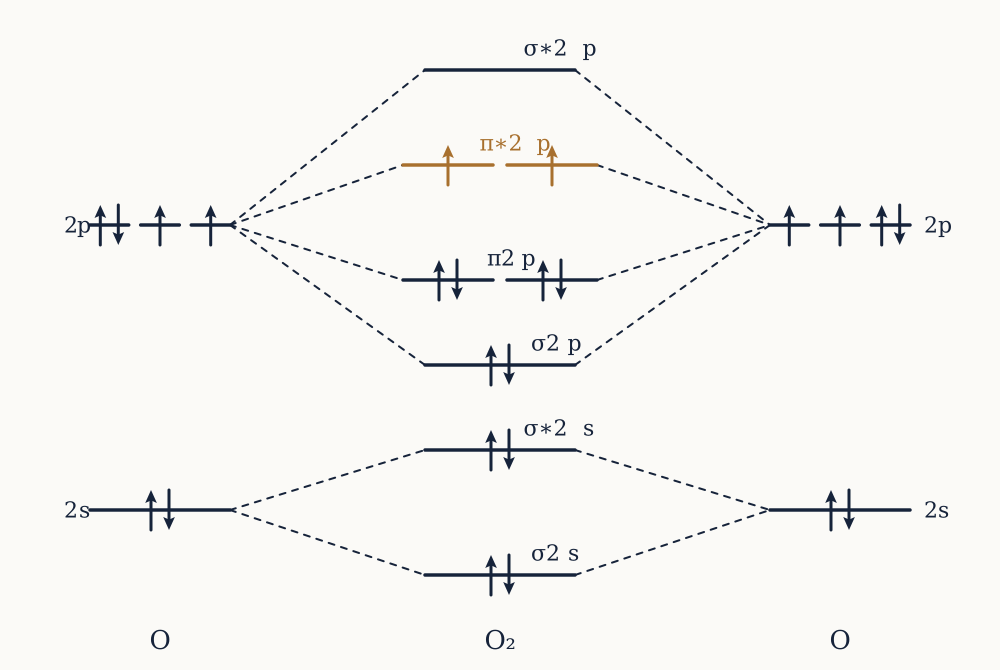
The same picture gives fractional orders, for and for superoxide, and order three for , hence its kJ per mol. Valence bond theory supplies chemists' intuition and their arrows, molecular orbital theory the spectra and the magnetism.
The continuum, and the metallic corner
There is no boundary between ionic and covalent, only a scale, with electronegativity difference as the crude ruler. Above roughly the description is essentially ionic and below essentially nonpolar, while the wide middle is polar covalent, shared but unequally, leaving partial charges at the ends. That shows up as a dipole moment . Hydrogen chloride would show D if transfer were complete, so its observed D makes the bond about per cent ionic.
The middle is reached from the other end too. A small, highly charged cation distorts its neighbour's electron cloud and drags density back between the nuclei, which is Fajans' polarisation argument. Aluminium chloride ought to be a refractory solid, yet it sublimes below °C as molecules.
Metals arise where there are many atoms and too few valence electrons to go round. Sodium has one electron and eight nearest neighbours, so pairwise sharing is impossible. Each atom gives its orbital to the crystal instead, and atomic orbitals give molecular orbitals spread over the sample, spaced so finely at that they form a continuous band. Sodium's is half filled, so empty states lie infinitesimally above the occupied ones: apply a field and electrons accelerate, carrying charge and heat alike, while the continuum of transitions absorbs and re-emits across the visible, which is lustre.
Malleability comes from the same delocalisation. The bonding is non-directional glue, so one plane of cations slides over another and finds the electron sea unchanged, deforming rather than fracturing, unlike the ionic lattice that shatters or diamond, where slip breaks directional bonds. Where a gap separates a filled band from an empty one, that freedom disappears and you have an insulator or a semiconductor instead.
Between the molecules, and back to Dalton
Bonding explains molecules but not why molecular substances condense. Methane is internally satisfied and externally neutral, yet it liquefies. The reason is dispersion: the electron distribution in any atom fluctuates, an instantaneous dipole induces a matching one in a neighbour, and the interaction is always attractive. It scales with polarisability, so noble gas boiling points climb from K for helium to K for xenon.
A permanent dipole adds dipole-dipole attraction. And where hydrogen is bonded to nitrogen, oxygen or fluorine, the pair is pulled so far off it that the proton is left almost bare, with no inner shell to screen it, and it grips a lone pair on the next molecule. This hydrogen bond is worth around kJ per mol, ten times a typical dispersion interaction but a twentieth of the covalent bond beside it.
Water is the consequence. Extrapolated from hydrogen sulfide and its heavier relatives it should boil near °C; it boils at , because each molecule donates two hydrogen bonds and accepts two through its lone pairs, tying the liquid into a network whose disruption absorbs energy and gives water its high heat capacity. On freezing the network completes into a fully tetrahedral and therefore open arrangement, so ice at kg per cubic metre floats on water at , leaving a lake liquid beneath its lid.
Look back at where this course began. Dalton saw elements combining in whole-number ratios and inferred atoms, because whole numbers demand countable things. We can now say why the numbers are what they are: sodium and chlorine one to one because single charges balance in a lattice, hydrogen and oxygen two to one because oxygen has two half-filled orbitals to overlap. Everything between sits underneath that. Thomson's electron and Rutherford's nucleus supplied the charges that attract. Bohr's spectra and Schrödinger's equation replaced orbits with orbitals and gave them shapes. Pauli's exclusion built the shells, raised the repulsive wall on the energy curve, and put one electron in each of two orbitals in oxygen. Mendeleev's columns turned out to be a count of valence electrons. A chemical bond, the thing that makes water wet and diamond hard, is those results and nothing else: two nuclei, a set of orbitals, and an arrangement that comes out lower in energy than the alternative.